

Washington's Former Military Base Is Now A Historic Park With Beaches, Tunnels, And Bunkers
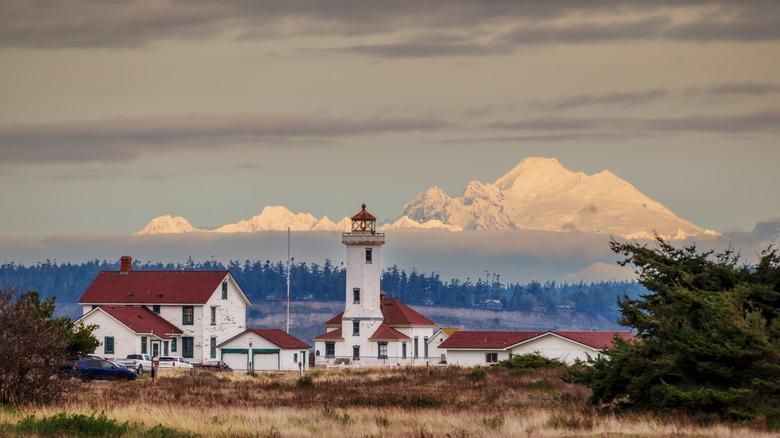
For a variety of reasons, including ocean borders and the might of the world's largest military, the mainland of the United States has rarely been attacked. However, this doesn't mean that its coasts haven't been fortified over the years, through installations like Fort Moultrie, South Carolina's former army base in a national historical park. Both coasts are littered with now-defunct military forts, including Fort Worden Historical State Park, a former army base turned picturesque park on Puget Sound. Unlike other forts, some of which are certainly the most chilling abandoned places in America, Fort Worden is now a lively state park featuring plenty of venues for various events and several museums.
Fort Worden lies on the northeastern tip of the Olympic Peninsula, across Puget Sound from Seattle and the Strait of San Juan de Fuca from Vancouver Island. The fort is under 2 miles north of the charming city of Port Townsend, a unique Victorian-era seaside town known as a gateway to Olympic National Park. Fort Worden's surroundings make it worth a visit, even if it wasn't full of fascinating history. From various points in the park, you can see beaches, islands, and dramatic peaks. If you're lucky, you may see marine animals such as orcas or seals.
To reach this idyllic spot, it's best to have a car. From Seattle, cross Puget Sound on the Bainbridge Island Ferry, then follow signs to Port Townsend, passing through Poulsbo and across the Hood Canal Bridge. If you'd rather avoid the ferry (though it offers incredible views of Seattle and its environs), drive south from Seattle to the Tacoma Narrows Bridge. North of Seattle, you can also hop on the Kingston Ferry from Edmonds. To park at Fort Worden, you'll need a Washington State Discover Pass, which starts at $10 per day or $45 annually as of this writing, and provides access to all Washington state parks.
History of Fort Worden State Park
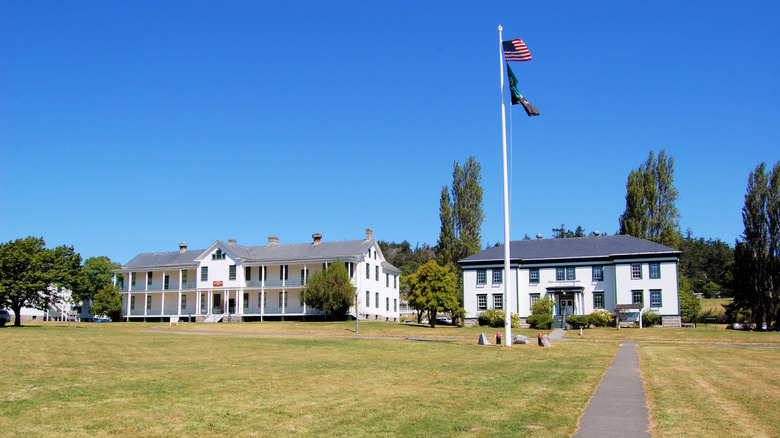
That acreage that would one day become Fort Worden lies within the traditional lands of the Coast Salish peoples, who relied on Puget Sound and its many riches for centuries. After the arrival of European settlers and the establishment of sites like Port Townsend, local Indigenous tribes were forced to surrender their lands to the U.S. government in 1855, though they were allowed to keep harvesting rights in their ancestral lands.
In the late 1890s, the United States military commissioned the construction of three forts to guard the narrow waters of Puget Sound: Fort Casey, Fort Flagler, and Fort Worden. These three forts became known as the "Triangle of Fire," even though none saw any action during their tenures as militarized forts.
Fort Worden was built on a spit of land at the mouth of Puget Sound, near Port Townsend. Across the Strait of Juan de Fuca sat Vancouver Island, home to the British Navy, and therefore a potential threat. Fort Worden was active until 1953 and played a role in training soldiers for World War I and was an underwater sonar device base during World War II. Fort Warden was eventually reopened in 1973 as a historical park run by Washington state after a short stint as a detention and counseling facility for juveniles. The fort was designated an official National Historic Landmark just a few years later and remains an important, well-maintained piece of history along the West Coast.
Fort Worden's beaches, tunnels, and bunkers
Although "abandoned fort" brings to mind mossy bricks half-buried in sand, Fort Worden is much more. In addition to the batteries and officers' quarters, Fort Worden is home to four museums, various offices and workshops, as well as a restaurant and shops. There's a performing venue, a picturesque lighthouse, and refurbished barracks available as accommodations in the summer.
And then there's the grounds. Visitors will find 12 miles of hiking and more than 8 miles of biking trails, a long sandy beach, 80 campsites, and endless opportunity for outdoor recreation like fishing, crabbing, beach-combing, birdwatching, whale watching, wading, and swimming (if you're brave enough to withstand the always-chilly waters of Puget Sound). The views are truly outstanding and change depending on which direction you face: there's Mount Baker, Vancouver Island, and the San Juan Islands if you take a walk on Point Wilson Beach Trail. Even if you're not too excited about the military aspect of Fort Worden, you'll find it a delightful visit.
Of course, the military aspect is what draws many. The officers' quarters have been restored to their former Victorian-era splendor at the Commanding Officer's Quarters Museum, and the batteries remain just as they were when they were first built, with some connected by old, forgotten tunnels. The batteries, which once housed artillery pieces and other weapon storage, are now hidden in the forest or along the hillsides. Enter at your own risk, and watch for the occasional staircase to nowhere. Make sure to wear sturdy shoes and bring a flashlight — the batteries are dark and uneven! If exploring on your own doesn't sound appealing, seasonal tours are available, and visitors can arrange tours with the Coast Artillery Museum upon request.