

Forget The Grand Canyon, Texas' Underrated State Park Is Home To The Second-Largest Canyon In The US
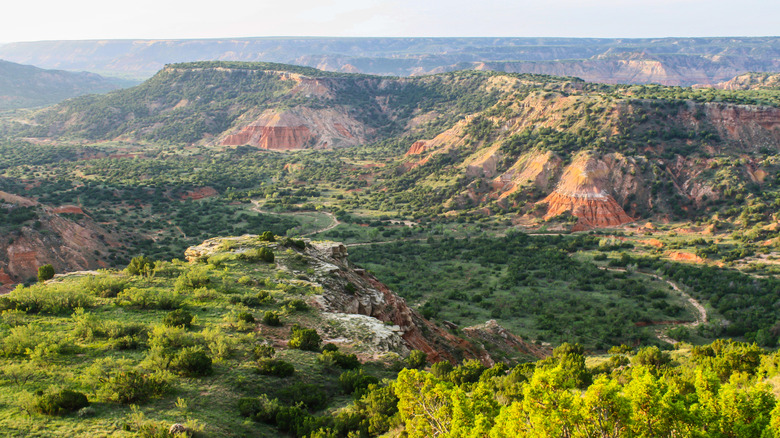
It's difficult to steal the spotlight when up against the mighty Grand Canyon. But there are advantages to being America's second-largest canyon system. While Palo Duro Canyon State Park may be one of the best parks in Texas, it receives far fewer visitors than its famous counterpart, receiving just over 370,000 visitors in 2025 compared to 4.43 million at Grand Canyon National Park. So whereas you may have to jostle for space at the bigger of the two, in Palo Duro – meaning "hard wood" in Spanish – you can enjoy wide-open space with fewer crowds.
The Grand Canyon of Texas is 120 miles long, up to 20 miles wide, and 800 feet deep, dropping away suddenly from the vast high plains of the Texas Panhandle. The park itself protects around 28,000 acres of the canyon, and instead of the prairie landscape associated with the Lone Star State, you'll find yourself surrounded by miles of richly colored rock formations. The canyon floor is surprisingly green, carpeted with cottonwoods, juniper, and wildflowers.
Carved out by the Prairie Dog Town Fork of the Red River around one million years ago, Palo Duro Canyon has been home to humans for about 12,000 years. The deep canyon walls have witnessed mammoth hunts by the Clovis and Folsom peoples, the Battle of Palo Duro Canyon in 1874, when U.S. Cavalry troops attacked Indigenous encampments and destroyed their supplies, and the region's ranching days, when the JA Ranch grazed around 100,000 cattle across the Texas Panhandle. A state park since 1934, Palo Duro lies just off State Highway 217, with the closest town, Canyon, around 13 miles away. The nearest major airport is Rick Husband Amarillo International Airport (AMA), in Amarillo, one of America's coolest desert towns.
Trails in Palo Duro Canyon State Park
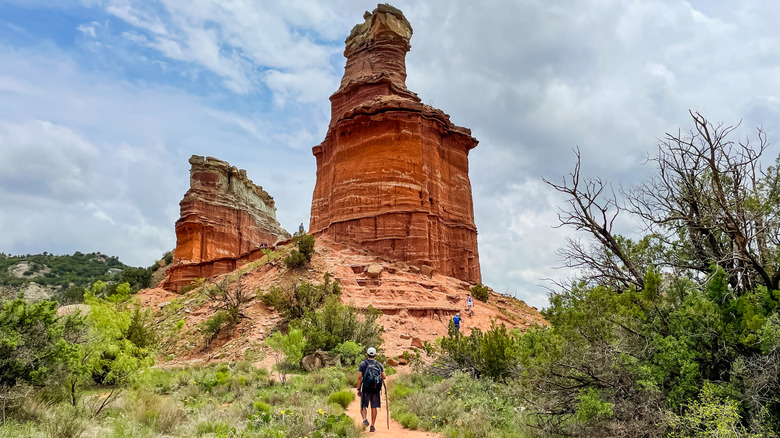
More than 30 miles of trails meander among the canyon's famous rock formations, including hoodoos, and are suitable for hiking, biking, and, in some cases, horseback riding. Trailheads are accessed via Park Road 5, a 16-mile paved scenic route that winds down from the canyon rim to the canyon floor, ideal for those who prefer sightseeing from their vehicle. The 6.1-mile round-trip Lighthouse Trail is a popular hike leading to the iconic Lighthouse rock formation. Mostly flat, the trail offers views of exposed red and orange rock layers veined with striking white gypsum, before finishing with a climb towards its namesake. A shorter, fun outing for families is Big Cave. More of a roadside attraction than an actual trail, it's a great spot for kids to explore a cave and the surrounding rocks.
The 2.5-mile Capitol Peak Trail takes mountain bikers on a moderately challenging loop with great canyon views. Horseback riders can take the 2.4-mile Equestrian Trail through former ranchland alongside the river. Guided rides can be booked at Palo Duro Stables, just outside the park, with prices starting at around $100 as of this writing. If bringing your own horse, there's a dedicated equestrian campground. While out on the trails, keep an eye out for white-tailed deer, roadrunners, and coyotes, and if you're very lucky, you may spot the threatened Texas horned lizard or elusive ringtail cat. And harking back to its ranching days, longhorn cattle graze the prairie grasses just inside the park entrance.
Aim for the cooler months during spring and fall for the best hiking conditions. The canyon floor can get dangerously hot in summer, with temperatures exceeding 100 degrees Fahrenheit and limited shade on the trails. Bring plenty of water and avoid hiking during the hottest parts of the day. A headlamp is also a useful addition if you're exploring the caves. Be aware that flash flooding can occur after heavy rain, so check the weather forecast and trail conditions beforehand.
Other highlights of the Grand Canyon of Texas
When you enter the park, stop off at the visitor center and Canyon Gallery, where you'll find information on ranger-led programs, including guided hikes and photography workshops. There are also exhibits on the canyon's history and geology, along with displays of authentic Native American arts and crafts. The building itself was constructed by the Civilian Conservation Corps (CCC) in the 1930s, using locally sourced materials to blend in with the surrounding landscape. The CCC workers helped turn the canyon into a state park, building cabins, roads, bridges, and picnic areas, some of which still exist today. From here, head out to the overlook for some of the best views in the park.
Down in the canyon at the Pioneer Amphitheater, the TEXAS Outdoor Musical drama runs Tuesday through Sunday during summer. Performers act out moments from Texas Panhandle history in an all-singing, all-dancing extravaganza against the natural canyon backdrop, with the option of tucking into a Texas barbecue dinner before the show. It's a popular event, so plan to book your tickets in advance.
If you stay in one of the park campgrounds, make the most of the naturally dark night skies for some stargazing. The Amarillo Astronomy Club organizes special events where visitors can discover the night sky through powerful telescopes under the expert eye of its members. There are also glamping sites, the opportunity to stay in one of the historic CCC cabins overlooking the canyon, or even these luxury cabins with outstanding views. Palo Duro Canyon State Park is open daily, with gate hours from 7:30 a.m. until 10 p.m. Admission costs $8 per adult, while children 12 and younger enter free.