

The Fascinating Reason Buildings In Greece Are Painted Blue And White
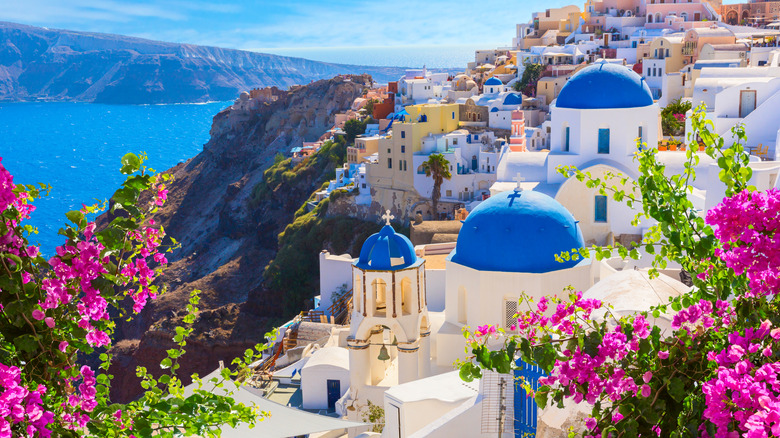
When we think of Greece, we often picture beautiful beaches, ancient history, and iconic white-and-blue architecture. But have you ever wondered what the whites and blues symbolize, and why they are so often associated with Greece, even though they are used on only one group of islands?
Surprisingly enough, the answer has nothing to do with the design of the country's flag — it's actually more complicated than you'd think. The colors are the result of several practical policies and traditions throughout history, including everything from cooling efforts to public sanitation and even Greek patriotism.
Although synonymous with the Greek Islands, these iconic whites and blues are found primarily on the Cyclades, a group of islands in the central Aegean Sea. The archipelago comprises 24 inhabited islands, including Santorini and Mykonos, which is much more than just a party island with its pristine beaches and visible ancient history. Both islands, along with Naxos, Paros, and Milos, are dotted with striking white homes and churches with blue domes, which are often the first things you see when you look up Greece online. While homes were once required to be painted white, the tradition lives on today, drawing tourist attention and maintaining an aesthetic that pairs so harmoniously with the local landscape.
Reasons for white and blue homes in Greece
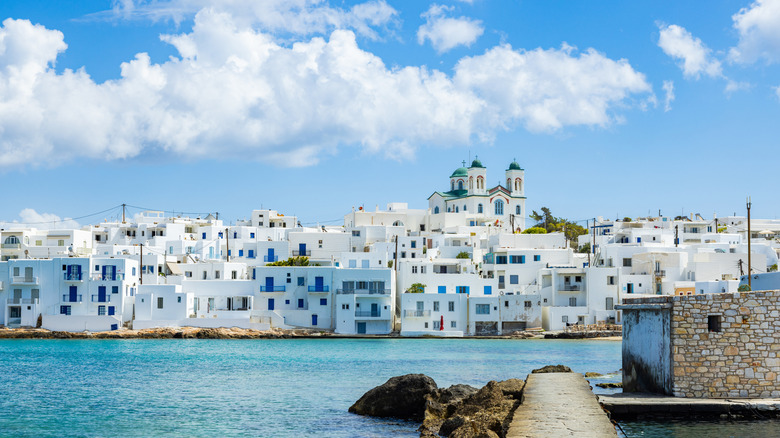
There's more than just one explanation for the vibrant white and blues of Cycladic homes. When houses were first being built on these islands, people had to use readily available resources, like dark stone and mud. However, the stone absorbed an immense amount of heat, which did not fare well during sweltering Greek summers. In order to reflect light and keep interiors cooler, locals whitewashed their homes with a mixture of water, lime, and salt, which was less expensive than paint. Similarly, blue paint was cheap and easy to make, which is why it was often the go-to accent color for island homes in the Cyclades. Composed of limestone and a cleaning product called "loulaki," this was a blue powder popular amongst sailors and fishermen who'd first used it to paint their boats. They'd bring the leftover blue pigment home, coloring their doors and shutters blue.
The whitewash on Greek island homes wasn't just ideal for heat control; it actually prevented the spread of disease. When a cholera epidemic hit Greece in the 1930s, national leader Ioannis Metaxas decreed that all homes must be whitewashed. This may seem odd until you realize that the lime found in this whitewash was a strong disinfectant. It stopped the spread of harmful bacteria, making whitewashing a common practice across European cities in times of plague, like Ostuni, Italy's "White City" in the Apulian countryside.
The 1930s cholera outbreak wasn't the only time when having a white home was required by law in Greece. After a military coup in April 1967, Greece found itself under a strict dictatorship that decided that every home in the Cyclades had to be painted blue and white. The colors were meant not only to invoke feelings of Greek nationalism, but also to show outsiders that Greece was a unified, patriotic country. The short-lived mandate was relaxed in 1974, but by then the tradition had caught on, as many realized the color scheme's tourist appeal.
Where to visit in the Cyclades for white and blue views
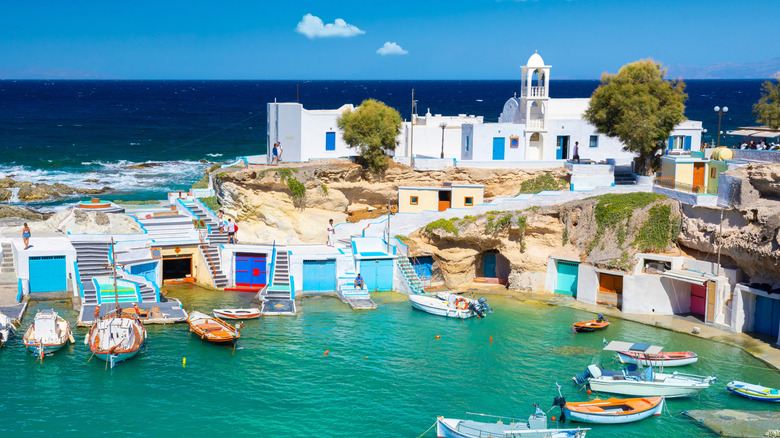
Today, homeowners in the Cyclades don't have to maintain the traditional blue-and-white aesthetic, but many still use these colors to preserve Greece's rich cultural history. You can still see these hues across more than 20 islands, which cater to a variety of different budgets, amenities, and activities for couples, families, and friend groups. Everyone knows Santorini for its iconic blue-domed churches and sweeping sunsets, but there are many other islands to choose from. However, if you do choose Santorini for your perfect Aegean getaway, make sure to try this Greece bucket-list hike for stunning views of the island's iconic white-and-blue cliffside homes.
If you aren't interested in the crowds of Santorini and Mykonos but still want a picturesque vacation with some white-and-blue charm, plenty of Cycladic islands remain to explore. Located in the southwestern Cyclades, Milos is a stunning island famous not only for its beaches but also for its volcanic rock formations. One beach in particular is Sarakiniko, which looks like the moon's surface and is popular for cliff jumping into turquoise waters. The island of Sifnos is perfect for food and traditional Greek pottery, while slow travelers will appreciate Koufonisia for its car-free roads and peeks into local life.
Summer might seem like an ideal time to visit the Cyclades, but prices tend to be higher on tourist islands. Plus, you might end up enjoying a Santorini sunset over the whites and blues with hundreds of other people in the same spot on a July night. For the best weather and fewer crowds, the islands are best in May and June, as well as September and October. Most of the Cyclades are reachable by ferry from Athens in three to eight hours, while some islands, such as Santorini, Naxos, and Paros, have airports. A daily budget can differ tremendously from island to island, from basic hostels on Ios for $30 a night to luxury resorts on Mykonos for $500 a night as of this writing. Combining three or four islands into one trip is another option for hitting several world-renowned beaches and, of course, seeing plenty of white-and-blue hues in one go!