

Data Proves This Popular European Country Sees The Most Tourists By Far
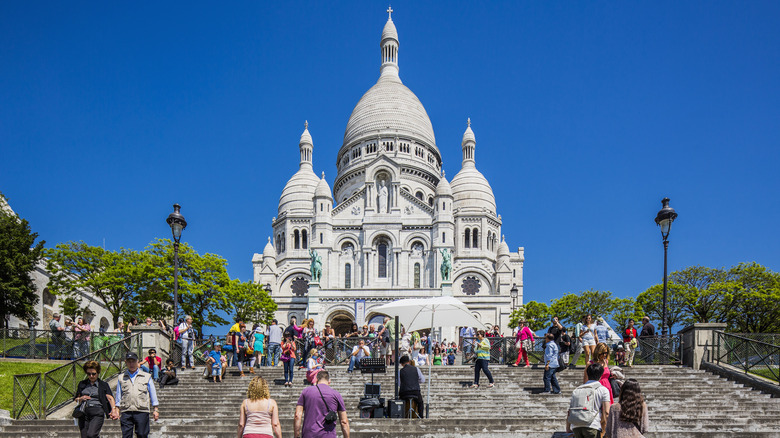
Europe has no shortage of popular tourist destinations, but one country welcomes more each year than any other. With an estimated 102 million visitors in 2025, France continues to be not only the most visited country in Europe, but also the most visited country in the world. For context, that is around 5 million more than the second most visited country in Europe, Spain, which saw nearly 97 million tourists in 2025 (per AP News). According to Atout France, the country's tourism development agency, overnight stays in 2025 rose by 7.5% from 2024, while tourism revenue was up by 9%. Tourism Minister Olivia Grégoire said of France's popularity, via ETIAS, "France remains the leading destination for international travelers. The growth in tourism revenue shows the strong appeal of the country's culture, food, and travel experiences."
While Paris remains the most visited city in France, with tourists flocking to see iconic landmarks like the Eiffel Tower and the Louvre Museum, tourists are combining visits to other significant cities with regional discovery trips. The French Alps, the Atlantic coastline, and the French Riviera along the southern Mediterranean coast are consistently popular. But national tourism campaigns are encouraging travel to lesser-known tourist destinations in France as well. Thanks to the rich diversity of its 18 regions consisting of 101 departments (including overseas), it's no wonder tourists flock to the country.
Why millions of tourists choose France every year

Considering you can fit the entire country inside Texas, France has an incredible cultural and geographical diversity within its relatively compact, hexagonal shape. From one side of the country to the other, you can go from the historical battlefields on the Normandy coast to the sun-soaked Mediterranean, passing through UNESCO World Heritage sites and award-winning vineyards along the way. Add to that lavender fields, one of the highest mountains in Europe, and centuries-old architecture, and that's just a fraction of what's on offer. Each region is like its own mini country, complete with its own traditions, specialties, and in some cases, language.
France borders eight other countries in mainland Europe, and thanks to its extensive rail system, many of these places are easy to reach. It transports more than 5 million passengers each day, making it one of the most frequently used rail networks in Europe. Thanks to high-speed TGV trains, you can reach Marseille from Paris in under four hours. That's just enough time to brush up on your French history, which is another reason France is so popular with tourists. History surrounds you wherever you go. Nowhere more so than in the Plus Beaux Villages de France, a recognition given to more than 180 villages of outstanding beauty dotted throughout the country.
On a grander scale, France is full of must-see châteaux, including the Palace of Versailles, the most visited château in France. Then of course, there's the food and wine. From the simplicity of biting into a freshly baked baguette from the local village boulangerie to splashing out on a Michelin-starred restaurant in the heart of Lyon, there's a reason France is known as one of the world's leading culinary destinations.
How France manages overtourism

Paris is the most visited city in France thanks to its abundance of museums, galleries, and historical landmarks. With so many hotspots in one place, there's no wonder the capital has been struggling with overtourism in recent years, putting pressure on the infrastructure and affecting local life. Residents living in the historical hilltop neighborhood of Montmartre have recently raised concerns about overcrowding, according to France24, and huge visitor numbers to Mont Saint Michel in Normandy have led to questions about crowd control and the fragility of the site.
But, despite this, France has managed to mostly avoid the anti-tourism protests that have broken out in Spain, Portugal, and Italy. This is in large part due to France's long-standing commitment to sustainable tourism. Thanks to its ten-year Destination France strategy, the government is invested in promoting more responsible travel. This includes encouraging visitors to explore beyond the usual tourist hotspots, using train travel rather than short haul flights, and developing tourism in lesser-visited regions.
The plan is already paying off. French tourism isn't seasonal, with visitors arriving all year round, helping to disperse numbers throughout the country. Thanks to the forward-thinking strategy designed to encourage longer stays and smaller crowds, France continues to provide an enjoyable experience for tourists, whilst managing to preserve its cultural and historical identity at the same time. President of B2C and Supply at Omio, Veronica Diquattro, explained via Euronews, "The focus now is on improving the quality of tourism experiences, spreading visitor numbers throughout the year to combat overtourism and emphasising ecological, digital, social and inclusive tourism practices."