

5 Unique Train Stations Worth Visiting In Europe

Some train stations are so memorable on arrival, they alone make it worth traveling to your destination. And with train travel growing in popularity, now is the perfect time to jump on the bandwagon — or in this case, the railway carriage — and pay them a visit. Europe's railway network is extensive, helping you reach even the farthest corners of the continent with ease. It's also a much greener way to travel, allowing you to enjoy constantly changing landscapes while not having to worry as much about your carbon footprint. When you plan your train journey well, this underrated method of travel can be cheaper than flying and much less stressful than the whole airport experience.
So, whether you're planning a long-distance rail journey that stretches across Europe, or just want to get off at the next town, consider adding a stop in Antwerp, Milan, London, Porto, and Arnhem to your itinerary. From award-winning designs to record-breaking engineering feats, these are five of the most beautiful and unique train stations in Europe.
Antwerp Central Railway Station, Belgium
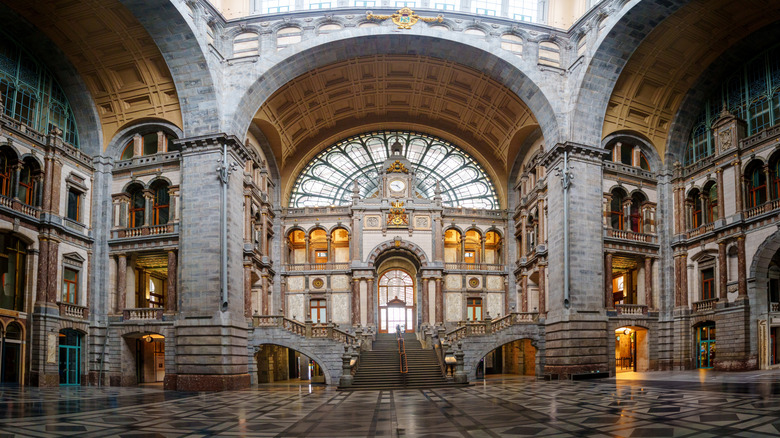
With sunlight beaming through stone-arched windows, and footsteps echoing off polished marble floors, you'd be forgiven for thinking you'd arrived in a church rather than Antwerp Central Railway Station. It's no wonder that it got the nickname Spoorwegkathedraal, meaning "railroad cathedral". As the city's main station, it's often voted one of the most beautiful train stations in the world thanks to its large decorative dome and impressive stone staircase.
Designed by Belgian architect Louis Delacenserie at the request of King Leopold II, it was constructed between 1895 and 1905, to replace the original terminus. Taking inspiration in part from ancient Rome, Delacenserie included the 75-meter dome directly above the waiting area. Along with the iron and glass vaulted roof and grand staircase leading to 14 platforms over three levels, he created a railway station on a grand scale. The station was updated between 2000 and 2009 to accommodate high speed trains. But to avoid making any changes to the historic building, new tunnels were built beneath it instead.
If you have some time to spare, take a wander around the grand hall, which also houses around 30 shops, including a diamond gallery, and several cafés and restaurants. If you want to venture beyond the station, it's within walking distance of the world-famous diamond district in this one-of-a-kind (and often overlooked) Belgian city. Both Eurostar and EuroCity Direct stop at Antwerp Central, with high-speed trains running directly to and from Paris, Brussels, and Amsterdam.
Milan Central Station, Italy
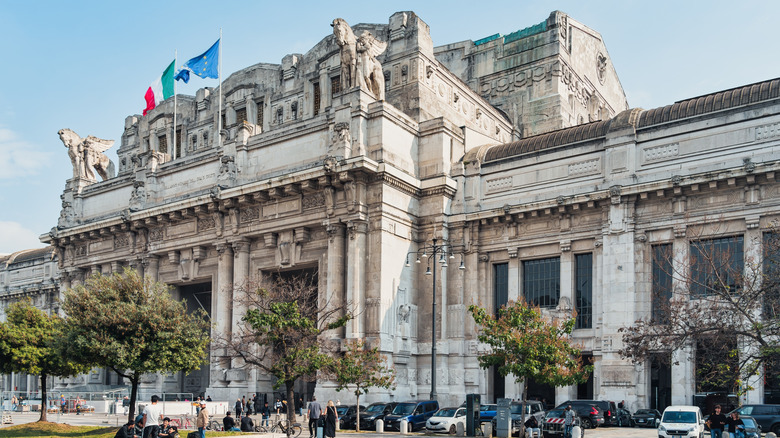
If you have the impression of stepping into a palace when you enter Milan Central Station, know that you are indeed following in the footsteps of royalty. The immense and beautifully decorated building has its own Royal pavilion that was created exclusively for the Italian monarchy until its abolition in 1946. These days, it's only used for special occasions. Built between 1912 and 1931, the station was designed by architect Ulisse Stacchini after he won a design competition in 1912.
The grand building project started off as a simpler design, but Italian dictator Benito Mussolini wanted to show off the regime's power and prestige through the station's heavily decorated stonework and immense size. Completed with marble floors and enormous barrel-vaulted ceilings, Stacchini also drew inspiration from the imperial architecture of ancient Rome. To get an idea of its scale, the vast glass and steel canopy of the vault spans 236 feet, making it one of the largest ever built at the time of completion.
With 24 tracks, over 300,000 passengers pass through Milan Central Station every day. It serves both national and international destinations including Paris, Zurich, and Amsterdam. It also connects to local bus and tram stations, and is linked to two metro lines. If you're passing through, there are dozens of shops and restaurants in the building, as well as the Shoah Memorial, a Holocaust memorial located below the main tracks.
London St. Pancras International, England
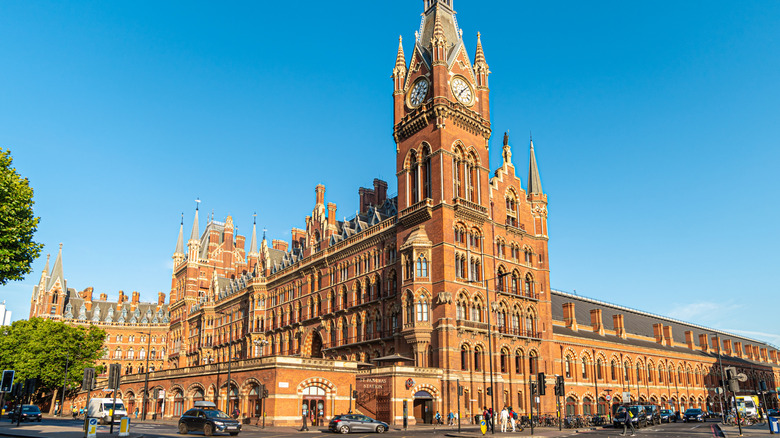
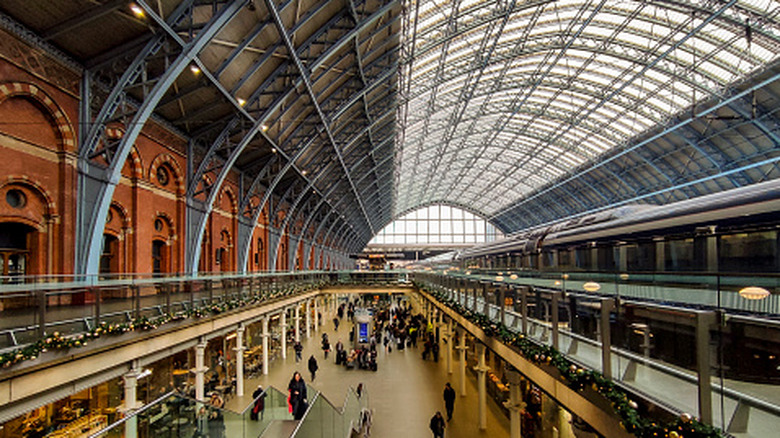
You can't not be impressed by the striking red-brick Victorian Gothic façade of London St. Pancras International on Euston Road. With its rows of intricately designed arched windows, pointed spires, and a clock tower, it would certainly have made an impression on passengers pulling up in their horse-drawn carriages. Opened in 1868, the station was built next to King's Cross Station by a rival railway company. Behind the ornate exterior designed by George Gilbert Scott rises William Henry Barlow's vast iron and glass train shed, which at the time was the largest single-span roof ever built.
As train travel started to decline in the 1960s and car ownership increased, the building started to fall into disrepair, in particular the roof, and was destined to be demolished. Luckily, it was saved at the last minute and declared a Grade 1 listed building. It was eventually restored to its original state in the 1990s and declared international in 2007. While the famous exterior exudes Victorian grandeur, the interior is bright, modern, and filled with light.
With 15 platforms, St. Pancras serves as London's main gateway to Europe. The Eurostar takes passengers to Paris, Amsterdam, and Brussels, with plans to extend the network to Frankfurt and Geneva in the future. As well as transporting passengers across London and the Midlands, the station is also connected to several Underground lines, and has direct access to Gatwick, Heathrow, and Luton airports. If you have some time to spare, there are over 30 restaurants, bars, and cafés as well as several shops inside the station. And if you want to push the boat out, book a stay in the five-star St. Pancras Renaissance Hotel next door to the station.
São Bento Station, Portugal
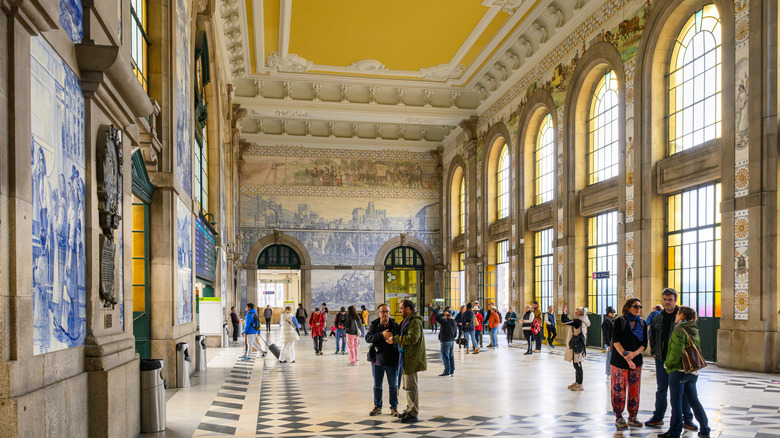
It's difficult to decide which part of São Bento Station in Porto, Portugal, is the most impressive: the inside or the outside. A mélange of styles, the grand neoclassical stone façade invites you into a richly decorated interior with large arched windows, decorative plaster ceilings and more than 5,000 square feet of azulegos – the blue and white glazed tiles for which Portugal is known.
Unlike the other stations on this list, São Bento is quite small in comparison, with just six platforms and eight tracks. Designed by José Marques da Silva, it was completed in 1916 and built on the site of a 16th-century Benedictine monastery. It's conveniently located in Praça de Almeida Garret, right in the heart of the city. The azulegos were added in the 1930s by artist Jorge Colaço, who used around 20,000 glazed tiles to complete his work. It's no wonder it took over 11 years to complete. Depicting scenes from Portuguese landscapes, historical events, and transport history, visitors often flock to the station to admire the artwork rather than catch a train.
São Bento is not Porto's main train station, serving more local and regional lines. If you're arriving from Lisbon or elsewhere, you'll likely arrive at Porto Campanhã with free transfers to São Bento every 15 minutes. However, the Douro Line, one of Europe's most scenic railways, departs from São Bento. The 100-mile journey runs alongside the Douro River through some of Portugal's most picturesque vineyard and valley landscapes. If you fancy a bite to eat at the station, the nearby Time Out Market has a choice of 12 restaurants, including a rooftop restaurant and bar with fantastic views over the city.
Arnhem Central Station, Holland
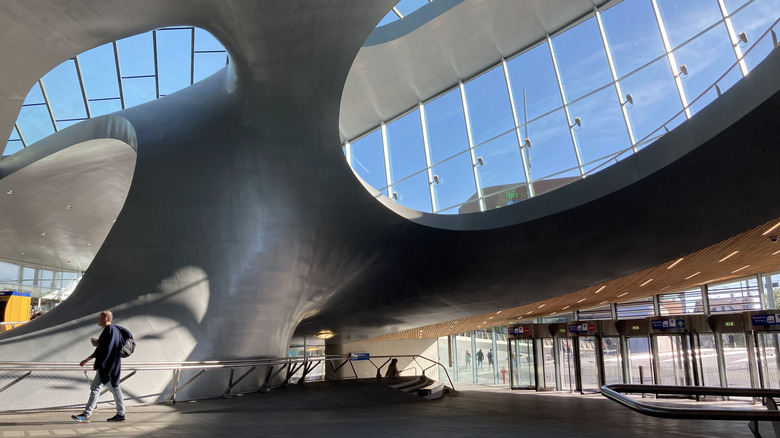
Whereas the other train stations on this list are considerably older, the current Arnhem Central Station was completed in 2015. A modern design masterpiece, the seamless transition from one floor to the next mirrors the flow of the surrounding urban landscape, which contributed to it winning several architectural awards. Designed by UNStudio, and constructed using traditional boat building techniques, the station's sculptured form is often described as the "front door" of the city, intended to embrace the spirit of travel and welcome visitors.
With eight platforms and 11 tracks, Arnhem Central connects to other major Dutch cities including Amsterdam and Rotterdam, and further afield to cities in Germany including Düsseldorf and Frankfurt. Living up to its role as a major transport hub, a large bus terminal is situated in the complex, as well as a multi-level covered bicycle park with room for thousands of bikes.
After wandering through the spaceship-like interior of concrete and glass, you'll find direct pedestrian links into the city center. For those interested in history, Arnhem has several significant World War II sites, such as the John Frost Bridge and Airborne at the Bridge museum, which are within walking distance of the station. If you want to grab a quick bite to eat, there are a few sit-in or takeout places to choose from in the station, or head into the city for a decent restaurant meal.
Methodology
To create this list of five of the most unique train stations in Europe, we reviewed travel publications and rail-focused travel blogs to choose those that really stand out and offer a unique experience both on and off the train. We then gathered practical information from official railway websites to verify details and narrowed down the selection to the stations that provide passengers with some of the most memorable arrivals, and departures, in Europe.