

Boomers Should Embrace This Popular Backpacking Trend For Safer, Healthier Hikes
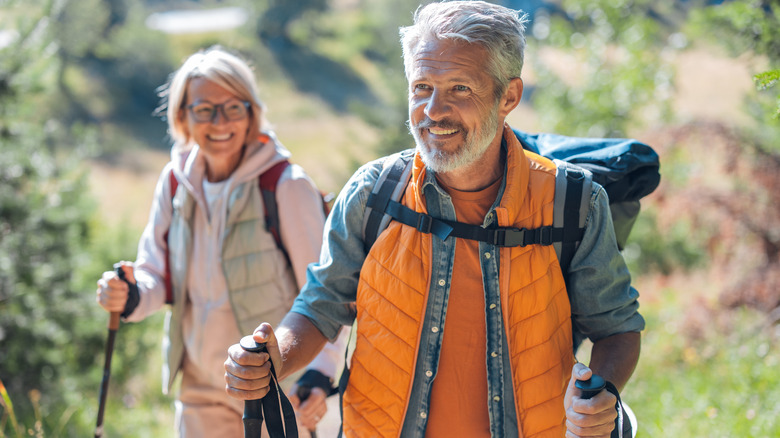
Younger generations like to give boomers a hard time (lovingly, of course), but you've really got to give it to them: They're a generation that never quits. Considering the average age of a baby boomer is 71 and many of them are still just as active as Gen X and, in some cases, millennials and Gen Z, it's hard not to be impressed. But as much as they're still engaging in some of the favorite outdoor activities of their youth or picking up new ones for the first time, there are some trends that they should embrace, especially if they're avid hikers.
Ultralight backpacking gear has become popular among young outdoor enthusiasts, and hauling heavy gear is one of the boomer camping habits younger generations have abandoned. Long gone are the days when canvas tents and even household kitchenware were your only options. Hiking and camping equipment have been redesigned to make enjoying the outdoors safer and more fun, and carrying lighter gear is much easier on the joints. From backpacks to tents and more, the future of hiking is here, and it's very lightweight, to say the least. And the best part is that you don't have to give up any essentials — you're just lightening the load thanks to an upgrade in materials and design.
Why boomers should make the shift to ultralight backpacking gear
According to a 2024 study published in the Journal of Aging and Physical Activity, when older people hike with lighter gear, it helps them maintain a steady heart rate, reduces muscle and joint pain, and increases overall alertness on the trails (via The Savvy Survivalist). This could also mean you need less time to recover after a day of hiking. There's also the issue of balance.
The oldest members of the boomer generation turned 80 in 2026, and at that age your body simply isn't as nimble as it used to be. A 2019 study published in Laryngoscope Investigative Otolaryngology found older people are more prone to falling, with one cause being a decline in their sensory systems. But with ultralight gear, it's easier to maintain a center of gravity, allowing for better balance, especially on rocky and uneven trails. Considering the leading cause of injuries for those over 65 is falling, per the Centers for Disease Control and Prevention (CDC), ultralight gear can actually be lifesaving.
While the ultimate guide to packing the best and safest hiking gear is going to be a little different for everyone, if you're a boomer, it's time to convert to ultralight gear. You don't need to buy it all at once, but if you want to continue hiking safely, it really is something you should consider embracing sooner rather than later.
How to start ultralight backpacking
If you're new to ultralight backpacking, weigh your current stuff before you invest in new equipment. It's important to know the base weight of your gear, which includes your pack, shelter, and sleeping set, before putting things like food and water in it. The ideal base weight should be somewhere between 10 and 12 pounds. When preparing your adventure pack, keep it on the scale and add only what you need, while also paying attention to how much weight each item brings to the bag. In doing this, you'll have an easier time choosing the right version of essential gear for your camping and hiking excursion based on how much weight it brings to the equation.
Should you realize during this process that you do need new gear to hit the 10- to 12-pound base weight, hold on. You don't immediately need to go out and replace everything — ultralight backing equipment can be pricey. Instead, buy one new thing each season. For example, maybe start with an ultralight pack, then upgrade to an ultralight sleeping system the following year. It's also worth noting that when you start to make the switch to ultralight, you may want to stick to some conventional gear. "There's really no reason to sacrifice good sleep for a foam pad," veteran PCT hiker and treasury analyst at the co-op, Brittany Goodson, told REI in March 2026. "A lot of people do bring a foam pad to start with, and then they switch once they get to the Sierras because [an inflatable pad] is just way more comfortable."