

Forget Conventional Tents — campers Are Opting For This Spacious And Easy-To-Assemble Alternative Instead
We may receive a commission on purchases made from links.
Many adore camping, but setting up a tent can be a pain, especially when the ground at a campsite is uneven. If the wind is blowing, you may struggle with how to secure your tent to feel safer so it doesn't blow away in the middle of the night. And then, if your designated parking space is set away from your campsite, you have to carry your sleeping bag, clothes, food, water, and other items back and forth between the vehicle and the tent, and that's no fun, either.
To address these issues, campers have been turning to car and SUV tents, which are different from standalone ones in that they attach to your vehicle, either to the rooftop, to the side, or around the rear hatch. As interest in overlanding (road tripping in remote areas combined with car camping) has grown in the years following the pandemic, so too has the popularity of car and SUV tents. Traditional campers may opt for them, too, simply for convenience's sake. However, purists may balk at the idea of camping on top of or beside their vehicle. How uncouth!
Car and SUV tents solve one problem, that's for sure. They reduce the distance between your vehicle and your campsite (or eliminate it altogether) — no need to make multiple trips with your stuff. These tents can also be easier to assemble, more windproof, and more stable than conventional standalone models without sacrificing space or comfort. To what extent that's true probably depends on a particular tent's style, brand, and model. Let's take a look, shall we?
The low-down on rooftop car and SUV tents
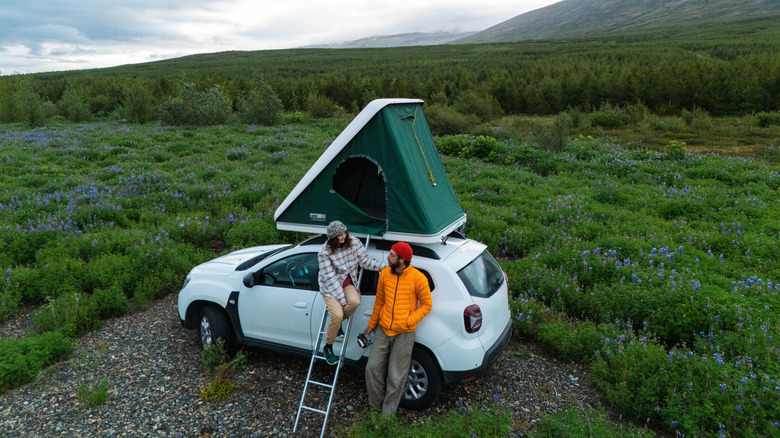
Rooftop tents offer so many perks. They eliminate the need to find a flat, smooth surface on which to place your tent when you're camping on public lands. They also keep occupants safer from potentially aggressive animals — a good feature if you're attempting some shut-eye in the wilds of Africa or Alaska. Once the tent has been mounted on your vehicle's roof rack, ideally before your trip, the hard part is finished. When it's time to rest, unfold or pop open the tent, pull down the ladder, and presto, your dwelling is ready. Climb in and enjoy the views of your surroundings from your lofty perch! When it's time to leave, your rooftop tent folds back into a compact shape to reduce wind drag while driving.
Rooftop models are generally more expensive than ground models, with some exceeding $4,000. You also need to ensure that your vehicle and roof rack can support the tent you choose. But investing in these tents may be worth it if you want to avoid sleeping on the ground.
Rooftop car and SUV tents come in two different varieties. The hard-shell styles tend to be smaller, heavier, warmer, and more durable but more expensive, whereas soft-shell ones are more spacious than their hard-shell counterparts. With their lighter materials, they may also be better suited for warmer climates. However, they're also less wind resistant and may rattle more in a storm. Which style you choose, then, depends on your budget, the climate at your destination(s), and the specs and dimensions of your vehicle.
The pros and cons of ground models
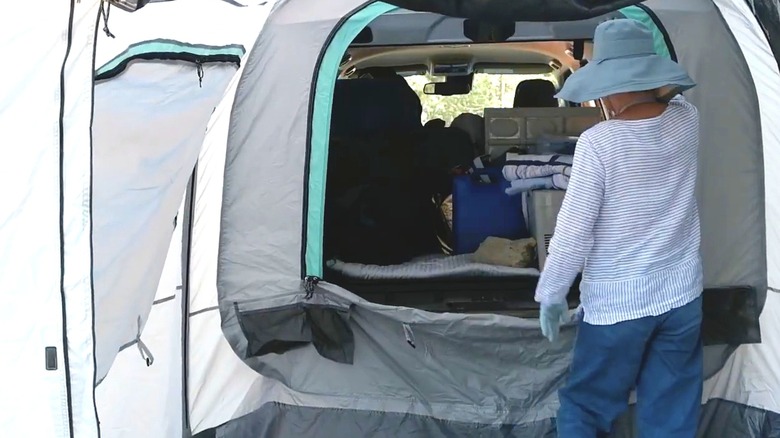
Car and SUV tents that sit on the ground and attach to the side or rear of your vehicle also offer many advantages. One of the main ones is space. Because these tents are designed to open up into your vehicle, it becomes part of your living space, creating a multi-room dwelling. For example, you could set up your sleeping space in the bed of your SUV and make the tented area your kitchen with a table and some chairs, with space left over for a yoga mat or a cushioned reading nook. Even budget models like the UNP 6-Person SUV Tent, which retails at Amazon for less than $150, are high and wide enough to allow for standing and can accommodate a family.
But if there's no level ground where you're setting up camp, it will be tough to enjoy all that extra space. And these models often take more time to set up than the rooftop ones, because you need to erect them and then secure them to your car or SUV. While many come with an adjustable sleeve to fit a variety of vehicles, you need to ensure a tight seal. Otherwise, rain, bugs, and even rodents can enter. With a little tweaking, however, other campers have been able to resolve these issues. A reviewer of the UNP 6-Person SUV Tent explained how she and her husband secured their tent while camping to make it "escape-proof" for their cats. "One thing I did notice if extra precautions aren't taken, there are gaps underneath the car," she wrote. "He has resolved this with the placement of a bin used to carry camping things. Not a big deal."
If you're heading out to camp soon, don't forget these five camping essentials people always wish they brought more of when out in nature.