

Forget Rainbow Springs, One Of Florida's Oldest State Parks Is An Underrated Gem With Stunning River Trails
Beyond its famous coastline, Florida has no shortage of idyllic swimming spots, and it's hard to beat the gorgeous Rainbow Springs State Park. With its crystal-clear springs and tropical-style waterfalls, it has inevitably become one of the Sunshine State's more popular natural attractions. More than 360,000 visitors graced its picturesque grounds in 2025, which can only mean one thing: it gets kinda busy. Compare this to the 71,000-plus visitors to O'Leno State Park, and this quieter, larger patch of leafy landscape starts to look like a worthy alternative to some of the best state parks in Florida.
As one of Florida's original nine state parks, O'Leno was developed by the Civilian Conservation Corps (CCC) and opened as a forest service training camp in 1938. It was handed over to the Florida Park Service soon after and became a state park in 1940. It may not have Rainbow Springs' inviting turquoise waters, but it does have Florida's largest swallet-to-resurgence system, where a river disappears underground and resurfaces elsewhere. In this case, it's the Santa Fe River, a tributary of the Suwannee River, that vanishes into a sinkhole in O'Leno State Park and pops back up to the surface more than 3 miles away in River Rise Preserve State Park.
You can explore the surrounding landscape thanks to a network of trails that wind through the swamps and dense woodland that make up much of the park. Not to be outshone by its southern counterpart, O'Leno also offers opportunities for swimming, paddling, camping, and wildlife watching. Located just off U.S. Highway 441 near High Springs in northern Florida, O'Leno State Park lies around an hour and a half from Jacksonville, one of America's most underrated cities. It's open year-round from 8 a.m. to sunset and has a $5 entry fee per vehicle.
The river trails in O'Leno State Park
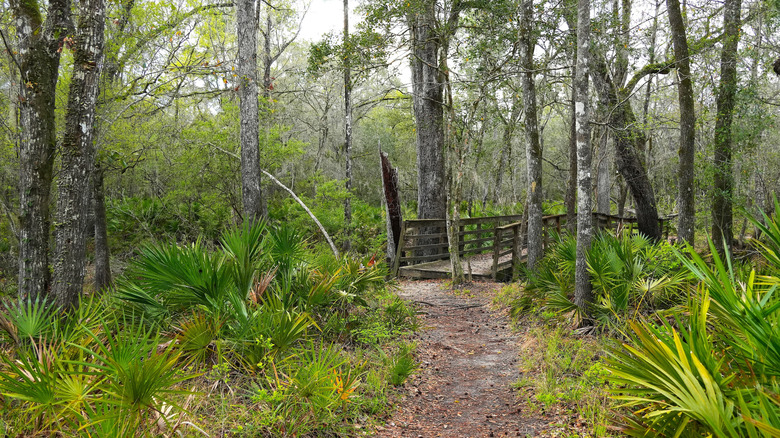
There are more than 11 miles of multiuse trails in O'Leno State Park, along with hiking-only routes and connections to the trails in River Rise Preserve State Park. There are 18 distinct natural communities, meaning there's a huge diversity of scenery packed into its 2,372 acres, with trails winding through hardwood hammocks, river swamps, pine flatwoods, sandy uplands, and karst landscapes, where a world of underground channels lies hidden beneath the surface.
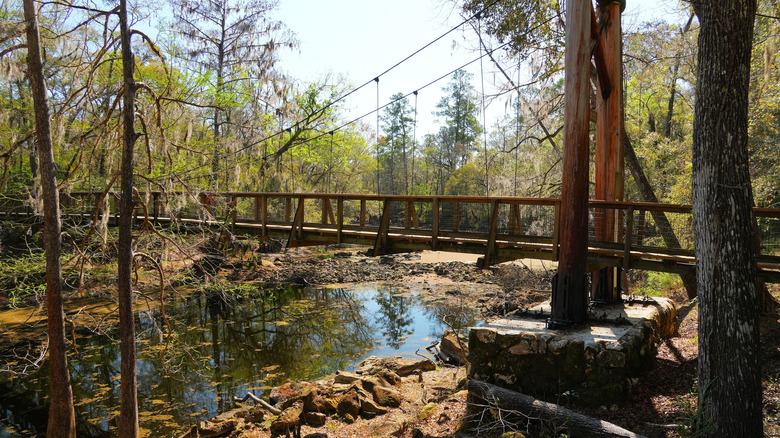
To see the sinkhole, the River Sink Trail is normally the best option, but at the time of writing, it is closed. This easy 1.6-mile hiking-only loop follows the Santa Fe River to the famous spot where it disappears underground. Along the route is an overlook and a historic suspension bridge built by the CCC in the 1930s. The 4.5-mile Parener's Branch Trail is a longer route suitable for both hiking and biking, and a good option if you want to spot some of the park's wildlife. Keep an eye out for gopher tortoises, turtles, and white-tailed deer as you pass through the woodland and several sinkhole ponds, with undergrowth filled with saw palmettos.
For a longer adventure, the 4.7-mile Sink to Rise Trail connects O'Leno to River Rise Preserve State Park, where the Santa Fe River resurfaces after its underground journey. Mostly flat and shaded, bikers may find some sections challenging, with soft sand and large exposed roots that are particularly striking but difficult to tackle in places. You can pick up a trail map from the ranger station when you arrive to help you choose.
More activities in O'Leno State Park
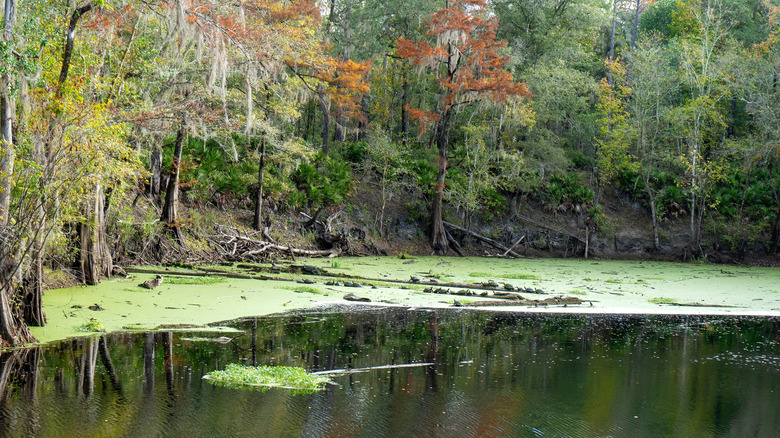
Swimming is allowed on a designated stretch of the Santa Fe River. It may look murky, but the water's tea-colored hue comes from natural tannins released by the decomposing vegetation. Paddling is also possible along the northern portion of the river, with canoe rentals available through the park. Although not a prime fishing spot, fishing is allowed, subject to Florida's licensing requirements, and you may get lucky with bass, bream, or catfish. Be aware that swimming and paddling are dependent on river levels, so check with the ranger station before visiting to confirm which activities are available.
With 61 family campsites across two campgrounds, along with primitive and group camping options, it's a great spot to spend a few nights surrounded by nature. Sites can be reserved up to 11 months in advance, although if you're in an RV, some spaces can be a little tight for maneuvering. The area can be prone to flooding after heavy rainfall, which could affect trail and campsite access. The insects, however, have a field day in this type of climate, with ticks and other equally annoying bitey bugs seemingly there for the sole purpose of ruining your day. Remember to take insect repellent and wear long pants when exploring the trails.
The abundance of songbirds makes a welcome distraction, and for keen birders, the park is part of the Great Florida Birding and Wildlife Trail, a collection of some of the best wildlife viewing sites across the state. Keep your eyes and ears open for black-throated blue warblers and breeding Acadian flycatchers, depending on the season. Don't forget to pop by the small museum, open daily from 9 a.m. to 3 p.m., to find out more about the role the CCC had in creating the park.