

New York's Former Landfill Is Now A Gorgeous Park That's Three Times Larger Than Central Park
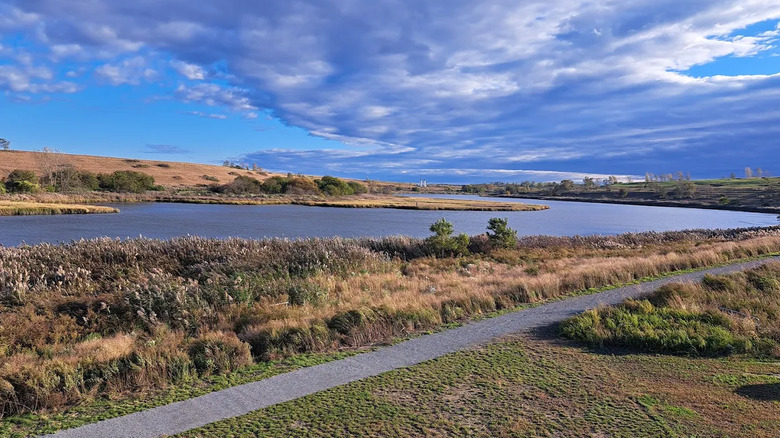
In America's biggest city, providing residents and visitors with ample parks and green space helps make New York City more eco-friendly while supporting the community. Even though Central Park is the city's most famous park, there are actually a few that are even bigger. Currently under development, the 2,200-acre Freshkills Park is a landfill-to-park project in Staten Island, similar to Virginia Beach's Mount Trashmore Park, which was once a 640,000-ton landfill. Expected to open in full capacity around 2036, Freshkills Park will be nearly three times the size of Central Park, with ample recreational space for sports and activities, opportunities to view reclaimed nature, and events that involve the local community.
Fresh Kills landfill opened in 1948 and was supposed to be used for only 20 years, but by 1991 it was the last operating landfill in New York City. At its peak, the landfill was the principal destination for New York's garbage, operating with 20 barges, each carrying 650 tons of trash. Every day between 8 a.m. and 12 a.m., 2,800 dump-truck loads of trash were dropped off at the facility. At one point, it was the largest landfill in the world and if it hadn't finally closed in 2001, it'd probably be around 500 feet tall now and definitely visible from Manhattan's skyscrapers. Despite closing in early 2001, the landfill reopened temporarily after September 11th to dispose of rubble and other wreckage, before finally closing for good in 2008. Since then, the park has opened in phases and is being built from the outside in to maintain close relationships with the communities that border it. The former landfill will be the largest park built in New York City in 100 years.
Freshkills Park nature and future development
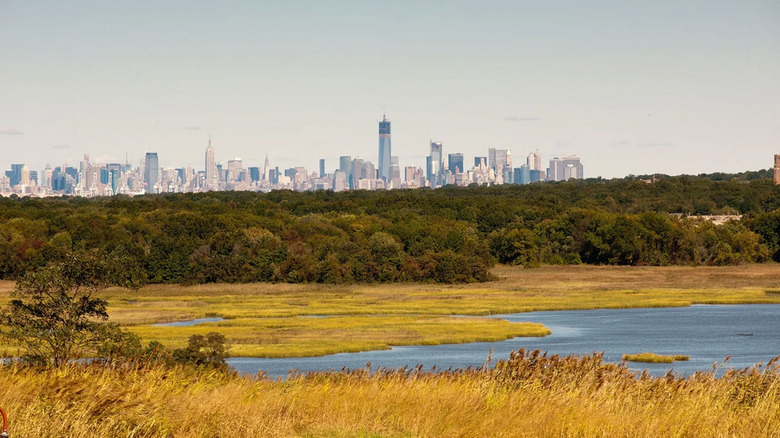
Freshkills Park is built on wetlands and on some of the largest grasslands in the northeastern United States. One major initiative in the landfill-to-park restoration efforts is allowing nature to regrow and flourish after the landfill filled the area's coastal marshes for 53 years. This is being done by revitalizing natural habitats, coordinated gardening efforts, and managing the residual waste from the dump site. In 2013, the Department of Parks and Recreation completed the restoration of two acres of wetlands, including creating a salt marsh and improving water quality. Since the landfill's closure in 2001, there has been a boom in wildlife, with over 200 species, like great egrets and white-tailed deer, returning to the area.
As a former landfill, Freshkills Park's water and soil safety is constantly monitored by both the city and the state of New York. Today, piles of garbage still lie beneath four grassy hills and release gas composed of methane and carbon dioxide, which they've found a clever way to filter. The mounds are covered with a strong liner and managed by mostly invisible systems. A network of underground pipes turns the gas into reusable energy for the surrounding communities.
Once Freshkills Park is completed, it will be the second-largest public park in New York City behind the family-friendly Pelham Bay Park in the Bronx. According to the park's website, it will include several public spaces, such as playgrounds, horseback riding trails, and kayak launches for the public to enjoy. Visitors will also gain access to a variety of waterways and sprawling fields with views of the New York City area.
How to enjoy Freshkills Park today
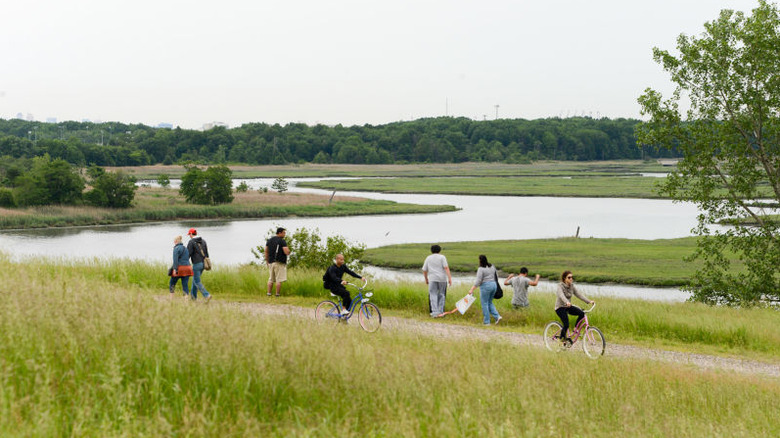
Although the entire park is not yet fully finished, visitors do have access to a few completed areas. Schmul Park connects the Travis neighborhood of Staten Island to Freshkills Park at the southwestern entrance. Opened as the first part of the larger park in September 2012, the playground offers hours of fun for kids, with a vibrant playground, a summer spray shower for cooling off, and courts for handball and basketball.
Owl Hollow Fields serves as the local community's soccer fields, with four fields across 20 acres. The 3.3-mile New Springfield Greenway opened in August 2015 for walking and biking, and Phase 1 of North Park was established in 2023, featuring a multi-purpose pathway, picnic tables, and a bird observation tower.
As of this writing, certain areas of the park are not open to the public, though some are accessible through private guided tours. NYC Parks has partnered with the Freshkills Park Alliance to provide limited early entry to the park for educational purposes. Private tours can be requested by school groups and community organizations to learn more about the park's initiatives. Tours are appointment-only and usually very limited, but visitors can still participate in park-run events throughout the year, such as nature walks and garden planting. Activities are listed on Freshkills Park's online calendar, and most are free, though some require a small donation to participate, making them a budget-friendly way to spend time in New York.