

Maryland's Former Army Base Is A Star-Shaped National Monument That Inspired The US National Anthem
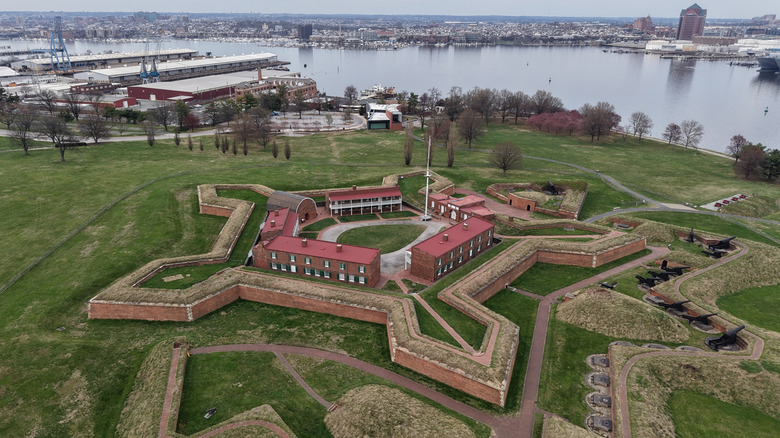
For travelers interested in American history, no trip to Baltimore, Maryland, would be complete without a visit to Fort McHenry. This is the historic, star-shaped fort that inspired Francis Scott Key to write the words to the U.S. national anthem. Key, a Maryland lawyer, originally composed the words as an amateur poem, which was published under the title "Defence of Fort M'Henry." Two years into the War of 1812, during the Battle of Baltimore, he had witnessed a naval bombardment on the fort from a truce ship in the surrounding waters.
The bombardment lasted over 24 hours, but on the morning of September 14, 1814, Key saw that the American flag was still flying over Fort McHenry. He soon put pen to paper, describing what he had seen "by the dawn's early light" and under "the rocket's red glare" the night before. After returning to shore, Key finished his poem at the Indian Queen Hotel in Baltimore. Soon thereafter, it was printed as a broadside, to be set to music with the suggested tune of "Anacreon in Heaven," a popular English drinking song. Copies of the poem made the rounds at Fort McHenry, and as newspapers along the East Coast picked it up, it underwent a name change, becoming the lyrics to "The Star-Spangled Banner."
Today, Fort McHenry endures as a national monument and the only National Park Service unit to be designated a historic shrine. Around the fort, there's a one-mile sea wall trail, lined with benches and cherry blossom groves that reach their peak bloom in late March to early April. Visitors can walk or cycle along this paved path or purchase a $15 standard pass to access the former army base's preserved brick buildings and outer battery.
Experience living history at Fort McHenry
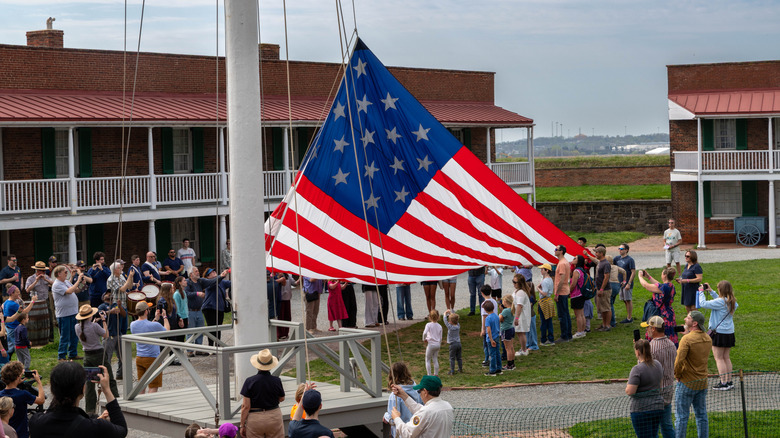
The buildings at Fort McHenry include a guardhouse, a magazine where gunpowder was stored, and four barracks for officers and enlisted soldiers. Each building has exhibits where you'll learn more about the fort's history and what it was like being stationed there. Every day at 10 a.m. and 4 p.m. (or 5 p.m. on summer weekends), visitors can also gather around the flag pole and get hands-on with the Star-Spangled Banner. At the fort's daily flag-changing ceremonies, you might hear park rangers play "Yankee Doodle" (another early national anthem contender) on the fife and drums. Living historians do music and weapons demonstrations in the summer as well.
Flags of different sizes and patterns fly above Fort McHenry, based on weather conditions, but typically, you'll see one with 15 stars and stripes. These represent the original 13 Colonies, plus Vermont and Kentucky, which had joined the Union by the time the War of 1812 broke out. The biggest possible flag that can go up in the morning is a 30-by-42-foot replica of the Star-Spangled Banner. The flag was designed to be "so large that the British [would] have no difficulty seeing it from a distance," as the fort's commander, Major George Armistead, put it (via the National Park Service). This same Armistead lends his name to another abandoned military fort that's now an urban park in Baltimore.
During the Civil War, Fort McHenry's cannons were pointed both inward and outward, as it continued to defend Baltimore while keeping secessionists there in line. The fort also held Confederate prisoners of war from the Battle of Gettysburg, and while it functioned as an army base turned POW camp, it came to include secessionist political prisoners, earning the nickname "The American Bastille." You can still see authentic Rodman cannons from this era positioned on the fort's outer battery, while a separate Civil War powder magazine is visible outside on the sea wall trail.
Visit the Star-Spangled Banner's birthplace
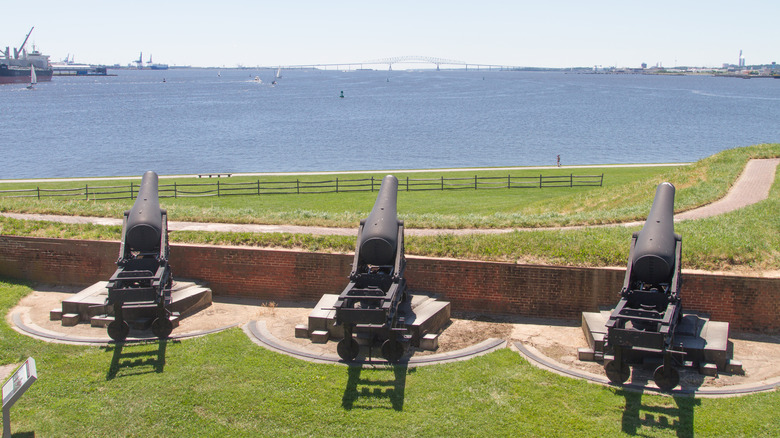
Fort McHenry is accessible along the Banner Route on Baltimore's free Charm City Circulator bus. The fort is situated on Locust Point (formerly Whetstone Point), a peninsula between the city's harbor and the Patapsco River. Looking out over the water from the fort's ramparts, you can see the once and future site of the Francis Scott Key Bridge — scheduled for reconstruction by 2030, after a container ship caused its collapse in 2024. The peninsula was originally the site of Fort Whetstone, an earthen star fort that went up in 1776. That same year, the founding fathers signed the Declaration of Independence, while a London gentlemen's club began singing "To Anacreon in Heaven" (also known as "The Anacreontic Song").
Fort McHenry's precursor and the melody for "The Star-Spangled Banner" therefore both originated in America's birth year. For its part, Fort Whetstone saw no action in the American Revolution, but as a defensive stronghold for Baltimore — then the nation's third-largest city — it was still considered a site of strategic importance. From 1798 to 1803, the fort was expanded as part of the U.S. government's first system of seacoast defenses. During this time, it was renamed after James McHenry, a Maryland delegate who signed the U.S. Constitution before becoming secretary of war under the first two presidents, George Washington and John Adams.
At the Maryland Center for History and Culture in Baltimore, you can see the handwritten words Francis Scott Key wrote for the national anthem while the fourth U.S. president, James Madison, was in office. The real Star-Spangled Banner — the one Key saw flying above Fort McHenry in 1814 — is on display in the National Museum of American History in Washington, D.C. Hop on America's most popular train in Baltimore, and you should be in Washington in about 45 minutes. There, you can supplement your trip to Fort McHenry with more American destinations every history buff should visit in their lifetime.