

America's Most Popular Train Connects Historic East Coast Cities From Boston To Virginia
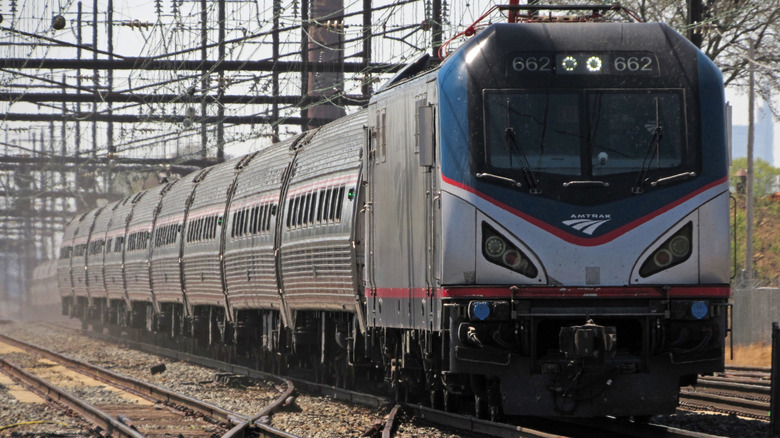
The Northeast Regional is Amtrak's busiest train route, connecting big cities like Boston, New York, Philadelphia, and Washington, D.C. for both travelers and daily commuters. Each year, over 12 million passengers ride this train up and down the East Coast from Massachusetts to Virginia. It's a trip that covers much of the same ground as the original 13 American colonies — those that issued the Declaration of Independence in 1776. Along the way, you'll find plenty of historic sites chronicling the development of the United States even before the first Fourth of July. From Boston Harbor to the Statue of Liberty, and Liberty Bell to the nation's capital, this is the train for history buffs.
Amtrak markets the Northeast Regional as a way to "skip the hassles" and "breeze past the back-ups" of I-95 traffic, and it does allow you to avoid the most dangerous U.S. highway. Flying — though generally more expensive on short hauls — may seem faster, but once you factor in the added cost and time it takes to get from the airport to the city center, Amtrak's "downtown-to-downtown service" starts to look more appealing. Instead of dealing with JFK or LaGuardia, you could step out of Moynihan Train Hall's concourse onto 8th Avenue and be right across the street from Madison Square Garden in the heart of New York City.
As the 2025 fiscal year rolled over into 2026, the Northeast Regional's trunk line, or "spine," from Boston to Washington also met the Federal Railroad Administration's minimum standard of 80% on-time performance for two consecutive quarters. It's still subject to delays (some of which are caused by freight train interference), but so is its high-speed cousin, the Acela. The difference is that any delay with the Acela could defeat the purpose of paying extra for a faster arrival.
Ride the Northeast Regional and discover historical Virginia
Another thing separating the Northeast Regional from the Acela is that it has more departures, since the latter caters primarily to business-class travelers with assigned seats during peak commute times. The difference in time between the two train routes is sometimes negligible if you're doing stop-offs in different cities, as opposed to riding the full length of the Northeast Regional (which would take over half a day). It's two hours, for instance, from Washington to Philadelphia on the Northeast Regional, and the Acela only shaves off about 15 minutes.
The Northeast Regional operates its trains under different service numbers, with some starting in Washington or New York and ending in New York or Boston. However, the full route includes some segments in Virginia, and if you're interest in U.S. history, it's worth starting or ending there, in what was once the most prosperous American colony. The second stop, northbound, is Williamsburg, which served as Virginia's capital from 1699 to 1780. Nearly 90 buildings, spread out across 300 acres, make up Colonial Williamsburg, the world's largest living history museum, where blacksmiths and other craftspeople keep 18th-century trades alive. You might even meet the first U.S. president, George Washington, and the original first lady, Martha Washington (played by costumed interpreters, of course).
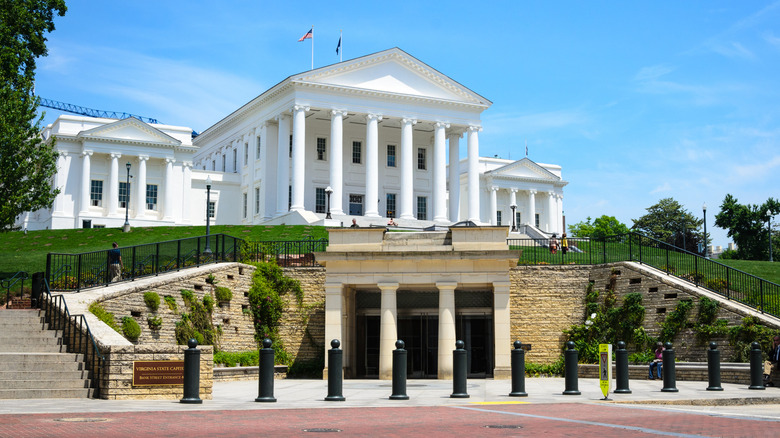
Richmond took over as Virginia's capital in 1780, and it's the next stop on the Northeast Regional. Here, you can visit the American Civil War Museum and tour the Virginia State Capitol building. Designed by another founding father, Thomas Jefferson, to evoke a Roman temple the building's Classical Revival architecture greatly influenced the form of other landmarks you might see on this route, such as the U.S. Capitol in Washington. Tour Jefferson's historic estate, Monticello, down the line in Charlottesville, Virginia.
Explore Washington, Philadelphia, New York, and Boston
Even if you arrive after 6 p.m. on the Northeast Regional, there are tourist attractions in Washington, D.C. that are better to visit at night. In the daytime, beyond the National Mall's memorials, you'll find a historical treasure trove in the Smithsonian's free museums and sites like Ford's Theatre, where President Abraham Lincoln was assassinated. If you don't mind sharing the halls with certain politicians, you can also arrange free U.S. Capitol and White House tours. The latter must be requested through your local congressperson months in advance. Ride the Metro back across the Potomac River into Virginia to visit President John F. Kennedy's gravesite and the Tomb of the Unknown Soldier at Arlington National Cemetery.
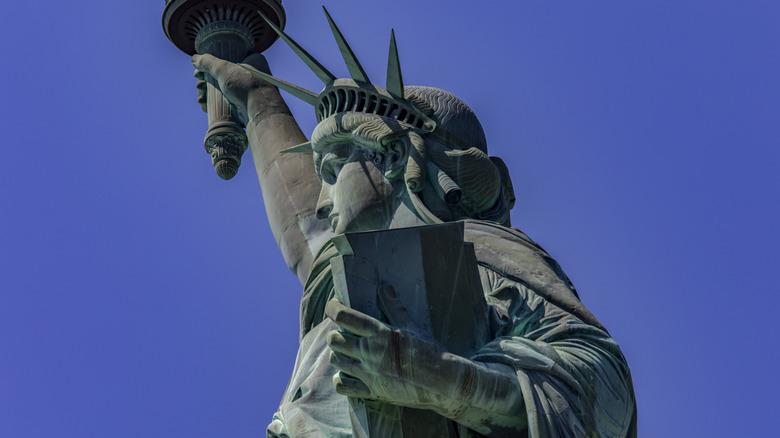
Philadelphia's Historic District is worth a stop-off on the Northeast Regional, if only to see Independence Hall and the famously cracked Liberty Bell. The hall is where the U.S. Constitution and Declaration of Independence were signed. The bell, which sits outside the hall, became a symbol of freedom to everyone from slavery abolitionists to women's suffragists down through the decades. When you get to New York, you can board a ferry to Liberty Island and Ellis Island through Statue City Cruises. That's the only way to get up close to the Statue of Liberty — close enough to read the inscription on its pedestal, with the line, "Give me your tired, your poor, your huddled masses yearning to breathe free."
Ellis Island is where those masses sought the American dream, with over 12 million immigrants entering the country through this gateway (now a museum). The 9/11 Memorial and Museum offers a sobering reminder of how turbulent American history continues to be in the 21st century. Finally, in Boston, you can go back to where the Revolution started at the Tea Party Ships and Museum. And the Freedom Trail walking route is one of the best New England attractions for history buffs.