

Arizona's Former Missile Silo Is Now America's Only Publicly Accessible Titan II Launch Complex
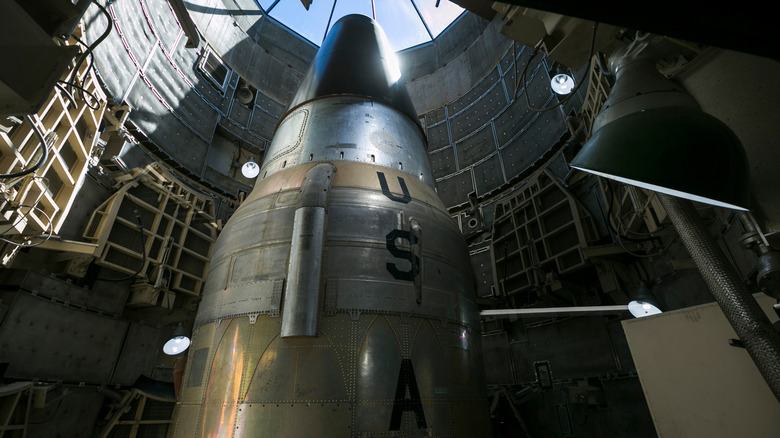
Visitors to Tucson, Arizona, may come for views of the largest cacti in America, but that's not the only interesting feature of the desert surrounding the city. Just south of Tucson, at an address shared by Sahuarita and Green Valley, Arizona, you can venture down into an underground silo where an inactive Titan II training missile is still aimed upright. During the Cold War, over 50 sites equipped with armed versions of these intercontinental ballistic missiles (ICBMs) maintained a state of alert, round-the-clock, in the United States. The Titan Missile Museum, a National Historic Landmark since 1994, preserves the last of those sites for public access.
Part of the procedure for converting the missile site into a museum before it opened in 1986 involved leaving the door over the silo half-open. This lets satellites verify that the missile in the launch duct is inoperative and of no threat to any other country. It also allows visitors who stay above-ground on the museum's topside tour to peer down into the silo through a window over the door. Since it's a training variant, the 101-foot missile on display was never armed with fuel or a nuclear warhead. It has holes in its propellant tanks and non-standard USAF markings on the side to show that it's a dummy. While the Titan Missile Museum might vie for inclusion on a list of unnerving dark tourism destinations, you should be in no danger of a nine-megaton blast going off when you visit.
You'll need to book an online reservation for a 45-minute guided tour of the museum's underground silo. As of this writing, prices range from $19.50 (for adults 13 and up) to $15 (for kids 5 and up). Visitors who don't have a reservation or who are unable to climb 55 stairs can still purchase admission for the $7 topside tour, which is self-guided.
Learn about launch procedure at the Titan Missile Museum
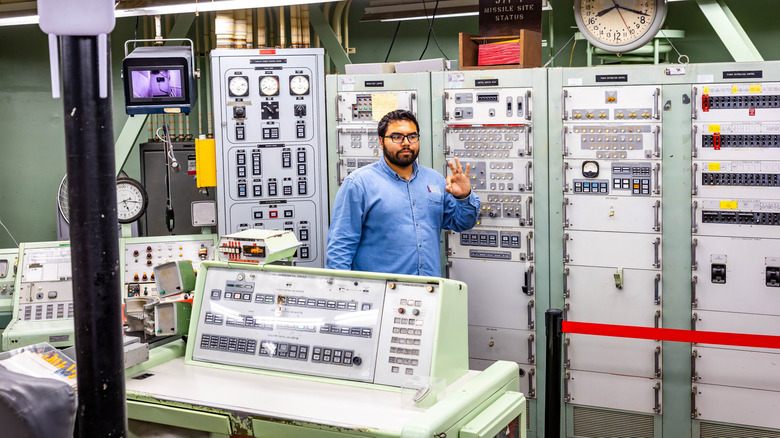
The guided tour of the Titan Missile Museum takes visitors down to the silo's second level and the launch control center, which are bridged by a cableway. In the control center, you'll learn how the turning of two keys could escalate World War III in under a minute — 58 seconds, to be exact. One visitor in each tour group may be invited to help their guide turn the spring-loaded keys, which were deliberately spaced far enough apart that a single person couldn't reach both. Suffice it to say, even just rehearsing for nuclear Armageddon in a simulated launch can bring up intense feelings.
The control center's regular combat crew consisted of two officers and two technicians, working a 24-hour shift like firefighters. Before a launch, crew members would have to unlock a safe with two unique combinations and then match an emergency code there with one from the radio. They would initiate the launch without knowing where a missile was headed, since its pre-locked targets were classified (and still are). This was the procedure that underpinned the Titan II's defense reign, which lasted from 1963 to 1987, until the U.S. Air Force transitioned to the Minuteman III missiles it currently has on alert nationwide. The museum, a straight shot down I-19 from Tucson, stands as a monument to those years.
Travelers interested in military history will find more of it beyond the Titan Missile Museum in Tucson. At the Pima Air & Space Museum, you can see aircraft like World War II bombers and kamikaze trainers, while the Tucson Military Vehicle Museum holds everything from Gulf War tanks to World War I tractors. If you're ready to rough it like a soldier in the desert, Tucson is also the perfect southwestern destination for a winter camping adventure. Yet nowhere, perhaps, is the weight of history heavier than the nuclear missile silo at the Titan Missile Museum.