

California's Popular Ghost Town In Death Valley National Park Has Eerie, Abandoned Mine Shafts
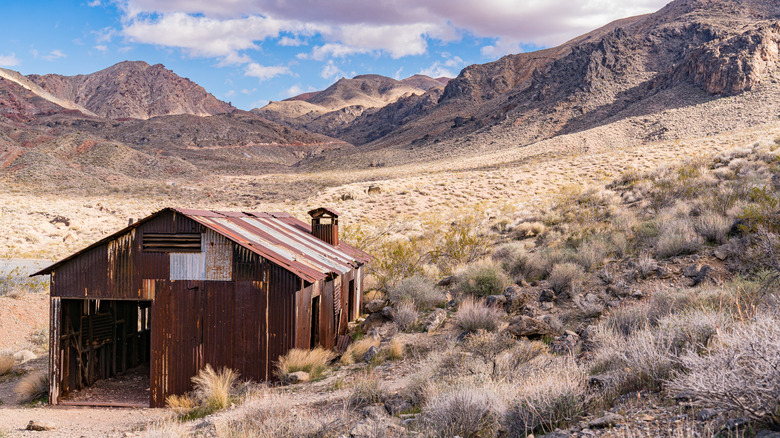
Located in southeastern California and not far from the Nevada border lies Death Valley National Park, a vast basin that contains over 3 million acres of wilderness. While known for its extremely hot and dry climate, it once attracted many prospectors hoping to strike it rich with gold and other minerals. While this led to the creation of many mining towns, some of those didn't last very long. In fact, the area is now home to a number of ghost towns that attract visitors from all over. One such is the now popular ghost town of Leadfield, located right off the Titus Canyon Trail.
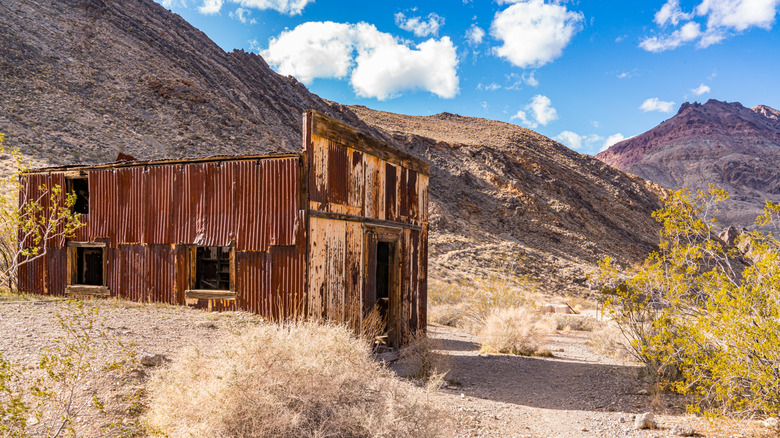
Not to be confused with Leadville, an outdoor recreation gem situated high In Colorado's Rocky Mountains, this California ghost town is simply the skeleton of a short-lived mining town. Initially, the land was promoted by a man named Charles C. Julian, who claimed that there were riches to be found in the local mines. He made plenty of empty promises and managed to attract hundreds of people hoping to make a life for themselves in the area. Sadly, there was no fortune to be made here, and the townspeople quickly began to retreat. With the closure of the local post office in 1927, Leadfield was essentially abandoned, destined to become the ghost town it is today. Nowadays, it's merely a stop along the way for many a Death Valley visitor.
Exploring what remains of Leadfield
If it weren't for the handful of still-standing structures in the area, you'd never guess this was once an up-and-coming mining town. On your visit to Leadfield, you'll be greeted by a sign that lets passersby know that this "mining boom town" was once home to 300 people. There's also some additional signage placed by the National Parks Service, which features a black and white photograph of what the town once looked like. It also gives visitors some insight into where different structures (such as the Leadfield Cafe, the Leadfield General Store, and the Pioneer Club) once stood. It also pinpoints where the post office still stands today.
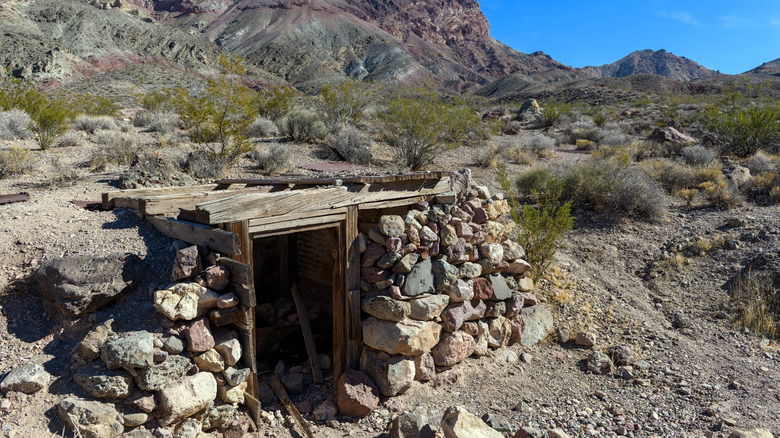
On your visit, you're welcome to hike around the area, inspect the few structures left standing, and take photos. You could also just use this time to stretch your legs out and enjoy a snack if you brought one, as the one-way journey through Titus Canyon, featuring the park's most frequented back-country road, can feel a bit treacherous. There are also some mineshafts to be found if you walk around the area that you're free to explore at your own risk. However, some are said to be boarded up, which is just as well as there are no nearby hospitals or other emergency facilities nearby. Leadfield is incredibly remote and difficult to get to, after all.
Preparing for your Death Valley ghost town visit
You can tack Leadfield onto a larger trip to the must-visit west coast national park that is Death Valley. More specifically, make it a special stop during your drive through Titus Canyon. Make sure to rent a 4-wheel drive vehicle with high clearance to account for potential adverse road and weather conditions. To get to Leadfield, start from Nevada Highway 374, and take the one-way road east for 27 miles, which takes around two to three hours total.
Death Valley is most accessible by flying into Harry Reid International Airport in Nevada, which is a two-and-a-half hour drive west of Titus Canyon and nearby Leadfield. Alternatively, you can fly into Eastern Sierra Regional Airport, then take the roughly three hour drive over or under and around the valley until you arrive at Titus Canyon. As for accommodations, Stovepipe Wells is located within the park about an hour's drive south of the canyon, and offers RV hookups for $20 to 40 a night, and rooms from $170 to $300 a night. You can also stay outside the park in the neighboring town of Beatty, Nevada, where hotels like the Death Valley Inn and the Atomic Inn have rooms starting at around $90 per night.
You'll also want to be sure you time your visit properly. Trip Advisor reviewers recommend getting an early morning start, maybe even before dawn, in order to beat the heat as well as the sun glare. This also improves your odds of encountering big horn sheep, if you happen to be a fan of the four-legged animals. Additionally, due to the extreme heat, visiting in the late fall through winter is best. And make sure to pack and wear protective clothing — just one of the many tips you need to know for a safe road trip through Death Valley.