

North America's Largest Tree Is A Magnificent Gem In California's Sequoia National Park
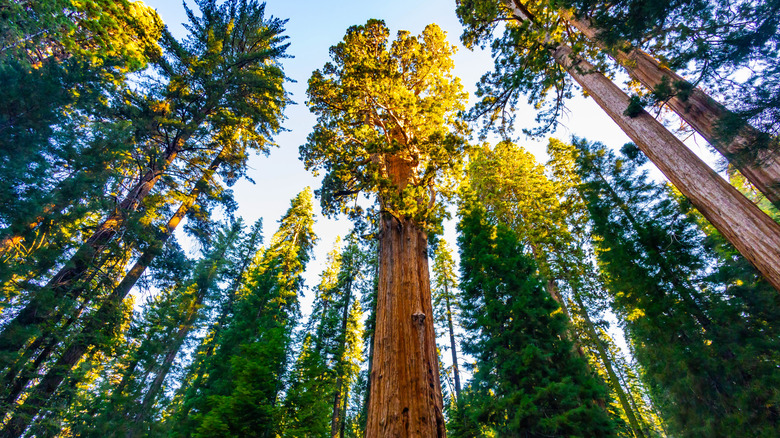
Sequoia National Park — often referred to in tandem with Kings Canyon National Park — puts in the work to earn its acclaim. Situated in central California about 90 minutes from Fresno, Sequoia not only hosts Mount Whitney (the tallest mountain in the contiguous United States at 14,505 feet) but also several sparkling lakes, fascinating caves, and sprawling trails. But these aren't the only elements that make this attraction one of the state's most visited national parks. A crucial feature of this magnificent gem is, of course, its namesake trees. A major claim to fame for the region, giant sequoias (also known as Sequoiadendron giganteum or Sierra redwoods) are beauties you can't miss during a visit to the park. And if there is one particular conifer worth making a beeline for, it's the General Sherman Tree — North America's largest tree by volume.
By the same metric, General Sherman is also the world's largest tree. While not the tallest redwood out there, Sherman earns the title of "largest" by measuring in at an estimated volume of 52,500 cubic feet. As the National Park Service (NPS) explains, that amount of volume could produce enough lumber to build 120 houses. Valued far more than for the lumber it could provide, this record-setting tree has actually prompted firefighters to go out of their way to protect it. During California's 2021 KNP Complex fire, workers enveloped the base of Sherman in a layer of aluminum to help it withstand potentially harmful conditions.
Today, the tree remains standing at a height of roughly 275 feet and a circumference of more than 100 feet. Those measurements are just the tip of the iceberg when it comes to this unique woodland icon, though. If you want to learn more about the General Sherman Tree, here are a few additional facts to explore.
Discover the General Sherman Tree's age, history, and trails
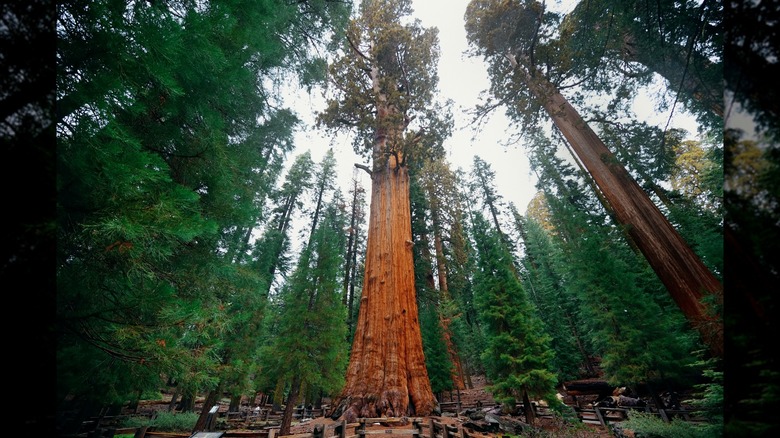
The General Sherman Tree's height and circumference aren't its only impressive stats. To grow into such staggering measurements, the tree also had to survive and thrive for many years — thousands of years, in fact. According to the NPS, "the most recent age estimate of the Sherman Tree is about 2200 years old." If accurate, that estimate means this one-of-a-kind sequoia predates the Roman Empire, the Tang dynasty, the invention of chess, and gunpowder.
In (relatively) more recent history, the tree's current name came about in 1879. The title is an homage to the Civil War-era Union officer William Tecumseh Sherman. This name isn't the only one the tree has had since then, however. Prior to Sequoia becoming America's second-ever national park in 1890, an attempted utopian society called the Kaweah Colony (formed in 1886) dubbed this famous landmark the Karl Marx Tree.
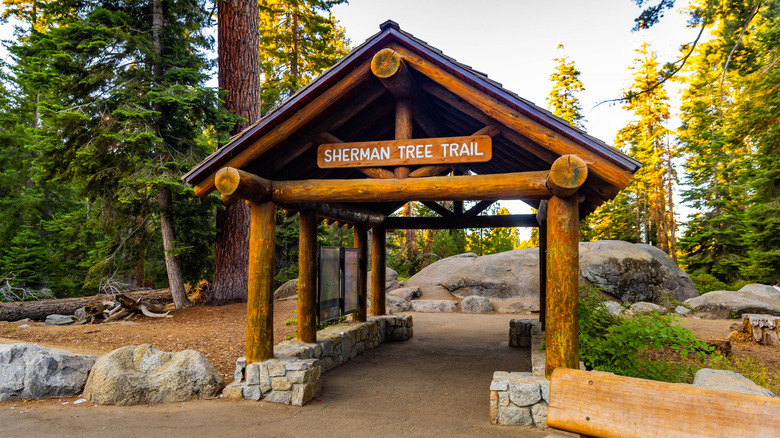
Nowadays, visitors will find this sight once again referred to as the General Sherman Tree. Nearby, sightseers can also discover scenic hikes along the Congress or Lodgepole-Sherman Tree Trails or at the General Sherman Tree Main Trailhead. The first is an easy and paved 2.7-mile route, while the second is a longer trek connected to one of Sequoia National Park's best campgrounds. Shorter than both, the third and final path is marked by a wooden pavilion with a sign reading "Sherman Tree Trail." Just over a mile long and outfitted with amenities such as restrooms, informational displays, and a shuttle stop, this route might just be the most convenient pick available for those who want simple, straightforward access to one of Sequoia's top attractions. Meanwhile, for one of the most accessible national park hikes in the U.S., travelers can wander about 4 miles south for the Big Trees Trail.
Plan your visit to the General Sherman Tree with these tips
When planning a trip to any major national park, you're bound to come across plenty of advice on how to make the most of your visit. Some people may be inclined to trust in tips from travel guru Rick Steves, while others may prefer old-school methods for a foolproof getaway. Still, whether you're planning to print maps or follow in the footsteps of celebrity sightseers, there's important information to know before you head to Sequoia National Park for a glimpse of North America's largest tree.
First, you'll want to know exactly where you're going. Though Sequoia and Kings Canyon National Parks are closely connected, they are two separate places. The General Sherman Tree is located within Sequoia National Park, near the northern end of the Giant Forest. There are some nearby parking areas available (including accessible spots for visitors with disability placards, which can be obtained at park visitor centers), plus a free seasonal shuttle service. During the summer, routes one and four both drop off at the General Sherman Tree Trailhead, with four also stopping at the adjoining parking lot. Typically available only for limited periods between November and February, winter shuttles also stop at the tree but can be impacted by severe weather.
While frosty weather and reduced transportation options make off-season Sequoia vacations tricky to plan, keep in mind that spring and summer bring their own challenges. As you might expect, during the warmer months (and especially around holidays), crowds can be heavy. Higher temperatures may also make hiking conditions less than ideal for those used to cooler climates. In the summer, you'll also need to remain aware of local fire restrictions, which forbid those staying at certain campgrounds from building fires or using stoves.