

US Customs And Border Protection Now Offers Passport-Free Screening In US Airports
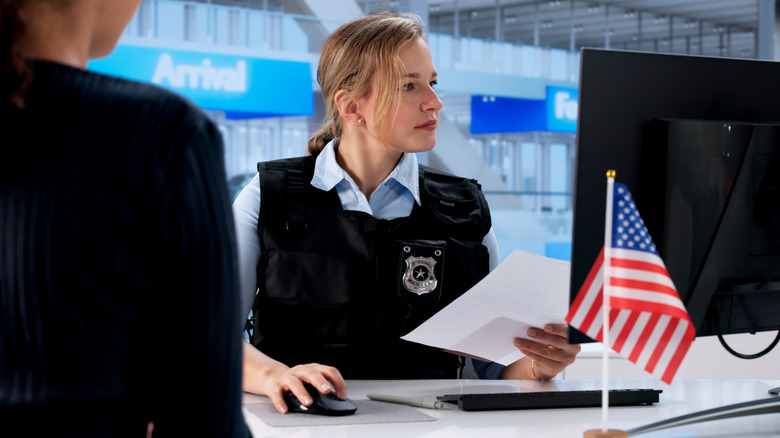
Hanging around for hours on end in an airport doesn't usually figure on lists of favorite ways to spend a day. Long lines and wait times, questionable food choices, and unpleasant exchanges with personnel or other passengers can send stress levels sky high before you even get in the air. While not much can be done about the last two items, the expansion of Enhanced Passenger Processing (EPP) by U.S. Customs and Border Protection (CBP) is making a big difference to those lines and wait times.
Facial recognition technology isn't new, but it still requires presenting your passport for verification with CBP officers. EPP takes that technology a step further by allowing eligible U.S. citizens to complete the process automatically. This system is already in operation in several U.S. airports, preclearance airports, and seaports, and has since proved successful.
Unlike Global Entry, a paid membership program for pre-vetted, low-risk passengers, and one of the best ways to get through airport security faster, EPP is free and voluntary. It works using an auto-capture camera that compares your photograph with images already in the system. If everything checks out, you can be on your way with no fuss and little interaction with a CBP officer. This doesn't mean you no longer require a passport; it just means all the information on your passport can be checked electronically.
If there are any issues, officers will still be available to step in. "In a few years ... people with Global Entry are going to be walking through at all of our airports, unless a CBP officer wants to speak to that traveler," said Diane Sabatino, a CBP official who oversees the nation's 328 land, air, and sea ports of entry, via the Washington Examiner.
What Enhanced Passenger Processing means for passengers

When you disembark an international flight at an EPP airport, there's no more frantic searching for your passport, less time spent in never-ending queues, and no more scanning travel documents. What you have instead is a brief stop at an auto-capture facial recognition camera, which should take no more than a few seconds, while all the checks are going on behind the scenes. Within those seconds, your image is being matched against existing records, your identity and citizenship are being confirmed, and security checks are taking place.
While the benefits to passengers are many, the procedure is there primarily to enhance national security. The CBP, who screen around 390,000 people a day, and that's just in airports, have so far reported an average 25% reduction in wait times since EPP was introduced. For busy hubs like Hartsfield-Jackson Atlanta International Airport, where travelers get frustrated over long TSA lines too, this makes a huge difference, resulting in fewer missed connections and less hanging around.
At the time of writing, 33 U.S. airports have EPP in place, as well as some preclearance airports outside the U.S., including Dublin and Montreal. America's third-busiest airport, Dallas-Fort Worth International, was the first to pilot EPP in 2024, with the most recent being L.F. Wade International Airport in Bermuda, a preclearance location, on August 31, 2026. Only U.S. citizens are eligible for EPP, although the process is not compulsory. Foreign passengers will continue to go through other CBP processing methods, although Seamless Border Entry, a separate system for existing Global Entry members, is open to select other nationalities.