
Not Indiana Dunes, Not Isle Royale: This Midwestern National Park Has The Most Visitors
The Midwest is home to some beautiful national parks. A few of these are adventure-filled havens on the Great Lakes, like Michigan's Isle Royale National Park in Lake Superior and Indiana Dunes National Park on Lake Michigan's southern coast. Surprisingly, though, these Great Lakes gems are not the most visited Midwestern national parks — by a long shot. Only 29,000 people visit Isle Royale every year on average (per data.hereandthere.club), while an impressive 2.63 million visit Indiana Dunes. But Ohio's Cuyahoga Valley National Park is the clear winner, with 3.03 million annual visitors on average. It's Ohio's only national park, located near the town of Boston, Ohio, around 30 minutes south of Cleveland and 30 minutes north of Akron.
Despite its high visitor numbers, Cuyahoga Valley National Park is not your typical national park. Its rolling hills and wetlands near suburbs and busy roads are more similar to an urban green space than to a backcountry wilderness area. It's also nowhere near as "grand" as Western national parks like the Grand Canyon. Encompassing only around 33,000 acres, Cuyahoga could be multiplied 36 times and still fit inside the Grand Canyon, which spans more than 1.2 million acres. But special things often arrive in humble packages.
One truly special aspect of Cuyahoga Valley National Park is its backstory, which has more to do with restoration than conservation. The Cuyahoga River, 22 miles of which is now part of the park, was formerly filled with toxic waste, leading to its catching on fire — not once but multiple times between 1868 and 1969. Spurred by the emerging environmental movement, a clean-up of the river began in the 1970s and continues to this day. As the river and wetlands have returned to their natural states — nourishing 65 species of fish, beavers, blue herons, bald eagles, and other wildlife — their restorations are now hailed as ecological success stories.
Top attractions at Cuyahoga Valley National Park
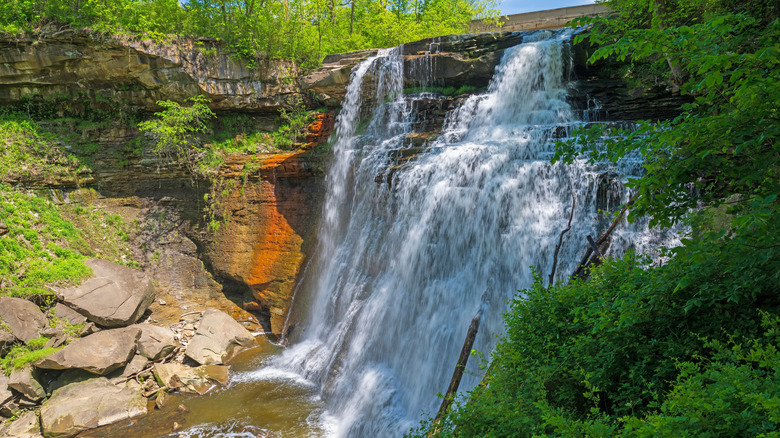
The park's most popular attraction is the 60-foot-tall Brandywine Falls, a bridal veil-shaped cascade along Brandywine Creek, which provided power for a community's grist, saw, and woolen mills in the early 1800s. Two separate viewing areas for the falls are accessible via boardwalks from the parking area. Those who wish to explore the area further can do the Brandywine Gorge Loop, a 1.5-mile route through a forested ravine and over a footbridge, with 160 feet of elevation change. Hikers familiar with this trail say it's lovely in autumn, as Cuyahoga Valley National Park is one of the Ohio parks where you can see brilliant fall foliage.
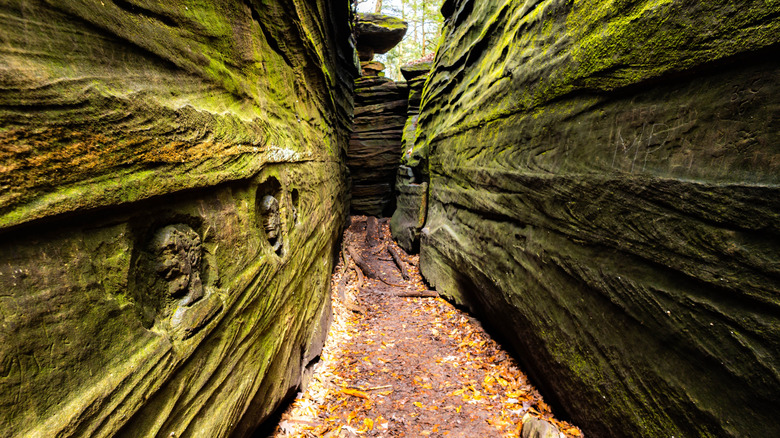
The Ledges Trail is another popular route. This is a 2.4-mile loop through an area with striking moss-covered ledges, cliffs, and rock formations. To navigate the rocky terrain and elevation changes of this trail, sturdy hiking shoes are recommended; tread especially carefully when snow or ice are present to avoid slipping. For easier strolling, head to the mostly flat and partially paved Towpath Trail, which follows the route of the historic Ohio & Erie Canal, which once connected the Ohio River and Lake Erie. The 20-mile section of the Towpath Trail that lies within the park is popular with walkers and bikers. Portions of the path are also suitable for wheelchairs, strollers, equestrians, and in winter, cross-country skiers.
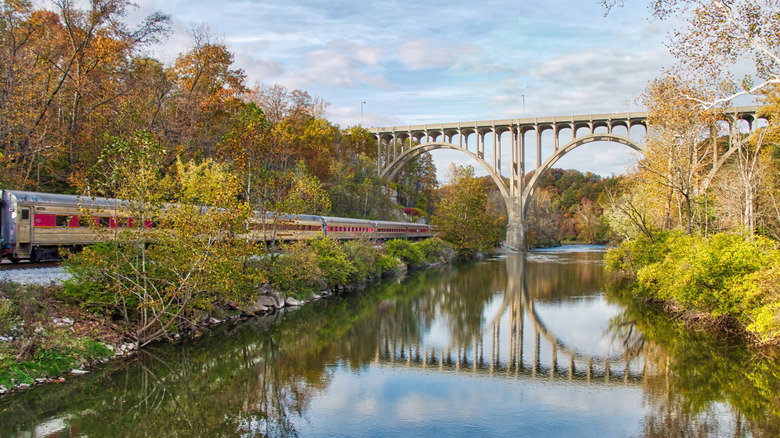
Another recommended experience is riding the Cuyahoga Valley Scenic Railroad (CVSR), which provides memorable views of the valley and park. A coach ticket is good for the whole day and allows riders to exit and enter trains at their own pace in order to visit key spots in the park. One of these is the Canal Exploration Center on the Towpath Trail, where visitors can learn more about the Ohio & Erie Canal and its important place in Ohio's history and state identity.
Planning your visit to Cuyahoga Valley National Park
Unlike many other national parks, Cuyahoga Valley National Park is completely free to visit and open all year round. As well as being gorgeous in autumn, it's one of the most amazing national parks to visit in spring, when wildflowers like trumpet-shaped Virginia Bluebells and vivid yellow Marsh Marigolds begin appearing around the park. Spring is also a great time to see Brandywine and other waterfalls at their full volume and to catch glimpses of wildlife, like industrious beavers and migratory bird species.
Summer and winter can also be lovely times to explore the park, but be prepared for the extremes of Midwestern weather: heat and humidity in summer and cold temperatures with the potential for snow in winter. Summer visitors should also expect to encounter more traffic on roads and trails, as this is when the park is at its busiest. To avoid crowds, summer visitors are encouraged to arrive before 10 a.m. or after 3 p.m., especially on weekends.
Camping is not allowed inside the national park, but cozy accommodations are available in two quaint inns. Stanford House offers reasonably priced rooms along with a communal self-service kitchen, while the Inn at Brandywine Falls is a more upscale B and B option. It offers luxurious rooms and gourmet breakfasts in a renovated Greek Revival estate that happens to be listed on the National Register of Historic Places. More accommodation options can be found in nearby towns and cities, including Cleveland and Akron, which are both around 30 minutes away. Each of these cities is also home to an international airport: Cleveland Hopkins International Airport (CLE) and Akron Fulton International Airport (AKC), respectively.