

Follow This Simple Airplane Etiquette Rule To Avoid Overhead Bin Drama
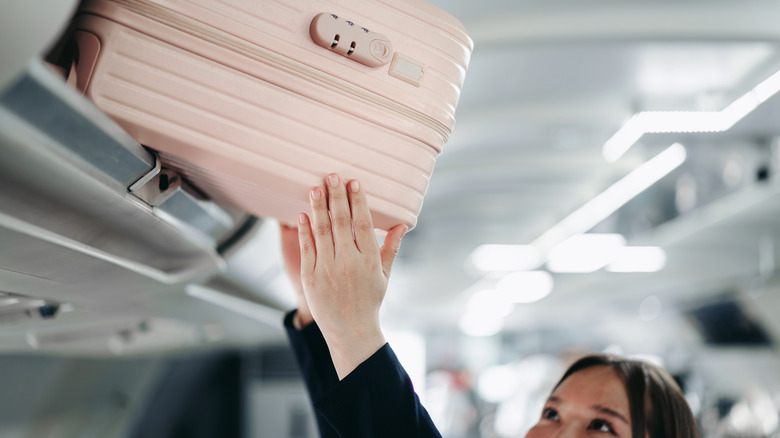
Traveling on a commercial airline makes getting to your destination super fast and convenient, but flying isn't always a stress-free experience. Rushing through crowded terminals and waiting in long lines at TSA can leave even the most laid-back traveler feeling a bit frazzled. Plus, it seems like those airplane seats are getting smaller and smaller as the airline attempts to increase profits by stuffing more passengers on the plane. Once you finally board the aircraft, you may feel tempted to maximize your leg room by throwing all of your belongings in the overhead bin, but do your best to avoid that temptation. The proper airplane etiquette rule is to place your personal items under the seat in front of you. Only your large carry-on bag should be placed in the overhead bin.
Boarding is one of the most stressful phases of flight for both passengers and flight attendants. There's a ton of congestion as everyone tries to make their way down the narrow aisles with their bags, and flight attendants are busy with important job duties. Don't be the kind of passenger who makes things harder on everyone by attempting to stow all of your items in the overhead bins.
When flights are full, overhead bin space fills up fast. The bins are designed to hold larger carry-on suitcases, and passengers are expected to place their smaller personal items under the seat in front of them. Putting personal items in the overhead bin can cause space to run out before everyone has finished boarding. If you break this simple rule, you may end up causing unnecessary drama. Do yourself and everyone else a favor by following the important airplane etiquette rules.
Properly storing your luggage on flights
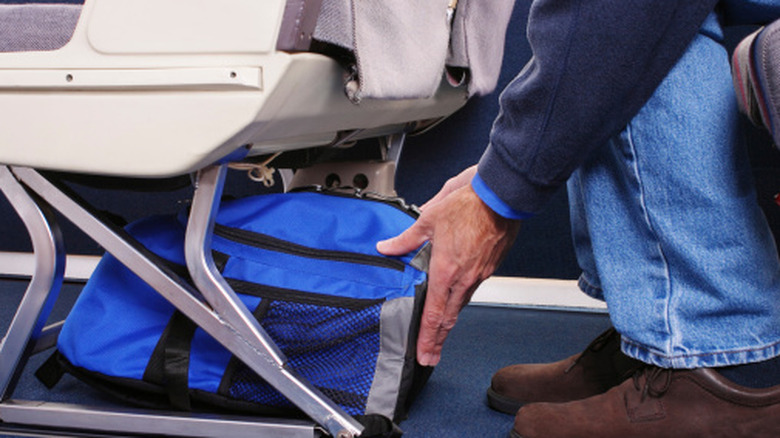
When traveling on commercial airplanes in the United States, passengers are usually only permitted to bring two items onto the aircraft with them: a carry-on bag and a personal item. Your larger suitcase is considered your carry-on bag. It can be a rolling suitcase, a large carry-on backpack, a duffel bag, or a garment bag. Generally, the maximum size that a carry-on bag can be is around 22 inches by 14 inches by 9 inches. Anything larger than that will probably have to be checked at the baggage counter when you arrive at the airport. The overhead bins on the aircraft are designed to safely stow carry-on bags. Many budget airlines charge a fee for a carry-on bag. If you hear a flight attendant say something like, "overhead bin space is reserved for large paid-for carry-ons," that's what they're talking about.
Personal items can be brought on board for free on most airlines, including the ones that charge for carry-on bags. The difference between a carry-on and a personal item comes down to size. A personal item should be significantly smaller and it has to fit completely under an airplane seat. Usually the maximum size that a personal item can be is around 18 inches by 14 inches by 8 inches. Personal items include things like purses, laptop bags, small backpacks, and totes. Items like diaper bags and medical devices do not count toward the two-item limit. Wearables like coats and sweaters can also be carried on board. According to federal regulations, "no passenger may board an airplane if his/her carry-on baggage exceeds the baggage allowance prescribed in the operator's approved program."
Personal items, including items like coats and sweaters, are expected to fit under the seat in front of you, unless you're seated in the bulkhead. It's crucial that all items are safely stowed. If they aren't, they could injure passengers or crew members once the aircraft starts moving.
Overhead bin etiquette
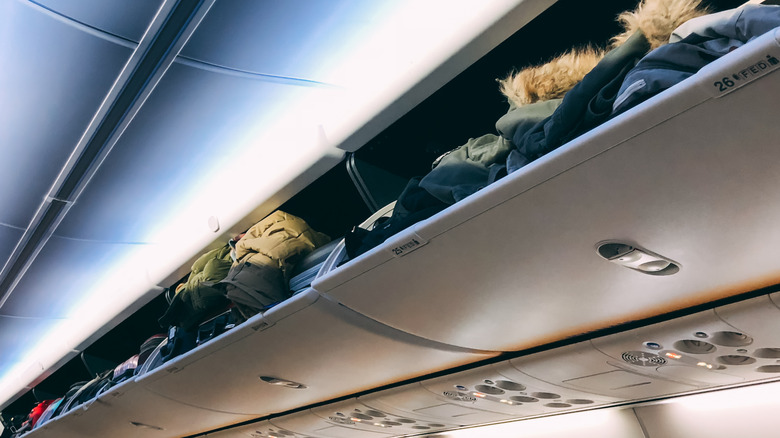
As a former flight attendant, most of the drama I have seen occur on airplanes has to do with overhead bin space and carry-on baggage. Most frequent fliers understand the rules and are happy to comply with overhead bin etiquette and baggage requirements, but there are always a few people who feel entitled to take up as much overhead bin space as they please. That kind of behavior can really annoy your fellow passengers, and your flight attendants.
Before an aircraft can depart, everything needs to be safely stowed. It's actually a federal law. This means that the airplane isn't legally allowed to leave the gate until all of the baggage drama is handled. On extremely full flights the overhead bins will also be full. There's no room for extras. If the flight is empty, your crew members may announce that you can put your personal items in the overhead bin, but don't do so without permission.
When passengers stuff their personal items, coats, and other belongings in the bins, it usually means that other passengers' carry-on items (which are too large to fit safely under seats) won't have space. It will take extra time to find room for them. Some people may end up making the mistake of storing their carry-on bags in bins located many rows behind their seats, which can create a traffic jam during boarding and deplaning. On very full flights, crew members may need to examine each overhead bin, remove personal items, find out who they belong to, and then make sure they're stowed under a seat. Flights end up departing late, and it adds to the stress for passengers and crew members alike. Don't be the drama on your next flight. Pack light, follow the basic airplane etiquette rules, take your assigned seat, and enjoy the privilege of traveling hundreds of miles in a few short hours.