

Why Do Airplanes Fly Trans-Arctic Routes But Not Over Antarctica?
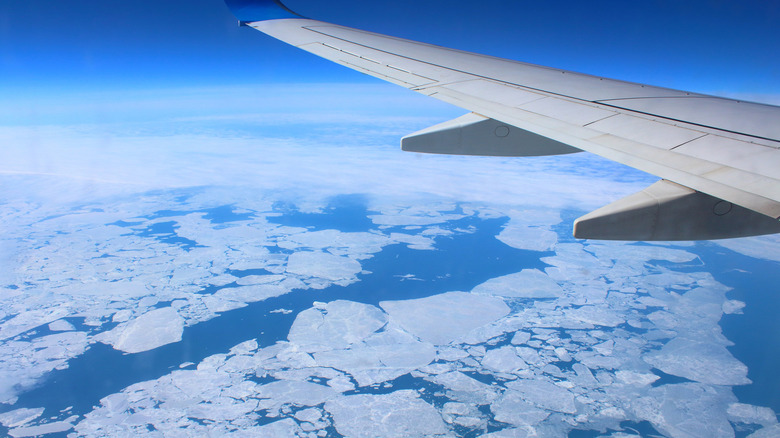
It's one of those questions you'd expect to be asked on a quiz show, along with why some countries drive on the right and others on the left. But the answer to why planes fly over the Arctic but not the Antarctic isn't as straightforward as you may think. There are several reasons why flight paths favor the North Pole rather than the South Pole. Simple geography is one. Because the Earth is round, what looks like the shortest route between destinations on a map actually isn't. Instead, flights follow great circle routes that curve northward and are in fact shorter. Passenger demand, weather conditions, navigational issues, and most importantly, safety regulations, also have a part to play.
Flying over the North Pole may be a common occurrence these days, with some travelers even choosing to stay in an Arctic resort, but it hasn't always been so. During the Cold War, military strategists realized that the shortest route between the Soviet Union and the United States was across the Arctic Circle and that by flying north, they could save hundreds of miles. Having limited infrastructure in the region at that time, they invested in polar navigation, communications, and weather forecasting systems. As airplane design and reliability improved, along with advances in satellite navigation technology, the long-haul flights that cross the Arctic today became possible.
Why airplanes fly over the North Pole and not the South

The world's busiest airports are all in the Northern Hemisphere, with the top three being Hartsfield–Jackson Atlanta International Airport, Dubai International Airport, and Tokyo Haneda Airport — also the cleanest airport in the world. With flights between North America, Europe, and Asia making up the majority of today's global travel, it makes geographical sense to fly north. Shorter routes mean quicker flight times, reducing fuel costs and emissions. The Southern Hemisphere, on the other hand, has very little traffic because there is simply not the same demand.
There's no disputing both poles are cold, but Antarctica has much harsher weather conditions. Winds can reach up to 200 mph, snowstorms are common, and temperatures regularly fall below -76°F. With far fewer weather observation stations, monitoring extreme conditions is challenging to say the least. Weather forecasts in the Arctic are generally more reliable thanks to an established infrastructure.
Then there are the safety risks. Airlines must follow ETOPS regulations, meaning the airplane must be within a certain time of a diversion airport should an engine fail. While there are several diversion airports in Arctic regions, in Antarctica, there are only a few military and research airstrips that are built on ice, and are unsuitable for commercial aircraft. If this hasn't put you off and you still have a flight over Antarctica on your bucket list, Qantas operates sightseeing flights, which depart from major cities in Australia, including Melbourne, Sydney, Brisbane, and Perth. Or you can go a step further with a number of specialist tour operators like White Desert offering stays over several days on the remote frozen continent.