

Two Dangerous Viral Outbreaks Are Plaguing Cruise Passengers

On April 1, 2026, a Dutch cruise ship called MV Hondius departed Argentina and continued through the South Atlantic. There were 88 passengers and 59 crew members on board. By April 6, things had taken a turn for the worse.
The first passenger to fall ill was an adult male who had a fever, headache, and diarrhea. Over the next few days, he became increasingly sick and developed respiratory issues. By April 11, he passed away on board. So began the outbreak of hantavirus that has dominated headlines around the world over the past few weeks. But hantavirus isn't the only dangerous virus that's plaguing cruise passengers.
So far, there have been two norovirus outbreaks on cruise ships already in 2026, according to the CDC. The first occurred on Princess Cruises' Star Princess, which sailed from March 7 until March 14. The second outbreak occurred on Princess Cruises' Caribbean Princess, which sailed from April 28 until May 11. On the latter cruise, more than one hundred people became sick. Norovirus isn't nearly as deadly as hantavirus, but it is much more contagious. Both outbreaks pose dangerous risks, and both are shedding light on how easily germs can spread on board cruise ships.
Hantavirus outbreak claims lives and sparks fear around the world

Most people alive today survived the COVID-19 pandemic that began in early 2020. The World Health Organization estimates that millions of lives were lost during the last pandemic, while millions more were forced to endure terrifying hospital stays. After months of worldwide lockdowns, travel restrictions, and other changes, it comes as no surprise that the news of dangerous viral outbreaks has the whole world on high alert.
Hantavirus is significantly more deadly than COVID-19. The virus is usually spread through contact with the droppings of rodents like mice and rats and is fatal in about 40% of human cases. The variant that passengers of the MV Hondius contracted, known as Andes virus, is able to be spread between humans. The good news, according to medical experts around the world, is that it is far less contagious than coronavirus when it comes to human-to-human transmission. Dr. Tedros Adhanom Ghebreyesus, the current director-general of the World Health Organization, said that "the overall public health risk remains low." Meanwhile, Maria Van Kerkhove, the WHO acting director for epidemic and pandemic management, assured the public, "This is not SARS-CoV-2. This is not the start of a COVID pandemic."
Although medical experts insist that the virus isn't likely to spread as quickly as COVID-19, it has no known cure. At the time of writing, three people who contracted the virus on the cruise ship have died and there are a total of eleven suspected or confirmed cases. The other cruise ship passengers have been evacuated and placed on rescue flights home to their respective countries where they are being monitored and treated.
Why norovirus spreads like wildfire on cruise ships
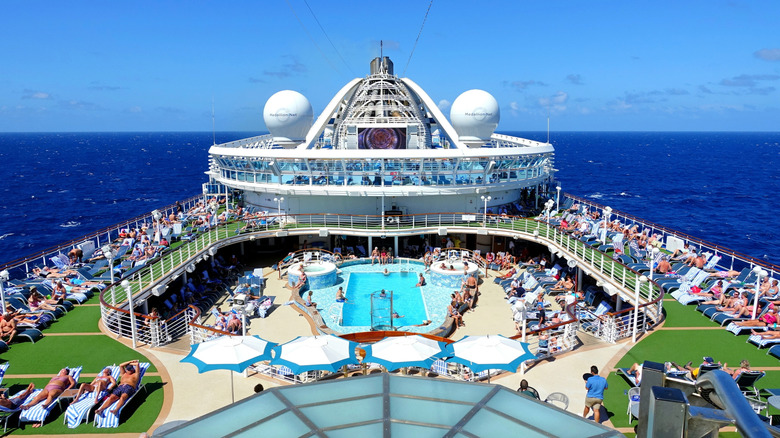
Norovirus isn't deadly for most healthy adults, but it can be extremely risky for people who are over the age of 65. Without proper care it can cause severe dehydration, which occasionally can result in death. Norovirus is often referred to as stomach flu, but it isn't the same thing as the influenza virus. It causes extreme nausea, stomach cramps, vomiting, and diarrhea and is often accompanied by a low-grade fever. Aches, pains, and headaches are also common symptoms. Once a person falls ill, the symptoms generally last from 1-3 days.
Norovirus is extremely contagious and symptoms come on quickly once someone is infected. People usually begin to feel sick between 12-48 hours after they were exposed. According to some medical experts, it is possible to contract norovirus from simply using the same bathroom as someone who was recently infected. People who are sick shed billions of billions of virus particles throughout the course of the illness. On cruise ships, where hundreds of people are eating together and using public restrooms, the virus can spread like wildfire. As an example, an infected staff member who was working in the kitchen could potentially get dozens of people sick unknowingly.
For many cruisers, the risk of illness on the high seas is well worth the reward. For others, the potential to catch a dangerous infection is one of their many reasons to never take a cruise.