

Scientists Reveal The Potentially Devastating Danger Beneath Yellowstone National Park
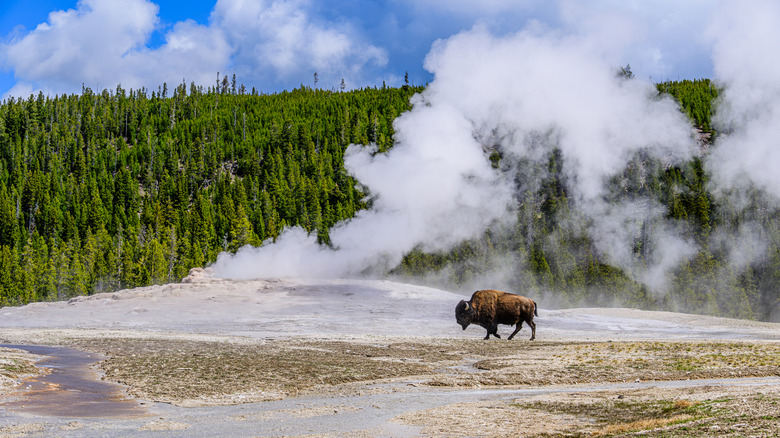
Yellowstone National Park is a regular fixture on many travelers' bucket lists since it was declared America's first national park back in 1872. Spanning over 3,500 square miles, it's one of the largest and most popular national parks in the U.S., and contains around half of the world's hydrothermal features. Geysers like Old Faithful shoot boiling water into the air on average every 90 minutes. Hot springs like Morning Glory Pool glow with multicolored waters and mud pots bubble away. With so much geothermal activity under the surface, it's no wonder Yellowstone is under constant observation.
The latest scientific research by the Institute of Geology and Geophysics of the Chinese Academy of Sciences (IGGCAS) has sparked headlines from publications like the New York Post about imminent eruptions, causing concerns that danger could be closer than previously thought. Rather than liquid-dominated magma chambers deep in the Earth's crust, scientists have identified a more complex magma system bubbling just underneath the surface. Despite popular belief, Yellowstone does not contain one volcano, rather, it is itself a supervolcano system. When you visit Yellowstone, you're essentially entering the Yellowstone Caldera, a 30-by-45-mile volcanic crater, created when a massive eruption emptied huge quantities of magma and caused the ground to collapse.
But despite alarming headlines predicting an imminent danger, there is still a very low chance of this newly discovered magma system wreaking havoc during your next visit to the park. That last supereruption that formed the current Yellowstone Caldera happened around 631,000 years ago. Since then, there have been many smaller eruptions, with the last lava flows around 70,000 years ago. Yes, Yellowstone is essentially an active volcano, but if it were to erupt, scientists would notice significant changes in geothermal and seismic activity. This is currently not the case. Yellowstone Volcano Observatory's current alert level remains normal and its aviation color code is green.
The real risks for Yellowstone visitors
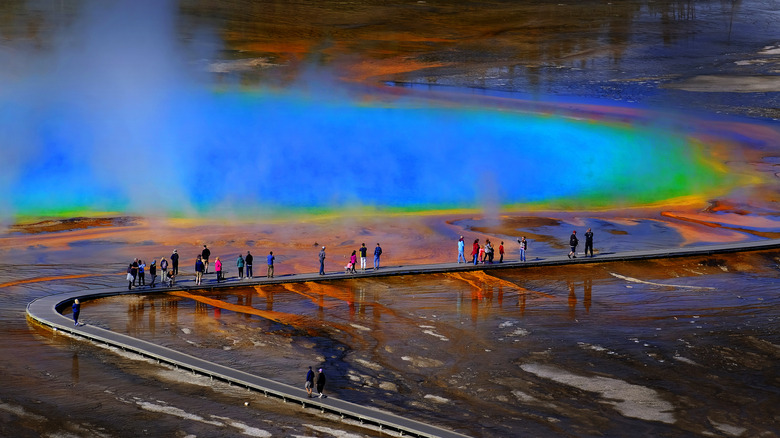
Geothermal features are caused by a combination of heat, water, and underground pressure from the active volcanic system below the surface. The most active areas around the geysers are where the heat is closest to the surface. While it was originally believed that Yellowstone was a ticking bomb waiting to erupt from large, deep chambers within the Earth's crust, findings from IGGCAS now reveal that the magma system is more spread out, being described as a "magma mush" system of molten and solid rock rather than one large liquid chamber.
While the remote possibility of another supereruption sounds scary, there are much more present dangers in the park due to geothermal activity that visitors should be aware of. Ground that looks solid can in fact have a thin crust with boiling water just below the surface, and steam explosions are a risk. Toxic gases in certain places can also make you feel a bit queasy. In 2024 at Biscuit Basin near Old Faithful, rocks, mud, and debris were thrown into the air during a hydrothermal explosion due to a build-up of pressure underground. While there were no injuries, it shows the unpredictability of the area and why safety should always be a priority.
Visitors should always stay on boardwalks and never get too close to hot springs and geysers. If there is unusual activity, areas will close as a precaution. If in doubt, always follow park ranger advice. While Yellowstone may erupt again one day, there are currently no signs the big one is coming, and a visit to the geysers is a must do if you only have one day in Yellowstone.