

Considering Full-Time Travel? Here's What Families Should Know Before Making The Switch
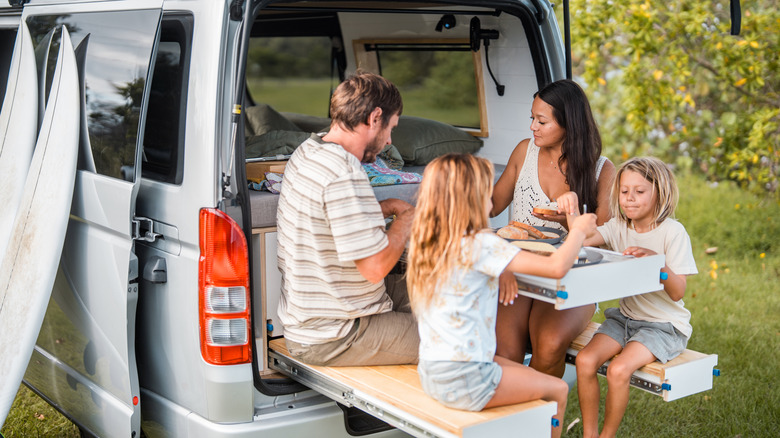
Imagine waking up with your kids in the South of France and wandering into town for some freshly baked croissants, or stepping out of your RV to explore the nearby hiking trails in a national park. Both sound like epic vacations, but what if you never had to return home? For families who opt to travel full-time, that's reality.
Traveling long-term with your loved ones may sound like a dream come true, and for some families it is. For others, the lifestyle ends up being temporary. Most full-time travelers with children agree that there is a lot you should be aware of before making the switch. Living a nomadic life has the potential to be extremely isolating, especially for children and teenagers who long to experience deep friendships. Adults may enjoy not having to deal with complicated relationships with co-workers, in-laws, and neighbors, but eventually parenting can become a struggle without a strong community.
When you are traveling full time with kids, you will need to serve as their parent, teacher, and friend. Along with ensuring their basic needs for food and shelter are met, you'll need to carefully consider a plan for their education and constantly reevaluate whether or not they are feeling fulfilled socially. You will need to find a way to make sure that every member of the family can have a reasonable amount of privacy and adequate access to healthcare with regular check-ups, teeth cleanings, and vaccines throughout your travels. If full-time travel is your dream, know that it isn't impossible, but according to multiple families who have lived the nomadic lifestyle with kids, it isn't always the fairytale they imagined it would be.
Finances
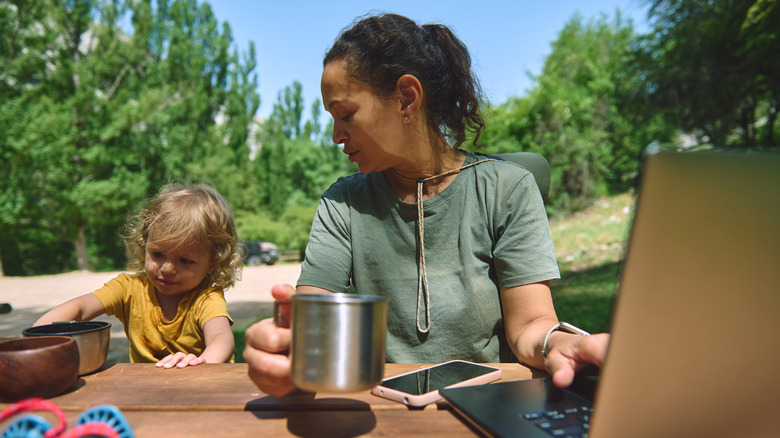
The cost of flights, accommodations, activities, food, and other necessities can really start to add up when you're traveling for more than a week or so. In order to travel full-time, you will need to budget carefully and avoid money-wasting mistakes when booking travel. Unless you are independently wealthy, you will also need to make sure that you have some type of steady income throughout your travels. Some people can work as digital nomads while others may choose to save up enough money, cash out investments, or use income from real estate ventures.
For some families, traveling full-time doesn't require much more spending than living a more traditional life at home. "I always say full-time traveling is like a substitute cost," a traveler named Jess said on her Jetsetting Family Travel Podcast. She went on to explain that instead of paying for rent or a mortgage, you're paying for an Airbnb or hotels. The cost of your car payment usually goes towards transportation. Instead of spending money on decor items for your home, you'll be purchasing tickets for experiences or excursions. Her husband Rod agreed. He added that traveling full time can limit your spending in some ways. As an example, he mentioned that it's hard to spend on clothes when you have limited space in a suitcase.
In the podcast, Jess and Rod also discussed the challenges of making a steady income while traveling. "Life on the road can be very chaotic and unpredictable. So if you are working remotely, that is a huge factor," Jess said. She explained that they would book accommodations that claimed to have Wi-Fi, but it didn't always work. "Read the reviews and look at what it says. But even then, it could have great Wi-Fi, but maybe that area of the world has constant power outages," she reminded listeners.
Education

Education should be a major concern for any nomadic family with kids. You will need to have a plan in place. Homeschooling is an obvious choice for many families who travel full-time, but it's important to consider exactly how that will work. Many families began traveling full-time during the Covid-19 pandemic when students were switched to virtual school. Kids were able to continue with their curriculum online, which made it easy for families to travel anywhere with Wi-Fi.
There are virtual programs available for homeschool students, but you are going to want to seriously consider whether or not that type of learning will work for your child. Some children are independent learners and can handle spending hours on a laptop doing their schoolwork. Other children are more hands-on and require experiences in order to fully understand their coursework. Some kids need constant supervision in order to stay on task. When I was in elementary school, before virtual schools existed, my parents homeschooled me so that we could travel for months out of the year. They would pack pounds of textbooks in our suitcases, and I was able to study and keep up with peers in my age group almost entirely through reading. It worked well for everyone until I got older. At some point, the coursework became complicated, and I needed more support than my parents could provide. They were forced to consider hiring independent tutors, which was very expensive, or placing me back in a traditional educational environment.
If you are opting for a more traditional homeschool environment instead of a virtual school, you will need to consider which parent will serve as the main teacher. If you're planning on working remotely and teaching your child simultaneously, that's going to be a lot on your plate. It may be difficult to balance all of the responsibilities while also traveling from place to place.
Privacy
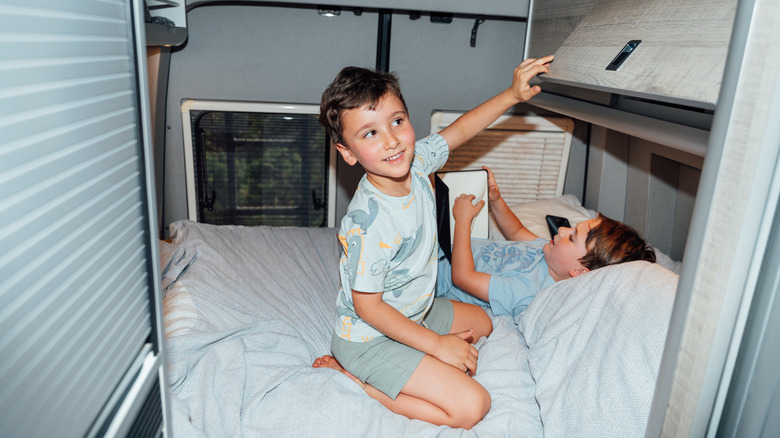
Privacy is something that most people value. It's particularly important for kids and teenagers to have some amount of privacy from their parents and siblings. You don't have to have children of your own to understand how crucial having privacy can be. Most of us remember times when we were growing up in which we felt as though we couldn't get away from our parents and siblings when all we wanted was a little alone time.
Families who are traveling together full-time often mention that a lack of privacy and space is one of the biggest challenges they face. In an article published by Business Insider, a former full-time traveler named Phil Lockwood discussed the reasons his family decided to leave nomadic life behind. When they decided to settle down in their new home, he was finally able to realize that traveling constantly had been difficult on his children. "After we stopped traveling full-time, our 11-year-old daughter, Brooklyn, became obsessed with her bedroom," he wrote. "After years spent in airports, hotels, and temporary spaces, this was the first place within her control," he added.
Having private time away from family is crucial for childhood development. As children grow, privacy helps them to develop personal boundaries, emotional regulation, independence, and self-identity, according to Psychology Town. It also helps to foster trust within family units. When you're traveling together day after day, alone time can be hard to come by. You'll need to carefully consider how you'll be able to provide the kids, and yourselves, with an appropriate amount of space. When you're sharing a hotel room for a short time, there are some clever hacks that offer instant privacy, but after a few weeks you'll need to develop a more permanent solution.
Social life

Adults and children are both likely to struggle with the lack of community that comes with life on the road. One of the things that the majority of full-time travelers mention as a downside to the lifestyle is that they lack a broader social circle for themselves and for their children. As a parent, there is no one around to offer you a break. The kids won't have a lot of options to entertain themselves or hang out with friends. Even if you are able to meet people and find other families to connect with during your travels, the relationships don't last because eventually everyone moves on. Kids are forced to say goodbye to their new companions over and over again, which can be painful.
"I think it's funny, the more we get to know our community, the harder it gets to leave due to friendships and connections made," Jess said on the Jetsetting Family Travel Podcast. "Traveling full time means you are stripping away and leaving a community of friends and family who can help to alleviate the stresses of parenting. You can't call a friend or babysitter to watch your kids for a few hours. You can't send them to their best friend's house so you can have two hours of quiet to decompress. Nope. It's just you guys," she added.
Phil Lockwood echoed a similar realization in his Business Insider article. "What I didn't fully appreciate was how much childhood depends on repetition — seeing the same faces, returning to the same places, building friendships that deepen rather than reset with new people every few weeks," he wrote.
Healthcare

A life of full-time travel is possible for families with special medical needs, but it may be difficult. If you or someone in your family requires daily medication, you are going to have to make sure that you have access to it while traveling. Every country doesn't offer the exact same types of medications, and the prices may vary drastically from place to place. You will need to plan carefully and find out where you can stop to refill along the way. If anyone in the family requires regular doctor visits, that's going to be another issue. You can visit clinics and hospitals while traveling, but you will have to explain your situation and needs each time you visit a new practice. Language barriers can be problematic. Primary care doctors don't always take new patients right away, so you may be limited to seeing doctors in hospitals, which can be expensive.
Even if you do your best to avoid getting sick while traveling, it's bound to happen at some point. Travel has bizarre effects on the human body, and it can weaken the immune system. Expecting to travel full-time without ever needing medical care isn't realistic. If you're traveling in a remote region or a developing nation, the quality of medical care available may not be what you're used to back home. Families from countries with universal healthcare might be shocked by the high cost of basic medical care while traveling in the United States.
Finally, you should make sure that you have a plan in place in case anyone in the family gets seriously sick or injured. Will you be able to afford long-term medical care abroad? If someone has to stay in the hospital for weeks or months, you will have to settle somewhere nearby for an extended period of time?
Methodology
To formulate our list of considerations for families who hope to travel full time, we researched primary sources like travel blogs and podcasts. We found examples of real families who had lived the nomadic lifestyle and shared about their experiences along the way. We also discussed some of our personal memories about what it was like to be homeschooled and travel full time as a child. Traveling for extended periods of time as a family can be a wonderful lifestyle, but it's important to be mindful of the many challenges.