

Why Doctors Warn Campers To Never Drink Rainwater
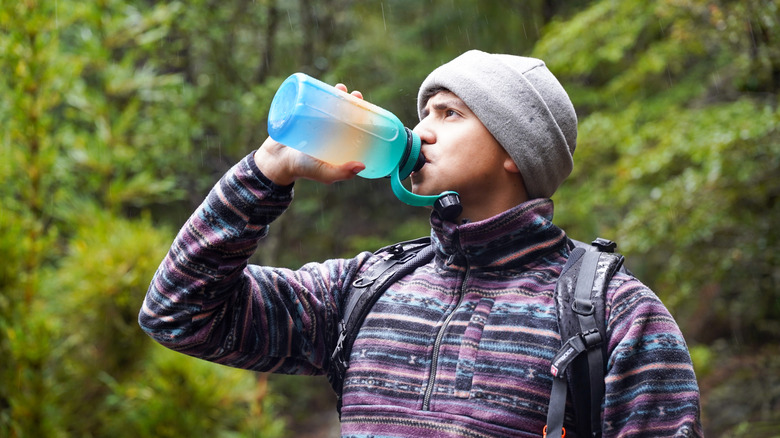
There was perhaps a time when you wouldn't have given a second thought about drinking rainwater. Especially when indulging in a spot of wild camping on wide open moorland, miles from anything resembling another being or building. So far from civilization, one would assume that the air you breathe and the water you drink would be as clean and as pure as can be. Alas, the latest research has burst that bubble and may make you think twice before breaking off an icicle from an old gutter and pretending it's an ice pop. Or sticking your tongue out to catch snowflakes. Yes, we've all done it and are still here to tell the tale.
But, just as doctors have warned about the dangers of eating snow, researchers at Stockholm University have also announced that rainwater is no longer considered safe to drink anywhere on Earth — even in the Arctic and Antarctica. Why? The reason is because of unsafe levels of per- and polyfluoroalkyl substances (PFAS), more commonly known as "forever chemicals."
These chemicals are entirely man-made and can be found in food packaging, furniture, carpets, electronics, and some shampoos and cosmetics. Basically, stuff we use in everyday life. These tiny, airborne particles travel through the atmosphere, making their way into the oceans, and have been linked to some serious health concerns. While not instantly dangerous, untreated rainwater is no longer considered safe to drink, even in the most remote and untouched corners of the globe.
Why rainwater isn't safe to drink
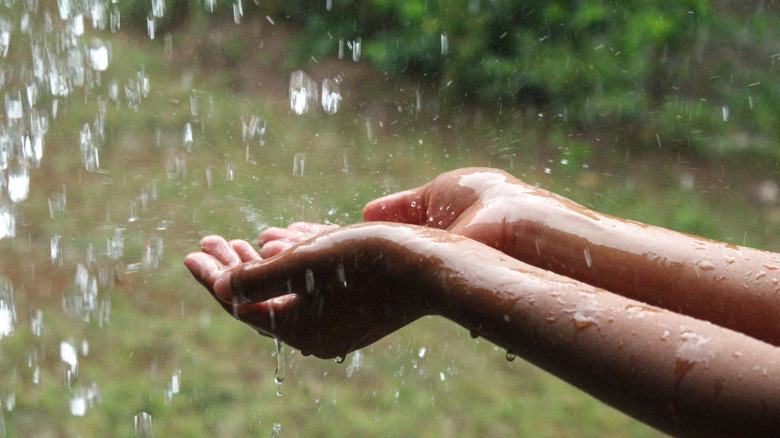
Exposure to PFAS, and in particular, perfluorooctanoic acid (PFOA), has been connected to some cancers, decreased fertility, and developmental delays in children. In light of these findings, U.S. drinking water guideline values have been significantly lowered, meaning the toxicity levels in rainwater are now above the recommended safety guidelines. As Dr. Ian Cousins, professor at the Department of Environmental Science at Stockholm University and lead author of the study, explains, "Based on the latest U.S. guidelines for PFOA in drinking water, rainwater everywhere would be judged unsafe to drink. Although in the industrial world we don't often drink rainwater, many people around the world expect it to be safe to drink and it supplies many of our drinking water sources."
But it isn't just PFAS we should be worried about in rainwater. There are all sorts of other pollutants in the atmosphere that eventually end up in water sources such as rivers and streams. Tiny microplastics end up in rainwater, as do heavy metals such as arsenic, lead, and mercury, particularly near industrial areas — something you should consider when choosing the right place to camp. Other contaminants such as viruses, bacteria, and parasites or debris from bird droppings, leaves, twigs, and insects are washed by rainfall into streams and collection points that campers often rely on. This can make water unsafe to drink, especially if it's been sitting for a while.
How to make rainwater drinkable while camping
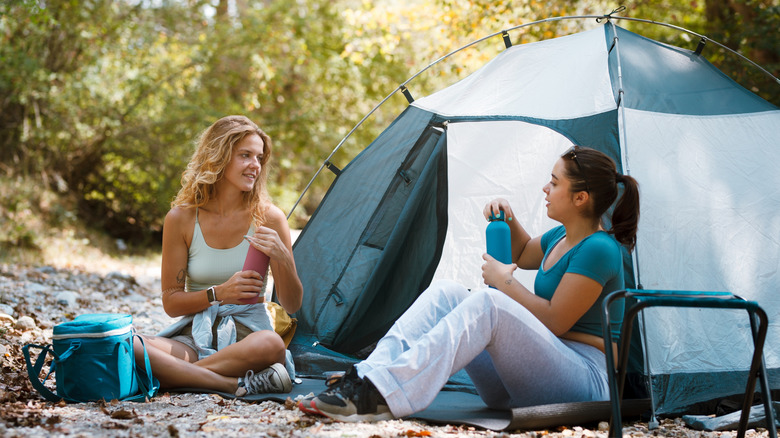
There are steps you can take to make rainwater safe to drink. While the following methods are not always practical, especially when camping in a remote location, the aim is to make the water as safe as possible. That said, the only way to effectively remove PFAS from rainwater is by reverse osmosis, where water is forced through an ultra-fine membrane. The downside is that you need special equipment, which is bulky and not at all convenient when all you're carrying is a light backpack. However, it's very effective and also removes heavy metals, microplastics, bacteria, viruses, and parasites.
Other solutions include boiling, charcoal filters, iodine tablets, UV purifiers, and portable filters. While these methods will not remove PFAS, they at least provide some protection. For most campers, one of the best options is a lightweight water filter, with some models able to remove 100% of bacteria and microplastics. Small and light, they're easy to carry without weighing you down, especially when carrying bottled water just isn't possible.
Boiling water will kill bacteria, parasites, and viruses, as do UV purifiers, but they won't get rid of chemicals or microplastics. Charcoal filters can reduce some chemicals and plastics and improve taste. Portable filters such as Life Straws, which work by forcing water through tiny hollow fibers, provide strong protection against parasites and some bacteria, but viruses and most chemicals will slip through. Iodine tablets are not as effective and should be used as a backup rather than a total solution.