

One Of Bob Dylan's Favorite Destinations Is An Iconic Southern City Full Of Music
From 1988 to 2013, music legend and Nobel laureate Bob Dylan played shows in more than 800 cities, according to Bloomberg. That's just one 25-year stretch of a career that's spanned over six decades. Dylan was on the road often even before '88 when he embarked on what the press calls his "Never Ending Tour," the same year he was inducted into Cleveland's Rock & Roll Hall of Fame. Since then, the troubadour who made rock history with a song about someone living "like a rolling stone" hasn't let up much, so he's had the chance to visit — and revisit — many places around the world. However, there's one ever-popular, southern U.S. city that Dylan singled out for special praise when looking back on his career. In his 2004 memoir, "Chronicles: Volume One," he wrote, "There are a lot of places I like, but I like New Orleans better."
Dylan hasn't played New Orleans as often as he's played New York City, where he first burst onto the folk music scene in Greenwich Village in the early 1960s. In his memoir, nonetheless, he romanticized New Orleans the way only a fresh-eyed visitor can. For the recording of his 1989 album "Oh Mercy," Dylan wrote that he had "moved into a large rented house near Audubon Park," a green oasis of live oak trees that's accessible via the historic St. Charles streetcar line. Some of the impressions he formed during that time might be shared by fans whose own travels have brought them to New Orleans.
In "Chronicles," Dylan spoke of how the Big Easy never gets boring, writing: "New Orleans, unlike a lot of those places you go back to and that don't have the magic anymore, still has got it. Night can swallow you up, yet none of it touches you. Around any corner, there's a promise of something daring and ideal and things are just getting going."
Jazz and cemeteries in New Orleans
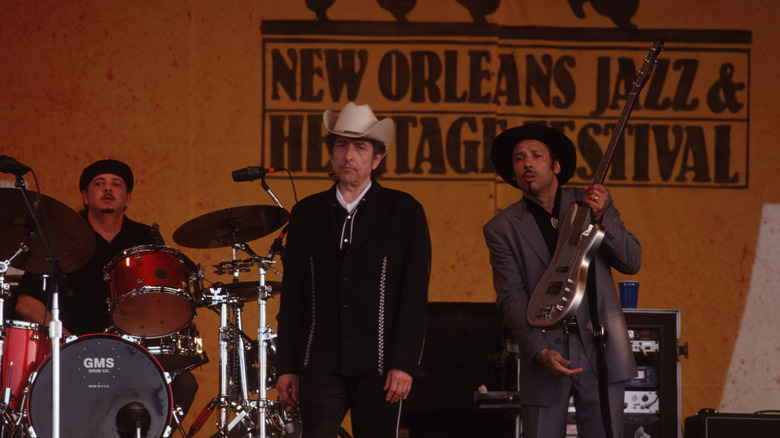
It's not surprising that Bob Dylan would be drawn to New Orleans, given the city's place in music history. It's there that you'll find the birthplace of jazz, which has been called the only original American art form. Dylan connected to that rich New Orleans musical history when he performed at the annual Jazz & Heritage Festival, a.k.a. Jazz Fest, on the Fair Grounds Race Course. Over the years, he's also played venues like the Saenger Theatre and the House of Blues, two of the most iconic places to see live music in New Orleans.
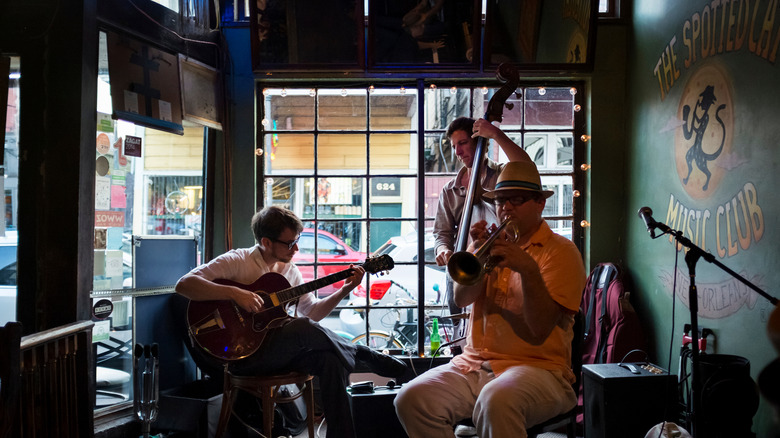
A former movie palace, the Saenger Theatre is now on the National Register of Historic Places. Like Jazz Fest, with its headlining performances by the Eagles and Stevie Nicks, it continues to host some of Dylan's '60s and '70s contemporaries, such as Santana and Robert Plant. Elsewhere outside the French Quarter, in smaller Frenchmen Street clubs like the Spotted Cat, you can go deeper into the city's thriving music scene and hear local artists capture its spirit the way they do best.
One site integral to jazz's development in New Orleans is Congo Square, where enslaved people once gathered to participate in African dancing and drumming rituals on Sundays. Congo Square is part of Louis Armstrong Park, named for the jazz pioneer who sang "What a Wonderful World." The park is located near St. Louis Cemetery No. 1, where you can take a guided tour to see another side of the city that Dylan appreciated. In "Chronicles," he wrote, "The first thing you notice about New Orleans are the burying grounds — the cemeteries — and they're a cold proposition, one of the best things there are here." The scene he described of ghosts "living in tombs" matches local "cities of the dead" — cemeteries where the tombs are above-ground, due to the city's high water table, low elevation, and French and Spanish architectural roots.
New Orleans' history through Dylan's footsteps
If you're not looking to rent a house and record an album in New Orleans, you can still follow in Bob Dylan's footsteps by staying at the Hotel Le Marais on Conti Street. Back when it was called the Marie Antoinette Hotel, this is where Dylan first met producer Daniel Lanois, who would work with him on the "Oh Mercy" album and help revive his career. Today, you can still sit poolside in the courtyard where they did.
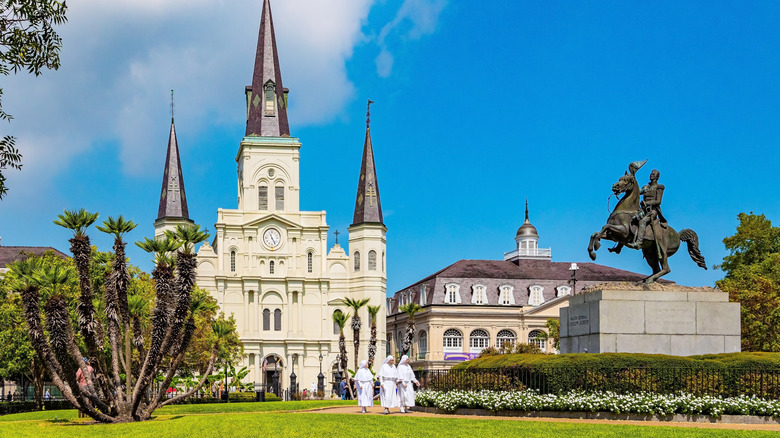
Writing about New Orleans, Dylan also mentioned "a town square where public executions took place." This is a reference to Jackson Square, which was once a site for hangings, though it's now a National Historic Landmark that receives over two million annual visitors. With St. Louis Cathedral looming over an equestrian statue of future U.S. president Andrew Jackson, the square serves as both an emblem of the city and a reminder of its dark past. Take a jazz cruise down the Mississippi River on the Steamboat Natchez, which docks near the square, and you'll see another place Dylan visited, the Chalmette Battlefield. It's where Jackson, as a general, led American forces to victory during the Battle of New Orleans in 1815.
Even after publishing his memoir, Dylan has continued writing about New Orleans through the outlet of social media. When he started tweeting in late 2024, one of the first things he wrote on X was, "Last time in New Orleans we ate at Dooky Chase's Restaurant on the corner of North Miro and Orleans. If you're ever there I highly recommend it." This Creole restaurant, a Bib Gourmand selection in the Michelin Guide, serves up a slice of history with its red beans and rice. In the 1960s, as the young, socially conscious Dylan rose to fame, civil rights leaders like Martin Luther King, Jr. were meeting to discuss their cause at Dooky Chase's in New Orleans.