

9 Lesser-Known Facts About The Seven Wonders Of The World
To the Ancient Greeks, the number seven held special meaning. They saw seven wandering objects, or planets, in the sky — the five visible with the naked eye alongside the sun and moon. They catalogued seven seas. The Pleiades star cluster was known as the seven sisters, education of Spartan children began at 7, and yes, there were, according to most scholars, seven Wonders of the Ancient World. By the time the final canonical list arrived in 1572, an eighth wonder — this time of the modern variety — was included as an addendum: the Colosseum in Rome took its place as the first of the seven modern wonders.
Other additions had to wait several hundred years to find themselves a place in the spotlight. The revised listing arrived in 2007. The new compilation was, naturally, far more global in scope. Europe was represented by its famous Roman amphitheater. North America had Chichén Itzá in Mexico, South America was blessed with the statue of Christ the Redeemer in Brazil, and Machu Picchu in Peru. The Indian subcontinent boasted the magnificent Taj Mahal, while to its east, the masterpiece of construction that is the Great Wall of China took its place in the list of Wonders. The ancient city of Petra, in Jordan, secured a spot for the Middle East. Meanwhile, Africa remained at least somewhat represented thanks to the simple fact that Egypt was still in possession of the only surviving ancient wonder, the Great Pyramid of Giza.
Each site was more than worthy of the honor bestowed upon it, thanks to the rich history, brilliance of design, and the sheer spectacle they offered to those who visited them. Still, some truths about them are less well-known than others. Here are nine such lesser-known facts.
The Great Wall of China cannot be seen from space
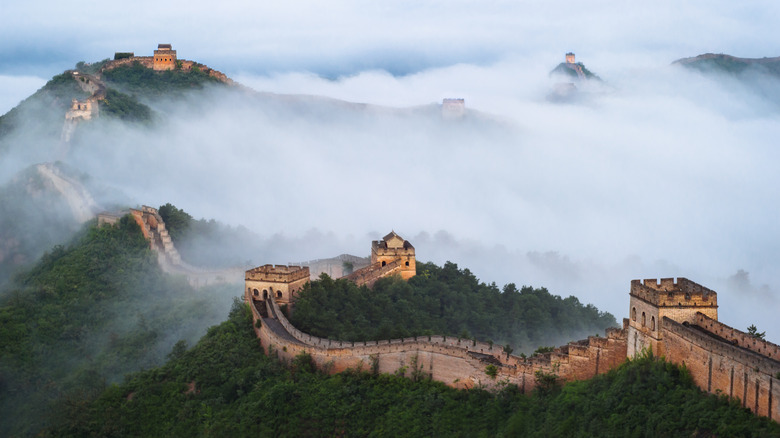
The far north of England may be a least favorite region for some veteran travelers, but few would argue that Hadrian's Wall in the United Kingdom is not worth a visit. The 73-mile-long wall once spanned the breadth of Britain and was designed with one purpose in mind: to keep the unruly Scottish clans on their side of the border. Construction began in 122 A.D. and took around six years to complete. Half a world away, the Chinese came to a similar conclusion about the best way to deal with unruly neighbors. Their first attempt was of limited scope, went up around 680 B.C., and was a herald of greater things to come. In 220 B.C., the Emperor Qin Shi Huang instructed his subjects to expand the project into a single unified structure.
To say the Great Wall is the largest of the modern wonders would be something of an understatement. The wall stretches across the historic borders of China, beginning in Jiayuguan in China's northwest, and continuing all the way to the east, where it meets the Bohai Sea. Upon its completion — a task that took some two millennia — the wall measured over 13,000 miles long, making it the largest feat of engineering in human history. Even so, it cannot be seen from space.
The idea that it could be dates to the 18th century, during a time when the idea of traveling into the ether was a mere fantasy. Famed English polymath William Stukeley's speculation that the wall might be visible from the moon was equally fanciful. The truth of the matter had to wait until the dawn of the space age, when multiple observers, including the Chinese-American astronaut Leroy Chiao, confirmed that the wall simply could not be seen with the naked eye.
Petra's famous treasury doubled as a tomb
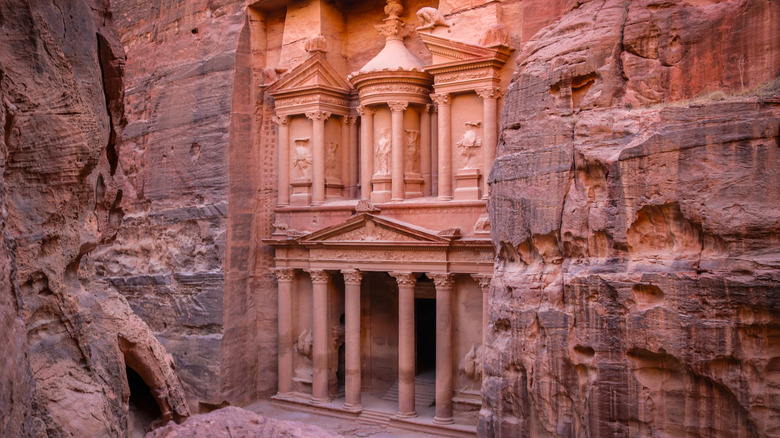
Jordan lies nestled against the eastern shore of the Dead Sea. To its south, the Gulf of Arabia stretches out toward the Red Sea. To its north, the city of Amman — one of the best-kept secret travel destinations in the world — rises from the desert like a crown of sandstone ruins, bustling bazaars, and glistening minarets. And, some 150 miles south of the capital, sits a 2,000-year-old metropolis that was literally carved into existence.
Construction began during the fourth century B.C., when the Nabataeans, an Arab tribe with a penchant for the nomadic life, moved into the area for the first time. The local red sandstone was easy to work with and gave the entire complex a pinkish hue. The dry desert air and its remote location allowed the city to survive the tides of history in a remarkably well-preserved state. By the second century B.C., the Nabateans had grown wealthy thanks to the caravan trade in spices and silk that began to flourish during that time. By the time the turn of the next millennium rolled around, Petra had become a thriving hub of commerce and an essential component in the Silk Road's success. At its height, as many as 20,000 people may have called Petra home. An earthquake in 363 A.D. did considerable damage, and by the seventh century, the city lay more or less abandoned, save for the presence of a few Bedouin tribes.
Interestingly, the city's most famous monument, the 140-foot-tall Al Khazna (or treasury), may not have been designed with hoarded wealth in mind. In 2024, 12 skeletons were discovered in a tomb beneath the site, offering further evidence that the building was, in fact, more likely used as a mausoleum and a place of funerary significance.
Petra, in Jordan, is mostly unexplored
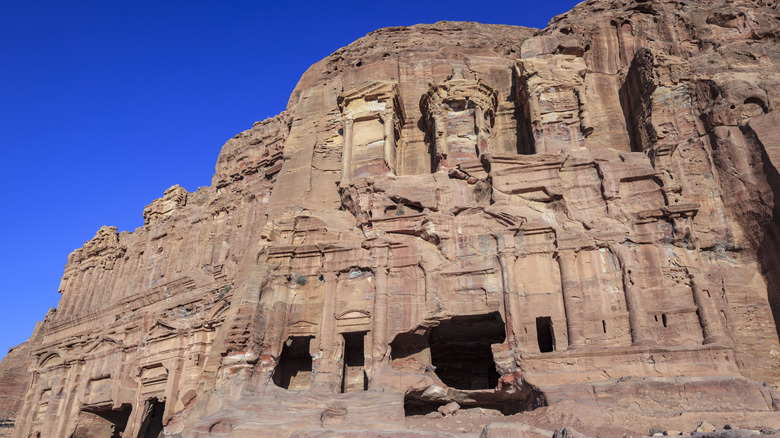
The stunning red-rocked future filming location lay hidden from Western eyes in the desert for many centuries before its rediscovery in 1812. An explorer from Switzerland by the name of Johann Ludwig Burckhardt entered the complex disguised as an Arab, and upon learning of his findings, European scholars wasted little time embarking on explorations of their own. By the late 19th century, systematic archaeological surveys began in earnest, and in 1985, Petra was granted UNESCO World Heritage status.
Early on, archaeologists became aware that the complex itself was deceptively vast. The original builders dug deep and included in their design a network of pipes and water-carrying tunnels designed to both prevent flooding and grant access to fresh water. Even after literal centuries of study, the site continued to yield secrets. In 2003, several new tombs were uncovered beneath the treasury as teams of scientists set to work clearing out debris from promising locations. Many tunnels, presumably collapsed by the ravages of time and multiple recorded earthquakes, remain unopened, let alone fully investigated. To date, an estimated 80% of the complex has yet to be subjected to professional exploration efforts.
The Taj Mahal is designed to be earthquake-proof
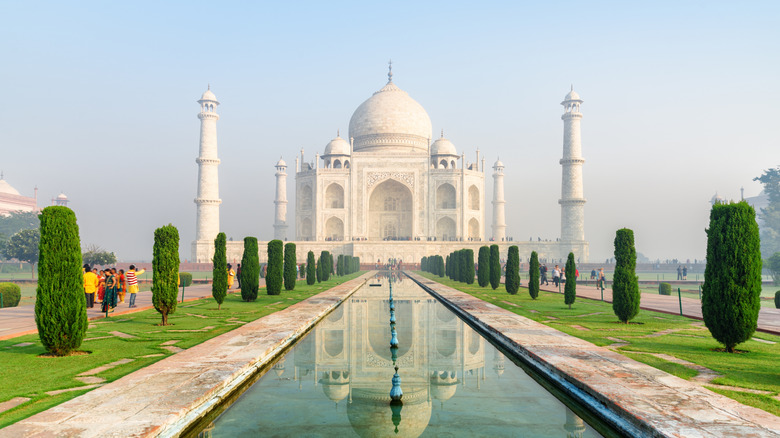
When the Persian Satrap Mausolus died in 352 B.C., his tomb was so opulent that its creation introduced a new word into the Greek vocabulary. His mausoleum overlooked the city of Halicarnassus, in what is now modern-day Turkey, and its sheer beauty and magnificence granted it a place on the list of the Seven Wonders of the Ancient World. It stood for centuries before succumbing to a series of earthquakes between the 11th and 15th centuries. Soon after, a mausoleum of even grander design entered the popular imagination.
The first stones were laid down in 1631, and the project ultimately required the labor of 20,000 people working alongside 1,000 elephants, taking two full decades before it was completed. Commissioned by Emperor Shah Jahān to house the remains of his most cherished wife, the Taj Mahal became a symbol of undying love, the excesses of imperial power, and a testament to the brilliance of human ingenuity. Built out of pure white marble, the 200-foot-tall structure is inarguably the finest example of Mughal architecture the world has seen, or indeed will ever see. Granted UNESCO World Heritage status in 1983, today the tomb attracts 7 to 8 million people annually. Suffice to say, it gets a little crowded, although noting that it is always closed on Fridays is another thing you should know before planning to visit the Taj Mahal.
Whether its architects were aware of the fate of the Mausoleum at Halicarnassus or not is open to historical debate. Regardless, they took pains to ensure that their masterpiece would survive any and all seismic activity. Its foundations are deliberately spongy. Its minarets lean in such a way that if they fall, they will fall outward, while the delicate balance of its famous cupola renders it resistant to sudden shocks.
The Colosseum originally had a retractable roof
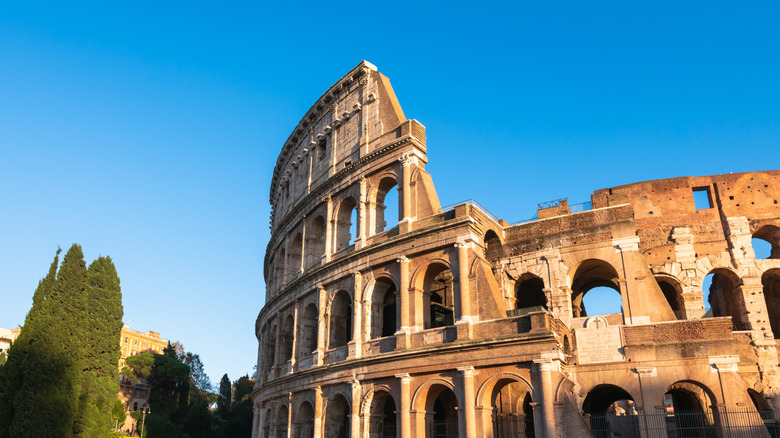
The Emperor Vespasian might not be as instantly familiar as some of the more infamous members of the Roman aristocracy. Less volatile than Caligula, lacking in the sheer brutality of Nero, and less interested in conquest than either Caesar or Trajan, he is known today primarily for one thing. He built the Colosseum. Or rather, he had it built for him.
The structure was commissioned in 70 A.D. and took only two years to complete. Officially titled the Flavian Amphitheater — in honor of the dynasty to which Vespasian belonged — it was designed to be a place of blood sports, gladiators, and one half of the eponymous bread and circus dichotomy that the Roman citizenry so thrived upon.
Today, much of the complex lies in ruins, although it is still possible to go behind the scenes for a very eerie and underrated tour. During the height of the empire, however, the Colosseum could seat as many as 80,000 spectators. The arena's fate was, of course, tied to the fortunes of the empire itself. Gladiatorial combat within the structure ended in 435 A.D., just a few short decades before the collapse of the entire western half of the empire. One feature that most assuredly did not survive the passage of time, however, was the retractable roof. Technically more of a ring-shaped awning, the Velarium, as it was known, could be rolled out to provide shelter for the audience, protecting them from both sun and rain while still allowing the contestants to remain lit by the sun above.
Chichén Itzá was designed to sound like the call of a sacred bird
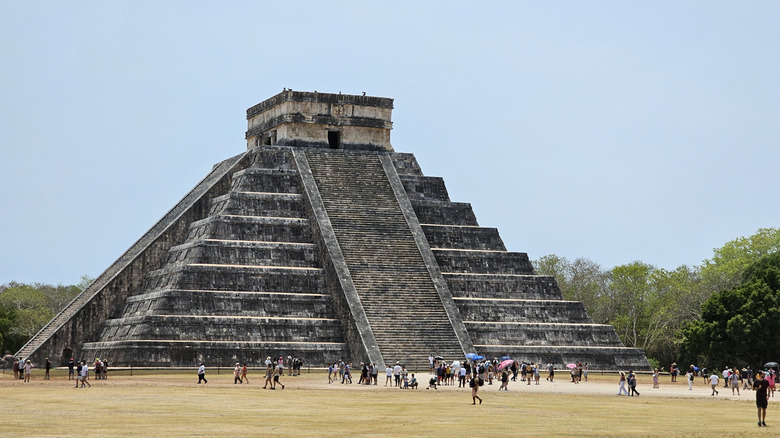
The Mayan people turned to agriculture around 1,500 B.C., and by the time the millennia ticked past the second century A.D., they had begun congregating in cities. At the height of the empire, some 40 of these cities stretched out across what is today parts of Mexico, Guatemala, and Belize. Chichén Itzá was one such city. Situated on the Yucatàn peninsula, just over two hours' drive from what is now Playa del Carmen — currently one of the 10 best budget-friendly destinations to fly to — the city rose to prominence during the ninth century A.D. At its heart stood the Pyramid of Kukulkán. It still stands to this day, and, for those who get the chance to visit, it is more than prepared to offer an echo of its spiritual past, laced with mystical timbre.
The Quetzal, also known as the Resplendent Quetzal, was a sacred bird to the Mayan people. It was closely associated with Kukulkán, a powerful deity who took the form of a feathered serpent. Kukulkán was able to influence the weather and was, as such, of great importance to the mostly agrarian society he presided over. The pyramid was built to both honor and worship him. The famous echo that rings out from those who stand before Kukulkán and clap their hands together contains within it a distinct chirping sound that mimics the call of the sacred bird. Archaeologists continue to debate whether or not the sound is a happy coincidence or the product of a deliberate, and unbelievably precise design. Regardless, the sound is a compelling enough reason to visit the ancient city in and of itself, and arriving early in the morning to test the theory for yourself is as bucket-list-worthy as it comes.
Chichén Itzá's famous snake shadow is no happy accident
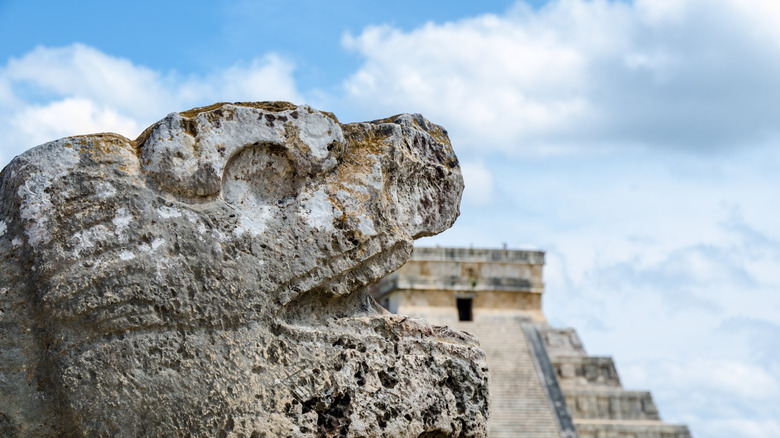
The calling of a sacred bird is not the only secret the UNESCO World Heritage Site has to offer. The exact age of the Pyramid of Kukulkán remains a mystery, but it is thought to be at least 1,000 years old. With a height of 78 feet and a 182-foot-wide base, the pyramid has exactly 365 steps, a number that gives an obvious clue as to its intended purpose; it was designed to be used as both a calendar and an observatory. Data gleaned from the movement of the sun and moon above allowed the Mayan people to calculate the best time to plant and harvest their crops while also granting them the opportunity to mark important days of special religious significance.
One such day was the equinox, an event that the Mayans understood marked the changing of the seasons. Each year, twice a year, the day and night cycles equalize, and on those days, those standing before the Pyramid of Kukulkán are treated to a lesson in Mayan architectural brilliance. As the sun dips below the horizon, a shadow, reminiscent of a slithering snake, makes its way down the structure's many steps.
It's tempting to imagine the ancient Mayans projecting the image of the feathered god Kukulkán upon the site as they gathered to witness the coming of spring and the waning of summer. The mathematical and astronomical precision needed to build such an effect into the very design of the building is, even to this day, a spectacular feat of ingenuity. Indeed, even if the effect was a simple if serendipitous quirk of fate for those who gather to bear witness to the phenomena each equinox, it remains a true wonder of the world.
Christ the Redeemer is something of a lightning rod
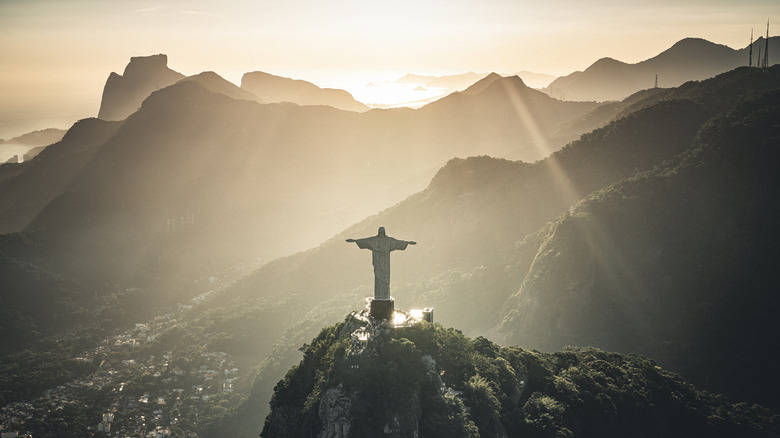
There are many things you should never do when visiting Rio, but declining to make the trek up to the statue of Christ the Redeemer is not one of them. The largest art deco statue in the world, it is close to 100 feet tall, its outstretched arms are almost as long, and it sits perched atop Corcovado Mountain, which towers some 2,300 feet above the city. It's a trek to get to the top for sure, and taking a train or guided tour to the summit comes highly recommended.
A priest by the name of Pedro Maria Boss conceived of the idea to create a Catholic monument atop the mountain during the mid-19th century, but many years would pass before his idea came to fruition. In 1922, the statue's foundations were laid down, and an engineer called Heitor da Silva Costa submitted the winning design in a national competition. A French sculptor by the name of Paul Landowski made some alterations to the brief, most notably the decision to include the iconic arms spread wide gesture. In 1931, after five years of construction, the statue was opened to the public.
Despite the fact that the sculpture is built of reinforced concrete covered in soapstone tiles, it turned out to be something of a lightning rod. The statue is struck by lightning, on average, between three and five times a year, and although most strikes leave the monument unblemished, there are exceptions. In 2014, lightning struck the statue's right hand, damaging two of its fingers and necessitating several months of repairs. Just nine years later, the head was engulfed in a huge blast of electricity in stunning footage that went viral across the globe.
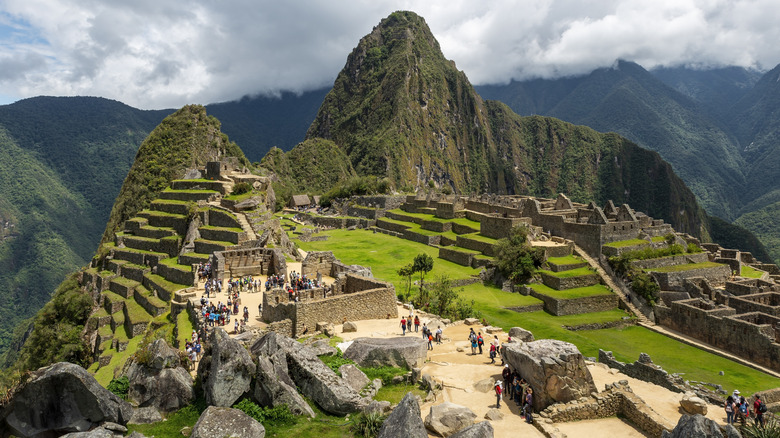
Machu Picchu holds a stone that perfectly aligns with the four cardinal points
By the time the Spanish arrived in what is now Peru, the Inca civilization encompassed an empire containing some 12 million people, had built thousands of miles of roads, and left a legacy that is still shrouded in mystery to this very day. And few places are more mysterious than the ancient city of Machu Picchu.
Located just over 5 miles from the town of Aguas Calientes at an elevation of close to 8,000 feet above sea level, the city was once used as a royal retreat and was probably built sometime around the 15th or 16th century. Today, over 1.5 million tourists visit the site each year, and although there are less-crowded and equally ancient cities worth visiting nearby, Machu Picchu alone was granted the title Wonder of the World.
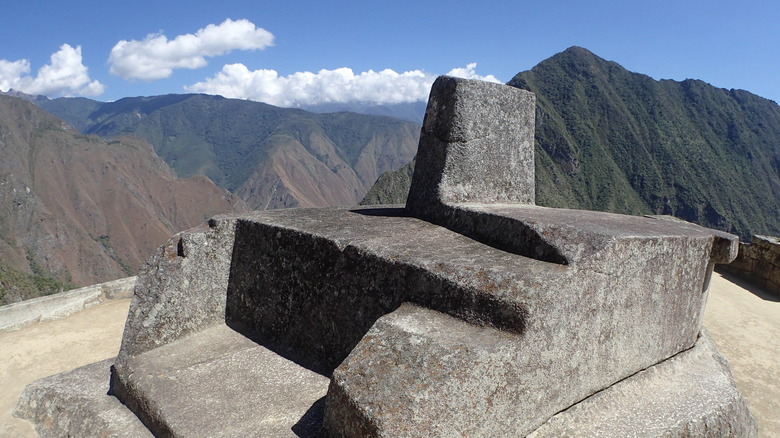
The Spanish conquistadors never found the city, and consequently, it was spared the fate of so many other Inca sites that fell to their excesses. Its design has fascinated archaeologists ever since its rediscovery by Western scientists during the early years of the 20th century. And one item in particular drew more attention than any other. The Intihuatana Stone is a sight to behold. It was used to observe and mark both the summer solstices and the equinox, but it almost certainly held some special religious and ceremonial significance. It also served as a compass, albeit a static one; as the sun rises over the carefully sculpted surfaces of the stone, the shadows align with the four cardinal points with astonishing precision. At noon, the shadow of the stone disappears completely, a phenomenon that too, was certainly a function of design rather than a happy accident.
Methodology
The amount of attention garnered by achieving World Wonder status guarantees a wealth of information available to those who are willing to dig through it. Archaeological papers, official UNESCO World Heritage websites, and summaries from respected journals such as the Encyclopaedia Britannica formed the basis of our list. Emphasis was placed on a some of the lesser-known details of the seven sites, and an effort was made to debunk commonly held misconceptions while also providing a frank overview of those occasions when the jury is still out on specific details.