

Rick Steves' Tour Guide's Favorite Town In France 'Ticks All The Boxes' For Travelers
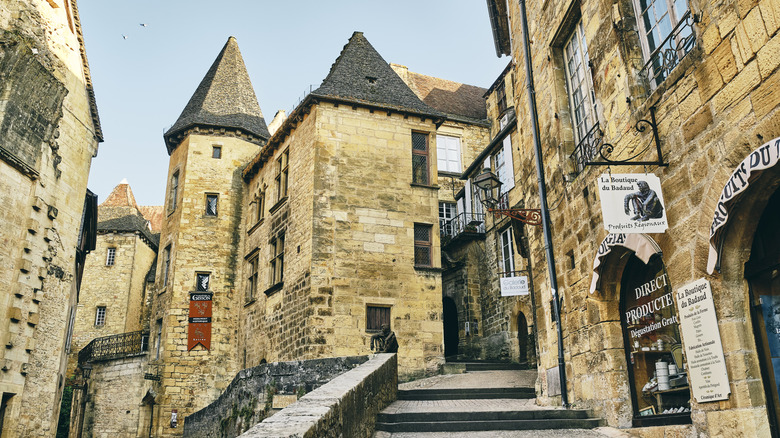
Walking through its maze of ancient cobbled streets framed by elegantly carved golden sandstone walls, and the occasional classic French turret peeking out overhead, it's hard not to fall in love with Sarlat-la-Canéda. Set in one of Europe's most exciting countries to explore, this rural town in western France is one of the most well-preserved examples of a 14th-century settlement in the whole country.
Rick Steves' tour guide Steve Smith clearly thinks it's sensational, describing Sarlat as "a beautiful place to be". Lying in a lush, green, forested valley in the Dordogne, in the heart of the Perigord Noir — one of France's most charming regions, it's easy to see why Sarlat is called the Town of Art and History. The exceptionally well-preserved Medieval and Renaissance architecture lining the streets and squares of the historic center make Sarlat a rare beauty where history, culinary delights, and a welcoming atmosphere come together in one highly walkable place.
Sarlat impresses with intriguing layers of history preserved within its sandstone walls. Built around a Benedictine abbey in the 9th century, Sarlat gradually grew into a wealthy town. Unlike many French towns, it suffered little damage during the Hundred Years' War, and many of the Medieval buildings remained intact. During the Renaissance, in the 15th and 16th centuries, wealthy nobles and merchants added elegant townhouses alongside the older buildings, creating the beautiful blend of styles still standing today. With 77 protected monuments, Sarlat-la-Canéda has one of the highest concentrations in France, and is listed on the Tentative List for UNESCO World Heritage classification.
Visiting Sarlat-la-Canéda
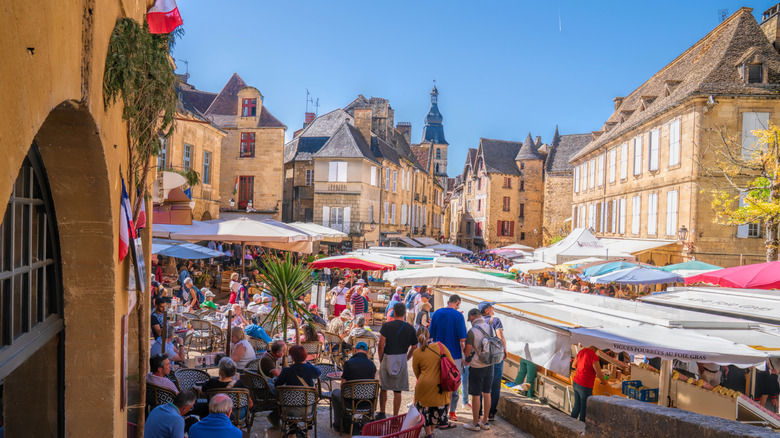
The beauty of Sarlat-la-Canéda lies in simply wandering through its maze of cobbled streets and imagining what life was like for those who lived behind the golden facades, discovering hidden corners, ornate stonework, and quiet courtyards that transport you back in time. For a tantalizing glimpse backward, visit the impeccably renovated Manoir de Gisson or the handsomely decorated Maison de la Boétie. You may want to make the large and well-stocked tourist office your first port of call to help you decide which buildings you'd like to explore first.
The Sarlat-la-Canéda Market is not to be missed, and is famous for its fresh local produce and quaint little stalls that line up along the mostly walkable town center. The focus here is on food, and you'll find plenty of gourmet delights in this region that's known for its walnuts, truffles, and foie gras, which Smith describes as "the raison d'être of the area".
On Wednesdays and Saturdays, the town becomes a feast for the senses, filling the air with the appetizing smell of freshly baked bread and fresh fruit and vegetables. The Church of Sainte-Marie opens its enormous doors every day, not for service, but as a covered market where artisans sell their wares. The church also surprises with a decidedly modern lift inside the converted bell tower, providing a spectacular panoramic view over the rooftops, accompanied by a brief history of Sarlat.
Getting to Sarlat-la-Canéda and nearby highlights of the Dordogne
Despite its rural setting, Sarlat-la-Canéda is conveniently placed when it comes to transport options, sitting near a major crossroads linking Paris, Toulouse, and Bordeaux. This is handy if you're arriving by car, especially if you want to visit the more out-of-the-way sites. But this convenience soon becomes a nuisance in high season, when roads can be blocked for hours. Luckily, Sarlat also sits on a direct railway line, taking around two and a half hours by train if you're arriving from Bordeaux. There are two airports nearby, one at Brive-Vallée de la Dordogne, about a 45-minute drive away, and another at Bergerac Dordogne Périgord, roughly an hour and a half away.
While Sarlat itself makes a wonderful base, with plenty of hotels and restaurants to keep you going, it's worth heading out of town to some of the other nearby sites. The surrounding area is one of the best places in France to see prehistoric art. While Lascaux may be the most famous of them all, you only see a replica rather than the real cave. But, at Grotte de Rouffignac, you can see the real thing, with original cave engravings dating back to around 13,000 years.
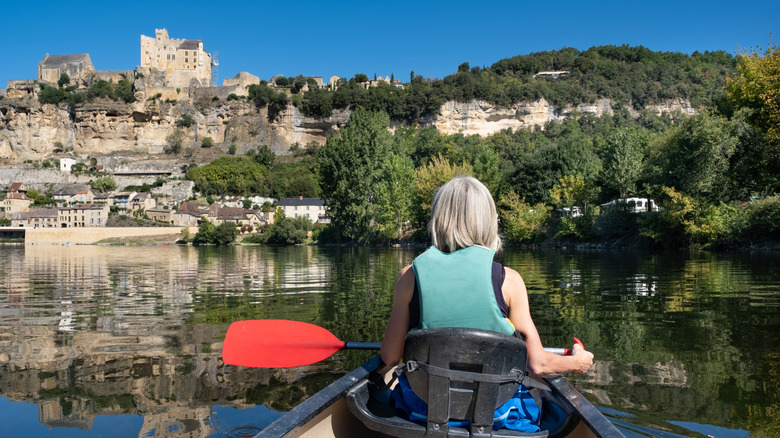
You'll need to book ahead, though, as visitor numbers are limited to protect the site. The Dordogne is also home to nine of the Plus Beaux Villages de France , and what better way to admire their beauty than floating down the Dordogne River by kayak. La Rocque-Gageac, Beynac-et-Cazenac, and Castelnaud-la-Chapelle all tower over the river, and if you hire a kayak at Carsac-Aillac, only around six miles from Sarlat, you can do some village-hopping in a more relaxed way.