

Avoid An Awkward Encounter In Japan By Following This Etiquette When Receiving Compliments
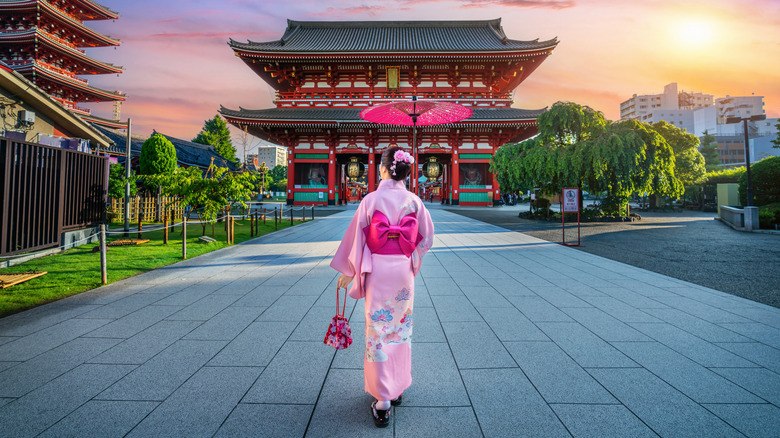
Coping with culture shock (which is a surprising or awkward feeling one tends to get when encountering unfamiliar or foreign customs) is something nearly every tourist faces abroad. The strange feeling could be about some unique things the locals do, how they do them, or the meanings attached to them — from food to dressing to gestures. As such, what feels polite in your own country could come across as disrespectful or arrogant in another, like how keeping your hands in your pockets can be offensive in some countries.
In Japan specifically, the way you handle compliments goes a long way in determining your level of humility or modesty. Unlike in the United States, where compliments are seen as a gift to which people respond with a "thank you" and a smile, such is not the case in Japan. That seemingly innocent thank-you response could be considered boastful. As the Redditor Haru1st puts it (via r/Japanese), "The regular regular response is to humbly deflect." This simply means that whenever you visit Japan and someone praises your outfit, your language proficiency, or any other thing, your best response would be to say something that pushes the praise away from you.
Why modesty is important in Japanese culture
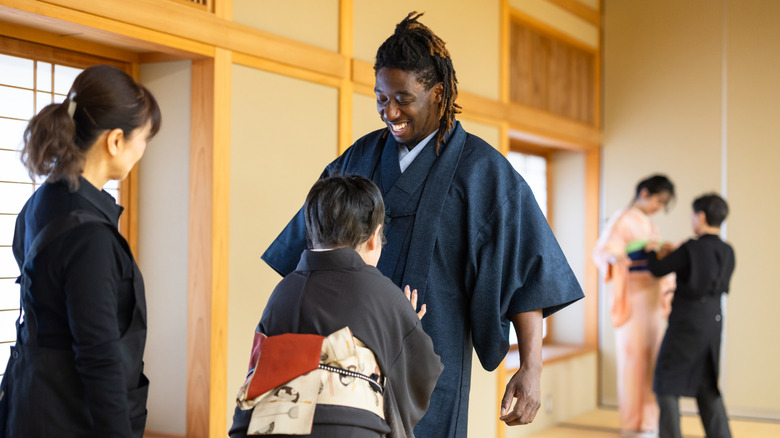
One of the things that sits comfortably in the heart of Japanese culture is modesty and mutual respect. And this is largely based on the concepts known as enryo (restraint) and wa (harmony). The expectation is that you avoid drawing attention to yourself and rather view things with a collective mindset while being sensitive to other people's feelings. So, instead of accepting a compliment and taking all of the spotlight, the culturally modest and polite thing to do is to gently deflect. To achieve this, you could just soften the compliment or even shift the credit to someone or something else.
This culture is so ingrained in Japanese society that the people do it instinctively, and you, as a tourist, might even feel they're simply rejecting your compliment or downplaying their own efforts. But far from it — the receiver is only giving the natural response they're used to. For example, you'd most likely hear a Japanese person who's just been complimented for their knowledge say they still have a lot to learn. Alternatively, they might say they've only been fortunate enough to have good teachers.
Handling compliments like the Japanese locals

If you're going to be a considerate tourist in Japan, paying attention to the unique local practices is non-negotiable. Part of this, of course, is knowing how to handle compliments gracefully without any problems. As already suggested, deflecting the compliment is the way to go. A sample phrase that can work in some cases includes "No, not at all" (tondemonai desu). Let's say someone says to you, "Your Japanese sounds perfect." You could respond by saying, "I'm not that good yet" or "I still make mistakes." Similarly, if someone tells you your dress looks beautiful, one way to respond is to say, "My friend helped me choose it." To Japanese people, this shows humility while also acknowledging their kind words.
Another helpful thing to note is to avoid being overly enthusiastic with your response, as that can feel out of place. Sometimes, a gesture as simple as a genuine smile, a slight nodding of the head, or a gentle bow can work. These seemingly little gestures can go a long way in showing that you understand and appreciate the compliment. The good thing about all of these is that locals wouldn't necessarily expect visitors to be perfect, but your little attempt at deflecting compliments clearly tells them you respect their culture. At the end of the day, staying aware of the things you should never do as a tourist in Japan, or even what to do, only helps to ensure that you have a wholesome experience during your visit.