

The Best Hacks To Stay Warm While Camping In The Winter, According To A Seasoned Camper
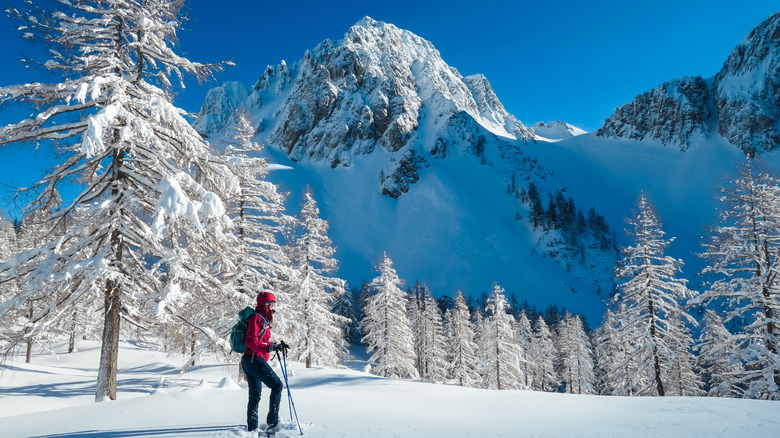
The idea of a camping trip often conjures up images of lush green fields, forested enclaves, or miles of rolling hills gleaming with sunlight. We imagine breathtaking camping destinations in Tuscany, hiking trails with coastal views in Wisconsin, or perhaps the mountain views of upstate New York. Thoughts turn to leaf peeping in a midwestern fall, braving the highlands of a Scottish spring, or perhaps a sojourn or two into the inky isolation of a winter-locked landscape.
Winter, however, brings a beauty of its own: the air feels crisp, the water collected from streams is pure, and the views, often carpeted with snow, present a side of nature at its most unforgiving. There is ice-fishing to enjoy, cross-country skiing destinations to explore, stargazing to indulge in, and the quiet peace of a cold night around a campfire. Still, the winter camp presents unique challenges for the would-be traveler. Keeping warm is a never-ending struggle against the elements. At its heart, the plans you make are all about staying comfortable. In more extreme climates, however, the onus switches to safety concerns. Hypothermia sets in when a body's core temperature ticks down to 95 degrees Fahrenheit or lower; it is a life-threatening condition, and those suffering from it need immediate medical attention. Frostbite can occur when the skin is subjected to temperatures below the freezing point; its early stages — a so-called frostnip — can be treated with first aid, but again, if it progresses, you need to seek medical aid.
Trips to the Arctic Circle, winters spent struggling through Scottish hinterlands, and aurora-seeking nights in Europe's frozen north helped inform this article. Other experts have been consulted, and the hard science of keeping warm double-checked against the latest research. Here then, is how to stay warm when the weather turns cold.
Layered clothes
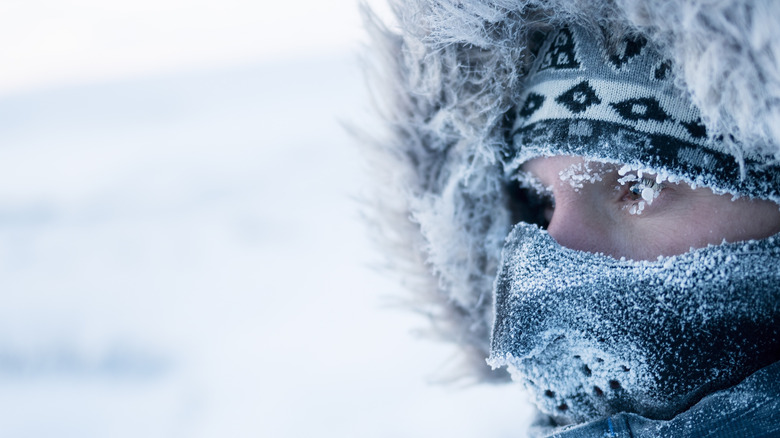
When it comes to serious weather, it's all about layering. Air is quite famously a poor conductor of heat; gas is, after all, a low-density form of matter. Heat is transferred via vibrating molecules; the fewer molecular neighbors you have, the lower the thermal conductivity you should expect. Simply put, trapping air between layers keeps heat in and cold out.
The amount of layering you are going to need depends very much on the temperatures you are dealing with, and finding the right balance takes practice. Overdressing is almost as bad as undressing; you don't want to get sweaty when you are battling the elements; damp clothes can suck the heat right out of you. All clothing comes with an intrinsic CLO rating, a measure of how much thermal protection it offers. For the most part, such a measurement is intuitive; we know, for example, that a woolly sweater is warmer than a cotton shirt. Specialist clothing, however, usually goes out of its way to provide guidelines on the level of security it offers. In addition, time spent in the cold and how active you are both play a part in how warm you are going to feel.
In truth, it's as much art as science. Different people react to the cold in different ways, but there are a few staples to consider. To start with, you'll need a base moisture-wicking layer to deal with any perspiration. Next comes an insulation layer, followed by an outer garment designed to keep out wind and rain. Using a little simple arithmetic helps you arrive at a combined CLO rating, which you can then compare with the worst-case scenario temperatures you expect to face.
Use topography as a natural shelter
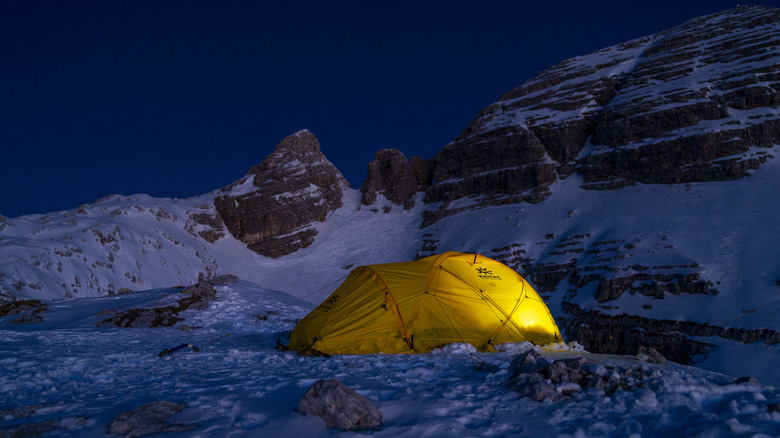
For winter campers, keeping the worst of the weather at bay by staying out of the wind is half the battle. Humans begin to notice the cold at around 50 degrees Fahrenheit. Freezing temperatures take chilly fall sweater-level vacations to a new level, but the ambient heat you are liable to encounter is far from the end of the story. The amount of wind to which you or your shelter is subjected must be considered. Wind chill factor is very much a thing.
Wind chill is a measure of both the humidity and speed of the atmosphere as it travels around you and seeks to approximate how much heat a person would lose when combating said forces. The net result is the eponymous feels like measurement, a metric that helps us to predict how our body is likely to react to excessive heat or cold. Thus, a weather report with a feel-like measurement of 30 degrees Fahrenheit should be treated as being below the freezing point even if the actual, ambient temperature is in the low forties.
Choosing a campsite that provides natural shelter can really help you stay warm. To start with, you need to avoid summits of plateaus; the views are nice, the gales are not. Cold air sinks, so valleys or depressions are also a bad idea. Instead, opt for a well-drained area that offers natural wind barriers such as rocky outcroppings, fallen branches, or patches of dense shrub. Stay away from any trees that are laden with snow, however, as they can be quite hazardous, especially in the middle of winter.
Choose a winter-rated sleeping bag
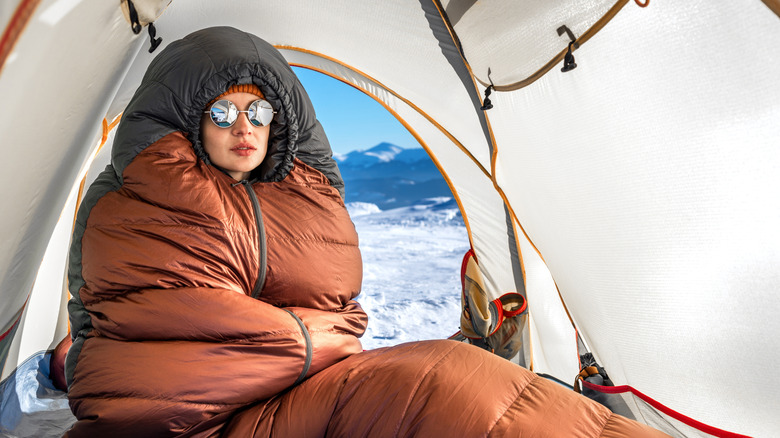
Layered clothing is all well and good, but when it comes to time to retire for the night, bulky garments must be shed, and boots need storing away for the day to come. Not all winter vacations are created equal; a trip to warm-weather European islands isn't going to require specialist equipment. Heading towards Canada's northern hinterlands or Europe's frozen north in December is quite another matter. Indeed, if your camping trip takes you to some of the frostier climates out there, you really need to know what kind of sleeping bag to bring along for the ride.
To start with, you need to do a little research. Weather forecasts are, of course, useful, but checking climate trends is also of great benefit. The key thing to look out for is the minimum recorded temperatures for any given region. Such data should not be used to override actual up-to-date meteorological forecasts, yet provide, in a more general sense, a worst-case overview of the location in question.
Meanwhile, since sleeping bags are rated by season, you have a ready-made benchmark to get you started. A one-season sleeping bag is designed for use over summer when even the nights are relatively temperate. Four-season bags are for winter use and should offer adequate protection even if the mercury ticks down to 15 degrees Fahrenheit or so. The concept of a five-season sleeping bag may sound somewhat incongruous, but they do exist. Such equipment is capable of handling temperatures as low as 5 degrees Fahrenheit. The CLO of clothing can also be factored into such calculations. Wearing thermal vests, thick woolly socks, and perhaps even some gloves or mittens while sleeping is highly recommended. And, having planned for the lowest temperature you can expect, you should stay warm and cozy all night long.
Fuel yourself with high calorie food
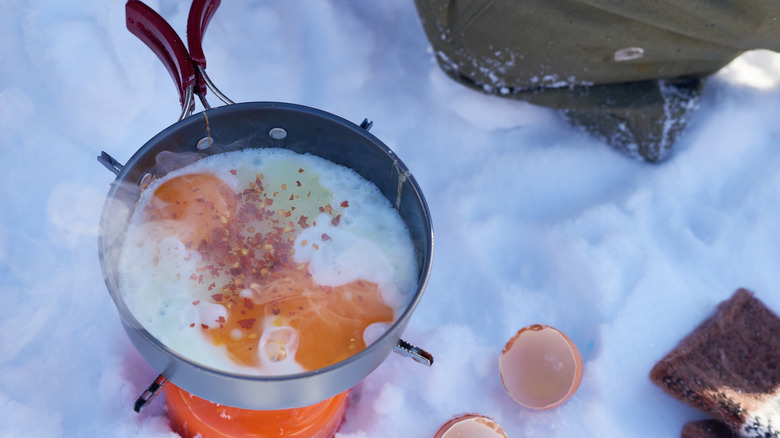
When it comes to preparing yourself for unexpectedly bad weather during a camping trip, minds often turn to thoughts of scrambling with umbrellas and tarps. During the winter, however, there is an extra level of preparation that must be contended with. When it gets cold, you're going to need to eat.
Once again, it is all about the extra energy you are expending trying to keep warm. Under normal circumstances, your body needs a set amount of calories to maintain body weight: around 2,000 to 2,500, depending on a number of factors, including size, age, and activity level. When winter camping, intake needs can rise dramatically; consuming somewhere in the region of 3,600 calories is quite normal, and in some cases, it might even rise as high as 6,000 calories a day. Activity levels matter here, as does the nature of the cold you are combating. Hiking across a blizzard-swept tundra with all your equipment upon your back is more tiresome than camping next to a not-quite frozen lake. Finding a balance is of critical importance.
Knowing what food to bring with you then is an important step on the road to staying toasty warm. Sugary treats offer energy spurts, but fats and proteins are king here. Hot casseroles, melted cheese, slices of well-cured meats, and hot bowls of oatmeal are a great start. Nuts are full of energy, and pasta and rice can be used to bulk up meals of oily fish, broths, and soups. A focus on hot meals — such as a cooked breakfast of sausages and eggs — is an obvious boon, and washing everything down with hot tea keeps you hydrated as well.
Stay hydrated
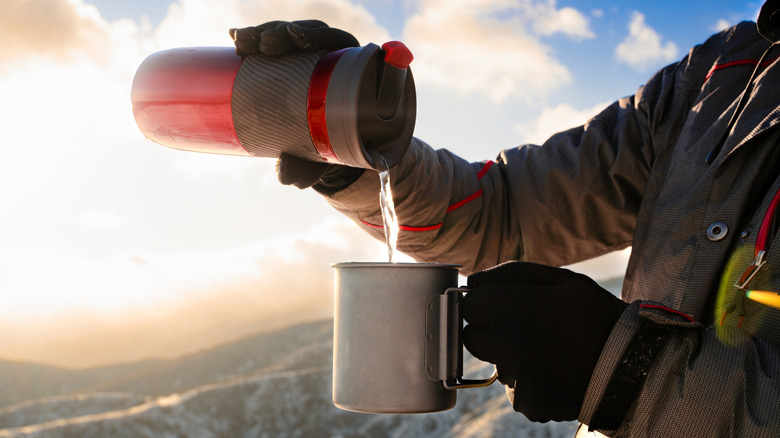
We often associate thirst with feeling too warm; heat does, after all, make us sweat, and a nice cold drink helps lower the temperature. The entire concept is, however, something of a misnomer. To start with, thirst is a poor indication of dehydration anyway; it is essentially your body's way of telling you that your water reserves have already run low. Secondly, your thirst response is less active during cold weather; veins narrow in response to cold air, restricting blood flow in an attempt to keep your core temperature stable. It's a neat trick, but also one that fools your body into thinking it has an adequate supply of blood to play around with. In short, it is far easier to become dehydrated than you think when winter camping.
Access to a source of water is essential during any camping expedition, but during the winter, there are a few extra steps you need to take to stay warm. Snow, if there is any, can be an excellent source of fresh water, but scooping up mouthfuls of it on the trot is a no-no. First, it needs to be taken from a clean, undisturbed location. Second, you're going to have to both heat and purify it. Physics gives nothing for free; it takes energy to melt the snow you eat. Consuming it in large enough quantities can lead to somewhat paradoxical dehydration. Since our bodies need water to generate heat, you can easily find yourself spiraling towards hypothermia
All of which means that you should make sure to always keep yourself well-watered. Hot drinks help warm us up and also improve our mood; a thermal flask on the trail is a godsend. Meanwhile, a mug of cocoa or tea before climbing into a sleeping bag helps lock in some heat and keep the chills away at night.
Insulate from the ground up
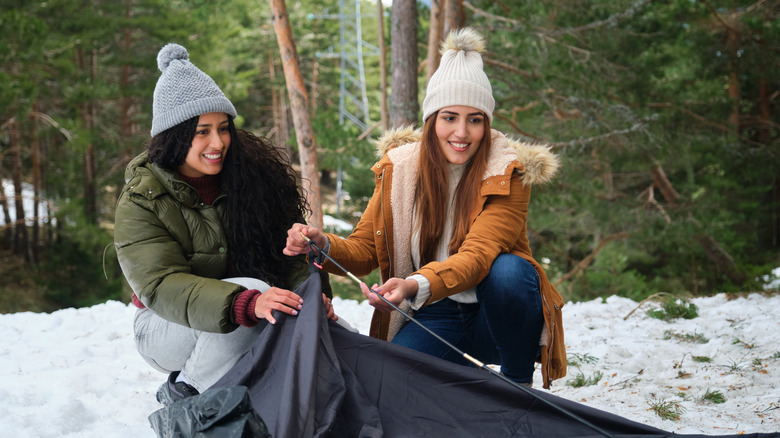
When it comes to staying warm, conduction is enemy number one. The concept — first postulated by French polymath Joseph Fourier — describes the stubbornly unidirectional nature of thermodynamics. Heat flows into cold, never the other way around. When it comes to lying on frozen ground with just a tarp or thin groundsheet between your body, this can be bad. Very bad. Thanks for that, physics. Indeed, keeping yourself away from frozen ground is of such critical importance that it is worth spending both time and money combating the issue. The question is how.
The first option is to thaw the ground. Build a fire, light it, and wait. As low-tech tricks to staying warm in your sleeping bag go, it's up there with the best on offer. Still, colder ground takes longer to thaw, and there are associated fire risks when using this method. It's also kind of labor-intensive, especially when it comes to chopping down all that firewood. An easier way is to simply take the ground out of the equation. Building a raised bed out of some logs puts some distance between you and the frozen soil below; since air is a poor conductor of heat, you'll stay much, much warmer.
For those looking for an all-in-one solution without the need to chop down too much foliage, a thermally rated sleeping pad is the way to go. Each comes with an R value, which indicates how much thermal protection they provide. When camping in the cold, opt for something rated at five or more. Self-inflating varieties offer an extra layer of comfort, but there is a puncture risk. If you are camping somewhere where the cold is a legitimate danger, bringing along a high R-value sleeping mat is the best option.
Stay active before bed

No matter how much cocoa you pour down your neck and no matter how highly rated your sleeping bag, tent, and thermal mat are, the fact remains that if you climb into bed half frozen, you are in for a chilly night. Sitting by the fire and watching the stars wheel over your head is all well and good, but as the sandman approaches, you might want to get up and move a little. Or perhaps even a little more than that.
The science of it all is well documented. Our body powers our muscles in a highly inefficient way; For every 100 calories you burn through exercise, about 80% of it is turned into what is known as metabolic heat. All that heat has to go somewhere. Hearts begin to beat faster as they attempt to redistribute excess warmth away from the core and towards the extremities. There, it can leak out into the atmosphere, where it is easily dissipated. Or, you know, caught by some layered clothing.
What kind of exercise you do depends on many factors: how cold it is, your age and fitness levels, and the topography of the location you have chosen. For those wishing to master camping alone, one workout is built into the winter experience; chopping a little extra firewood is a most excellent pre-bedtime ritual. Gentle exercises and stretches are also of great benefit, as are other activities such as re-checking equipment, shoveling away any built-up snow, or perhaps just a little jogging on the spot. As always, the goal is to stay warm and dry; exercising yourself into a pre-bedtime sweat is the very definition of missing the point.
Secure a source of heat
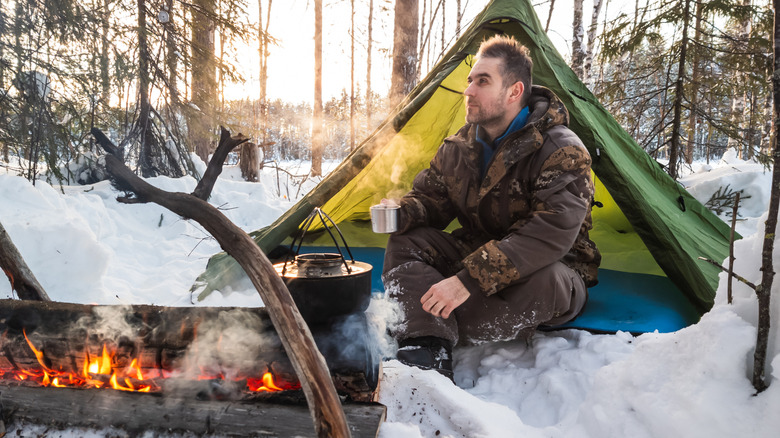
Speaking of chopping wood, there are few things as satisfying as a roaring campfire. Learning to build the perfect blaze every time is one of those skills that is a delight to master. Still, turning all that carbon into heat is not always an option. In some areas, fires are forbidden, even in winter. In others, you might not have access to a ready source of firewood. Lastly, there are those places that simply won't let you chop down any old tree you come across, and carrying all that you need with you simply isn't always possible. Fortunately, other options abound.
First up are some obvious dangers. Campfires emit carbon monoxide, which is an odorless gas that, if inhaled, can render a person unconscious and even kill them in fairly short order. Propane stoves and kerosene heaters also produce the deadly gas; they should never be used inside a tent. If you suspect there has been a carbon monoxide leak, you should evacuate the tent immediately and seek immediate medical advice.
If you are heading into very cold climes, portable, enclosed camping stoves that are fitted with a sealed chimney are an option. Still, a fully-charged CO detector brings added peace of mind once set up inside your tent. Better yet, opt for an electric heater. You'll need a campsite with an electrical hookup to use one, but they work well and carry with them a low risk of fire and zero concerns when it comes to emitted gas.
Supplemental heat
When all else fails and you are still struggling to get up to temperature during your winter sojourn, there are a few tried and tested ways of staying warm. Hot water bottles carry a small amount of inherent danger, but when it is a matter of life or death, they can make all the difference. For those who neglected to bring one along, there is at least one water bottle camping hack that can help turn things around. Filling a plastic bottle with almost boiling water and then wrapping it in layers of clothes reduces the chance of scalding if it bursts during the night. Meanwhile, it can be placed inside the sleeping bag to either prewarm it before climbing in, or, as long as you are careful, kept with you during the night to add an extra layer of coziness.
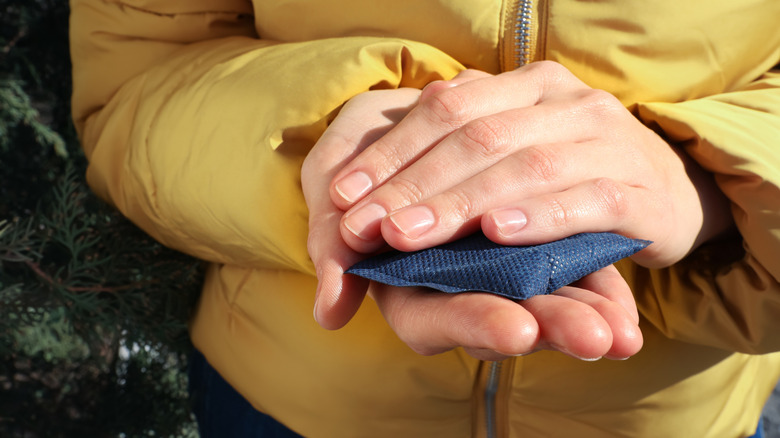
Meanwhile, keeping your hands and feet warm is an important part of staving off frostbite. Hand warmers – small enough to fit inside mittens — are something of a no-brainer, and helpfully, there are ways of making them last longer even when hiking in the cold. They tend to come in two varieties: a chemical pouch that can be activated as required and portable electric heating devices that either run on batteries or are rechargeable in some way. Just remember that the cold can affect battery life, so keep them somewhere snug when not in use. Thermally heated insoles are also a thing, and it's a good idea to use them to thaw out any footwear before putting them on first thing in the morning.
How we compiled this list
Years of camping experience in some of the coldest places on the earth played a large part in the construction of this list. Safety concerns relating to inherent dangers were double-checked via respected sources such as the Mayo and Cleveland clinics. Where equipment was mentioned, time was taken to seek out reputable suppliers of camping equipment. In a similar vein, data related to meteorological phenomena was lifted from official sites such as the U.K.'s Met Office, and any scientific concepts mentioned are fully in line with current understanding.