

One Of Rick Steves' Favorite European Churches Is An Ornate, Baroque Gem In Bavaria
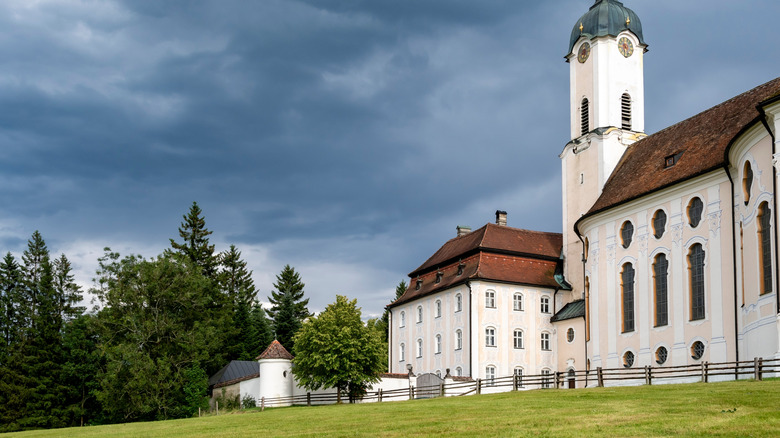
One of the great joys of any trip to Europe is discovering the extraordinary range of gorgeous churches that exist across the continent. From Europe's largest cathedrals to its smallest private chapels, almost every country on the continent is brimming with amazing places of worship. And visiting them isn't only for religious travelers. Churches are fascinating places for fans of in history, art, and architecture, and they have shaped cultural life in Europe for centuries. European travel expert Rick Steves has been to his share of European churches, and one of his favorites is the Wieskirche in Bavaria.
"The Wieskirche is Germany's greatest Rococo-style church, and this 'Church in the Meadow' looks as brilliant now as the day it floated down from heaven," according to Steves. The sacred building is one of Germany's most significant places of pilgrimage, located on the Romantic Road in Bavaria, a picturesque route that runs from Würzburg on the Main River to Füssen in the foothills of the Alps. The Wieskirche is located between the small towns of Steingaden and Wildsteig, just over 60 miles from Munich. The closest international airport in Germany is Munich Airport, a drive of just under two hours, although Innsbruck, across the border in Austria, is slightly closer and can be reached by car in about an hour and a half.
An exuberant display of joyful Rococo color
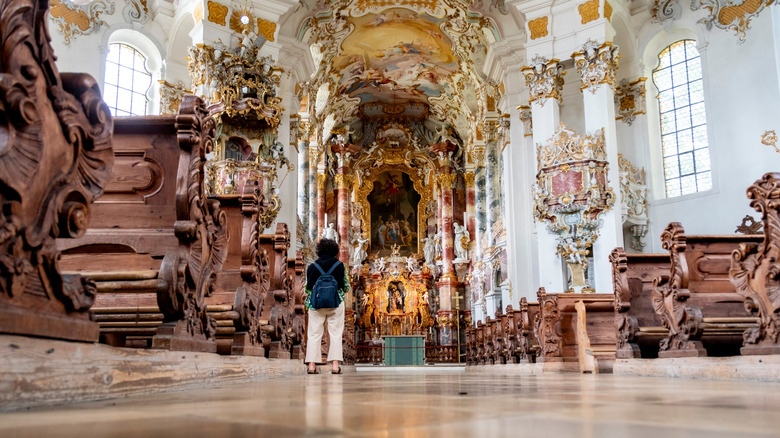
The Wieskirche is a work of art, an exuberant, abundant showcase of the glorious, over-the-top Bavarian Rococo style. "It's a divine droplet, a curly curlicue, as overripe with decoration as this sentence," Rick Steves writes. And if anything, he doesn't do it justice. The church is a UNESCO World Heritage Site, and one of the best-preserved examples of the eye-catching blend of gilt, stucco, and white plaster that epitomizes the Rococo era. Elaborate artworks covers the walls, making the experience almost overwhelming in its grandeur.
The Wieskirche is a pilgrimage church, built on the site of a miracle that occurred in 1738, when a wooden statue of Jesus in the Premonstratensian abbey was seen crying. After so many pilgrims flocked to see the wonder, the abbot decided to build a church worthy of receiving them and housing the miraculous statue. Designed by architect Dominikus Zimmermann, the church was built between 1745 and 1754 during the height of the Rococo period.
It's a far cry from the stark Lutheran interiors found in other parts of Germany. Steves likens the Wieskirche's Rococo style to "Baroque that got shrunk in the wash — lighter, frillier, and more delicate, with whitewash and pastel colors". The enormous ceiling painting is another highlight, a feast of trompe d'oeil skies and soaring angels, crowned by a beaming image of Jesus Christ.
Exploring the Romantic Road
A large part of the unique charm of the Wieskirche is its incredible natural setting. "You approach up a pathway, walking through fertile fields where cows graze peacefully and the scent of cut hay, fresh cow pies, and an alpine breeze saturates the air the way the Holy Spirit permeates the created world," Rick Steves writes. The church is just one of the gems on Bavaria's Romantic Road, which is one of the best ways to take in the scenic beauty of Germany by car.
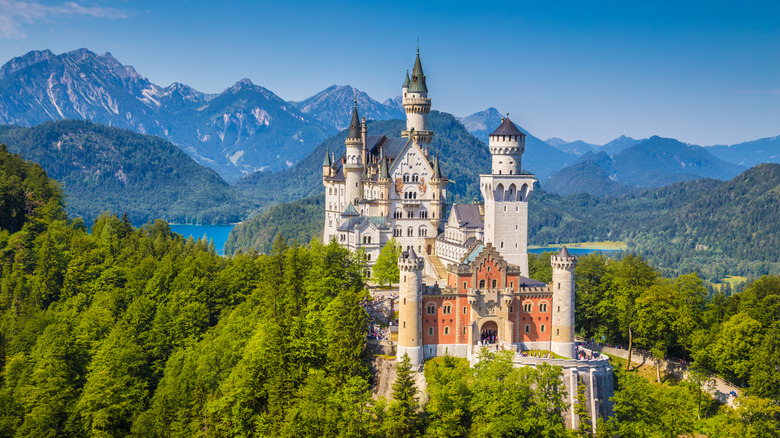
Other stops on the road include fairytale castles, quaint villages, and delightful alpine landscapes, and there are plenty of exciting things to see and do around Wieskirche. The showstoppers on the route nearest to the Wieskirche are the twin castles of Hohenschwangau and Neuschwanstein, one of Europe's most mesmerizing cliffside castles. These stunning fortresses tower dramatically over a landscape of rugged mountains and crystal-clear lakes, and gave Disney the inspiration for Cinderella's castle. Landsberg am Lech offers a lovely taste of German medieval life, with its excellently preserved old town, fortified walls, and 15th-century basilica.