

Rick Steves Reveals The Clever Way He Avoids Paying For Water At Restaurants In Europe
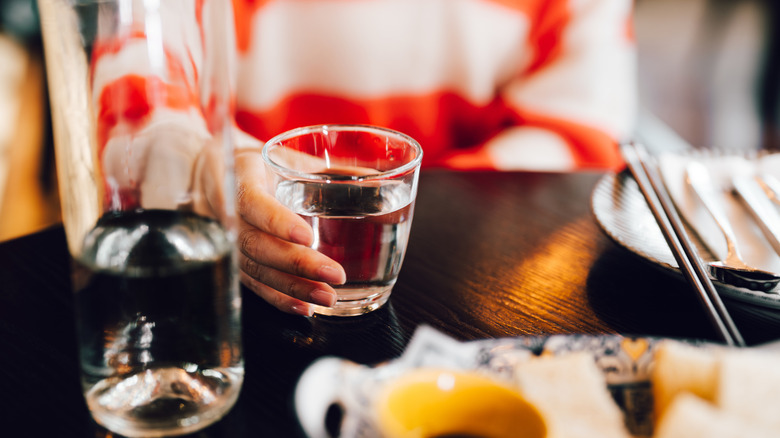
Most of us are familiar with the subtle cultural differences between American and European restaurants, like the portion sizes and tipping norms. But they're even different when it comes to something as basic as water. There are certain things Americans are accustomed to after being seated in a restaurant and handed a menu. It doesn't matter if it's a dingy diner or an elegant dinner spot — a glass of ice water is usually placed on the table without asking. The server then asks if the table would like to order any other drinks while periodically filling up the water glass throughout the meal.
That is not standard in European restaurants. Servers don't give an automatic, chilled glass of tap, and it's much more common to pay for bottled water when sitting down at a restaurant. The tap water in Europe is generally very safe to drink, but it's another cultural nuance where Europeans prefer bottled water — often sparkling — with their meal.
While on a trip to Europe, paying for bottled water in restaurants won't necessarily break the bank, and travel sage Rick Steves says accommodation is the biggest budget challenge. But Steves is always there to lend a hand and has a clever way to avoid paying for water at restaurants. He wrote on his website, "While it's possible to get tap water, to do so you may need to be polite, patient, and inventive, and you'll need to know the correct phrase." Studying up or making a note on your phone about how to say "tap water" in the local language could be the key to staying hydrated and saving some euros on your trip — and Steves also has a secret to cheaper alcohol while in Europe.
How to order tap water in Europe
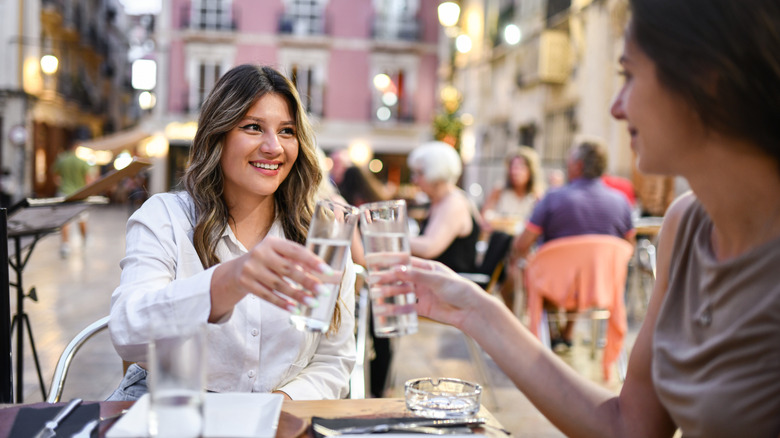
The different culture of water consumption between the U.S. and Europe extends beyond restaurants to daily consumption recommendations. In America, it's recommended by the Institute of Medicine of the National Academies that adults drink 2.7 to 3.7 liters a day, while the European Food Information Council advises 2 to 2.5 liters daily. That might explain why we Americans are famous for carrying large reusable bottles wherever we go and are often perplexed by how Europeans seem to drink so little. As blogger Helene Sula told CNN Travel, "I just figured, maybe Europeans just don't get as dehydrated as we do."
In most European restaurants and cafes, if you just order "water," you'll probably get a chilled bottle that will cost a few euros. That's why Rick Steves' advice is to learn how to say "tap water" in the local language. When the server comes to the table in Italy, politely say, "acqua del rubinetto." In Germany, it's "leitungswasser," and in Spain, the order would be "agua del grifo." Steves says that the availability and willingness to serve tap water varies from country to country. Restaurants charge for it in Belgium, it's only available after ordering other drinks in Denmark, and in Greece, it might not be an option at all.
If all else fails, a little acting might be in order, and Steves says, "Hold an imaginary glass in one hand, turn on the tap with the other, and make the sound of a faucet." The server might consider it a special favor, but if you follow Steves' advice, you can avoid paying for tap water in Europe. And if you're still struggling when ordering H2O, try his simple tip for overcoming language barriers when abroad.