

Not Yosemite, Not Colonial Creek Falls: This Is The Tallest Waterfall In The US Hands Down
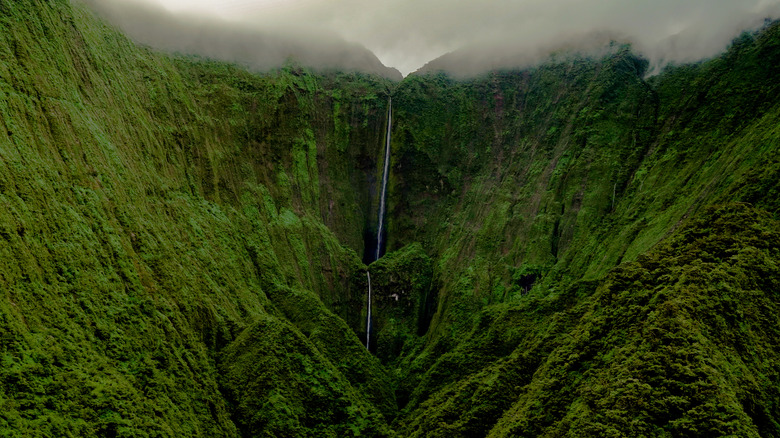
While the U.S. may not be home to the tallest waterfall in the world — that honor goes to Angel Falls in Venezuela — it still has its fair share of some truly stunning waterfalls. Some may think the waterfalls in Yosemite National Park or Colonial Creek Falls in this picturesque national park with fewer crowds take the cake on the tallest waterfalls in the country, but it turns out you're going to have to go further west and over part of the Pacific Ocean to find the biggest descent. At a whopping 2,953 feet in height, making it the highest sheer drop, Olo'upena Falls in Hawaii is the tallest waterfall in the United States.
If you're surprised by this, then hold on to your seat for even better news. Should you want to see the top three tallest waterfalls in the U.S., you're in luck, because they're all in the Hawaii. Not far behind Olo'upena Falls is Pu'uka'oku Falls, at 2,756 feet, and Waihilau Falls, at 2,592 feet (Colonial Creek comes in fourth, at 2,568 feet). Both Olo'upena Falls and Pu'uka'oku Falls are on the Hawaiian island of Molokai, while Waihilau Falls is on the The Big Island (Hawaii), located in the Waimanu Valley. Unfortunately, unlike the beautiful American falls you can actually swim in, trying to access any of these waterfalls for a selfie moment isn't exactly easy, making the goal to do so that much more of an exciting adventure.
What makes Olo'upena Falls so unique
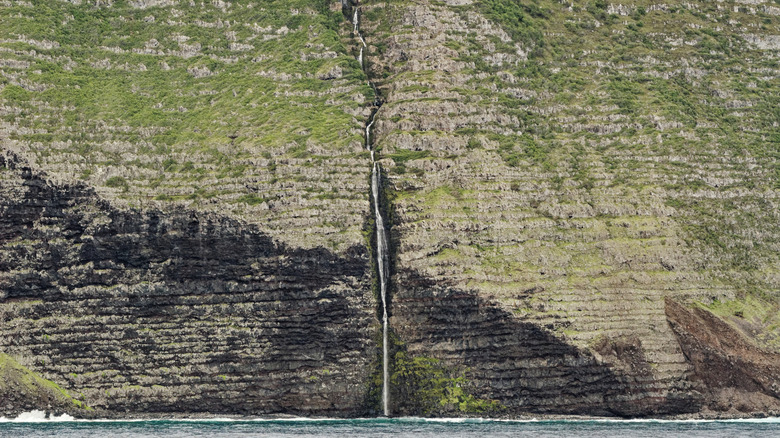
While a waterfall lover may want to visit the Olo'upena Falls for its impressive drop directly into the Pacific Ocean, what makes these falls extra unique are the 3,000-foot cliffs from which they plunge, because they just so happen to be the tallest sea cliffs in the world. In fact, nearby Kalaupapa, Hawaii, is one of the most isolated towns in the world because of these impressive cliffs. This also means you have your work cut out for you if you want to get up close and personal to the falls.
To really see the falls in all their glory, a helicopter tour is your best bet due to the remote location of the Olo'upena Falls. You can also reach the falls via a guided boat tour that takes about three hours. However, it's worth noting that because of the terrain and weather, you have to be one lucky duck to find a day during the wet season (between November and March) where everything is just right and safe for an excursion to see the falls — although experienced kayakers can navigate themselves fairly close to the falls by kayaking along the coast of the cliffs. Because there are no direct trails to the falls, that's another component adding to the inaccessibility. In other words, trying to see the Olo'upena Falls isn't something you do one afternoon on a whim; it takes planning and, ideally, scoring a day with manageable weather so you can feel the falls' mist on your face.