

The Important Safety Rule Travelers Should Know When Using Portable Chargers On Flights
Travelers have become increasingly dependent on technology. Most of us are constantly checking our texts, social media, and our emails — even when we're on vacation. When traveling for work, having functioning devices becomes even more essential. While it's a fun novelty to try going analog on your vacation, and refreshing to fully unplug at a phone-free vacation spot from time to time, there's no denying that technology can be extremely convenient when traveling. You can easily purchase tickets online to an event or attraction that catches your eye when you're sightseeing, or check in for your flight without having to wait in a long line. You can check what time the next train leaves, or call a rideshare like Uber to pick you up at the airport. Considering how often we use our mobile devices when traveling, keeping them charged can be a hassle.
In this day and age it's nearly impossible to travel without at least a few electronic devices. Many of us bring along our power banks and portable chargers whenever we fly. They're great to have on hand, but it's crucial that travelers understand the safety rules about using portable chargers on flights.
Portable chargers are the perfect solution since they allow you to keep your device charged on the go. For many people who travel by plane, portable chargers are a travel essential. They are permitted on airlines around the world, but they aren't without risk. Portable chargers are capable of starting a fire, so it's important that passengers keep them visible and never put the useful tech gadgets in their checked baggage. Some airlines have additional requirements about using and storing portable chargers in flight.
The problem with portable chargers on airplanes

Have you ever noticed that your cell phone or laptop can become extremely hot when in use or when it's being charged? Electricity creates heat, and so many electronic devices are capable of overheating. Even though it isn't extremely common, portable chargers can start a fire. "All lithium-ion batteries are capable of overheating and experiencing a process called thermal runaway," the FAA website states. "Thermal runaway can occur without warning as a result of various factors, including if the battery is damaged, overheated, exposed to water, overcharged, or improperly protected. Thermal runaway can also occur on its own due to manufacturing defects."
On an airplane, fires can be disastrous if they aren't dealt with quickly. When I used to work as a flight attendant, we were trained to fight fires aboard the aircraft using a variety of techniques. There are fire extinguishers placed strategically throughout commercial airplanes so that crew members can react quickly. During training, it was stressed how important it is to put out fires as soon as possible, because even a small fire is an emergency that puts the lives of everyone on board at risk. Without a quick and effective response, an airplane fire can spread extremely quickly. In a short amount of time, the entire airplane could go up in flames.
According to U.K. aviation authorities (via BBC), there were 206 instances of devices with lithium batteries "overheating or malfunctioning" in 2025. The 2026 BBC article claimed that portable chargers and vapes are the biggest safety risks to aircrafts. The U.K. Civil Aviation Authority found that about 36% of travelers were unaware of the dangers of traveling by plane with battery-powered devices, but around 49% of travelers bring a portable power bank with them. There have been over 300 incidents involving battery packs in the United States over the last 10 years, according to the FAA.
How to safely bring portable chargers on flights
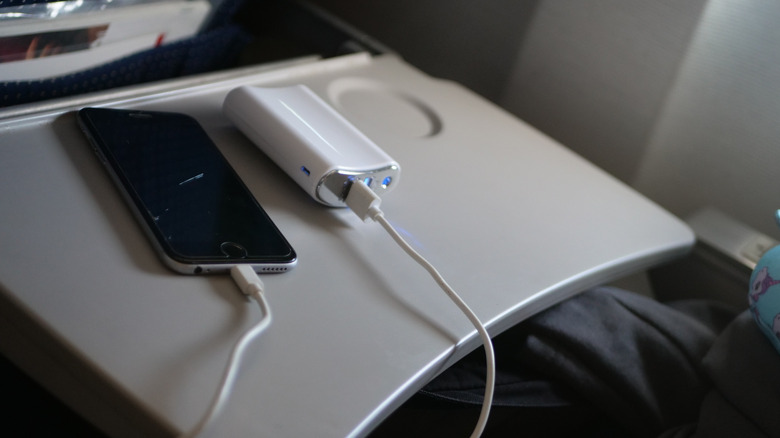
According to the FAA website, all portable chargers should be brought on board an aircraft in a carry-on bag. They should never be placed in your checked luggage underneath the plane. If the portable charger were to catch on fire in the checked baggage stowage area beneath the plane, no one would be able to access the device or put the fire out.
There have already been a number of safety incidents related to portable chargers on airplanes. In early 2026, a portable charger caught on fire on an Alaska Airlines flight. The flight attendants were able to put out the fire using fire extinguishers and the device was placed in a thermal containment bag until the plane could make an emergency landing. Some airlines have implemented their own rules that are more strict than the current federal regulations. Southwest Airlines now requires that passengers keep their portable chargers visible when in use. Each Southwest passenger is only allowed to bring one portable charger, while Delta and American Airlines both have a limit of two portable chargers per passenger. Delta and United Airlines no longer allow passengers to stow portable chargers in the overhead bins. They must now be in reach at all times. On an American flight you'll be allowed to stow them in the overhead bin only if they're powered off.
If you notice that your portable charger, or any other electronic device that you've brought on board, is overheating, it is critical that you notify a flight attendant immediately. If the device is "overheating, expanding, smoking, or burning," act quickly. "Flight crews are trained to recognize and respond to lithium-ion battery fires in the cabin," the FAA website explains.