

Not Bryce Canyon, Not Canyonlands: This National Park Has The Most Natural Stone Arches
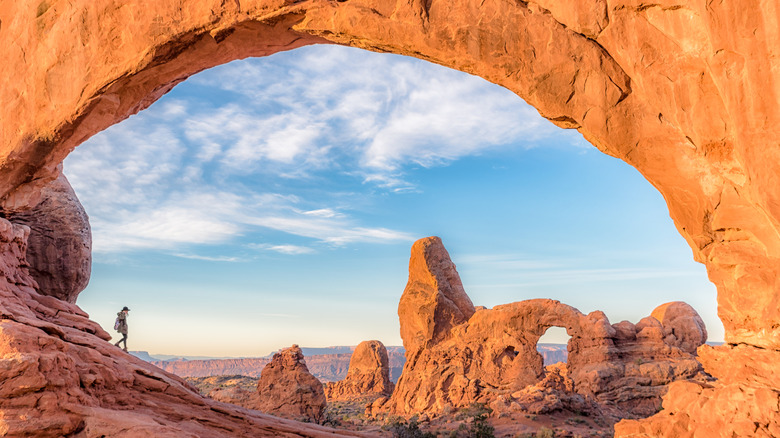
Nature is a prolific and patient sculptor, generating new land masses during volcanic eruptions and whittling down others through water and wind erosion over millions of years. In the southwestern United States, natural forces have produced some of the most surreal rock formations on the planet: stout mounds and flat-topped mesas, fire-hued swirls and pinnacles, and perhaps the most daring of them all — perfectly executed, sometimes enormous stone arches.
A great way to get up close and personal with natural stone arches is on a an epic road trip through some of Utah's national parks. Around a dozen of them have been identified in Bryce Canyon National Park, and Canyonlands National Park boasts an impressive 80. But one park blows all the others away. Arches National Park is home to around 2,000 documented arches, the highest concentration found anywhere in the world. Some of these arches span more than 300 feet.
The sandstone formations here are mainly the result of water seepage and erosion, causing layers in the rock to separate, buckle, crack, and dissolve. Over time, these processes have revealed and continue to reveal the arches in all their glory. Because the erosion is always ongoing, the arches are in a constant state of flux. Old ones collapse while new ones are slowly forming. In other words, the park you see today may not be the same one that other visitors see tomorrow.
Arches National Park's most celebrated arches
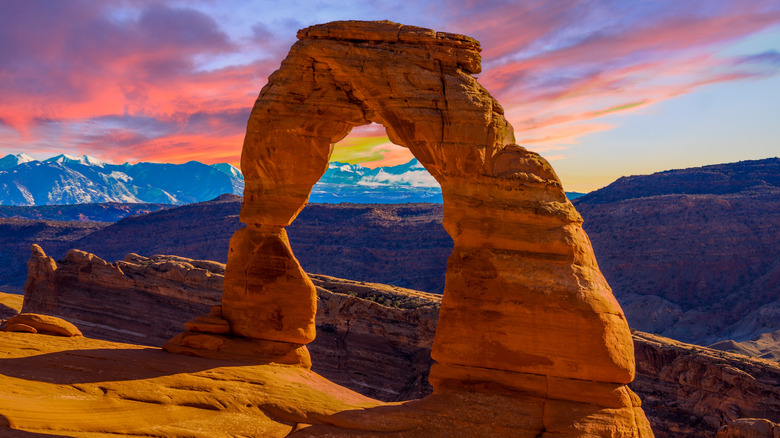
In the park's current iteration, a few arches stand out for their remarkable size and beauty. One of these you may recognize from Utah's license plates: Delicate Arch, the most famous arch in the park and also on the planet. The opening under this arch is 46 feet high and 32 feet wide, making it the park's biggest free-standing arch. It's possible to hike right up to this incredible stone arch via a moderately difficult 3-mile roundtrip trail that passes petroglyphs and a cabin along the way. The journey is well worth it. Seeing the arch in photos is impressive, but viewing it up close — a gigantic red-rock window framing the blue sky, desert, and distant La Sal Mountains — is so awe-inspiring it almost feels sacred.
Another star of the park is Landscape Arch. This arch's rock ribbon has the longest span (306 feet) of any in the park and seems magically suspended in mid-air. However, this magic may be nearing its expiration date. In 1991, onlookers heard popping sounds and watched as a piece of Landscape Arch broke away and crashed to the ground. One of the witnesses, Michael Müller, described his experience in a report provided by the National Park Service. "The sandstone, however, did not come to rest until a larger amount of rocks fell with loud cracking noise, releasing some of the stress," he explained. "I could feel the earth shaking since I was standing only 60 meters above and 80 meters away from the impact site. For a moment I felt paralyzed." While scientists in the park continuously monitor all the arches, they do not plan to do anything to prevent further deterioration of Landscape or any other arch. Nature runs its course in this park as it does in others — one reason why we cherish them so much.
Top experiences in and around Arches National Park
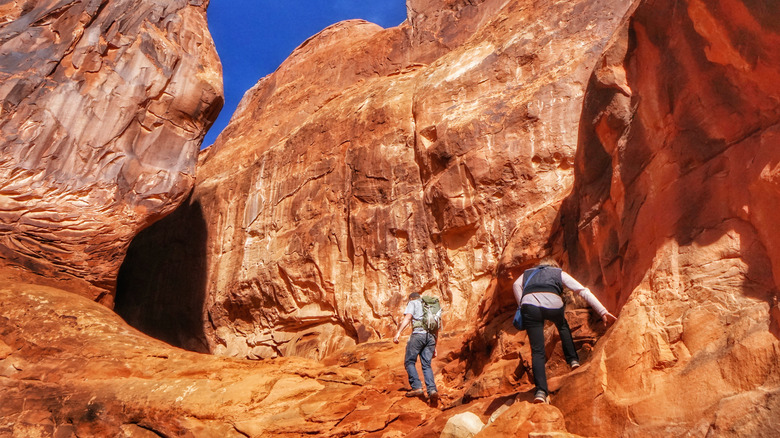
On a ride through the park, you can certainly see spectacular scenery right from your vehicle.But the close-up views of arches are the ones you'll remember years down the road. As described above, many arches and other rock formations are accessible via short and relatively easy trails. In addition to the Delicate Arch and Landscape Arch trails, be sure to hit the mile-long Windows Trail, which meanders through one of the most scenic areas of the park, passing iconic arches like North Window, South Window, and Turret Arch.
Some of the park's other landscapes are also fascinating to explore, like the Fiery Furnace, a bizarre, one-of-a-kind adventure In Arches National Park. This is a 2.2-mile loop through a maze of red rocks, with no clear trail. Rather, navigating the terrain requires following a series of arrows on the rocks. Self-guided adventurers need a permit to hike here, and otherwise, it's possible to arrange a guided tour with a ranger from spring through fall.
The closest major airport to Arches National Park is Utah's Salt Lake City International Airport (SLC), 235 miles northwest of the park. From here, the most convenient mode of transportation is a rented vehicle, giving you the freedom to discover everything the area has to offer. Camping is available within Arches National Park at the Devil's Garden Campground. Advance reservations are necessary for those camping between March 1 and October 31; otherwise the campsites here are first-come, first-served. In addition, a wide range of restaurants and accommodations are located in the nearby town of Moab, an oasis in the desert that's only 5 miles from the park.