

Why Scientists Think Elderly Couples Should Have To Sit Separately On Airplanes
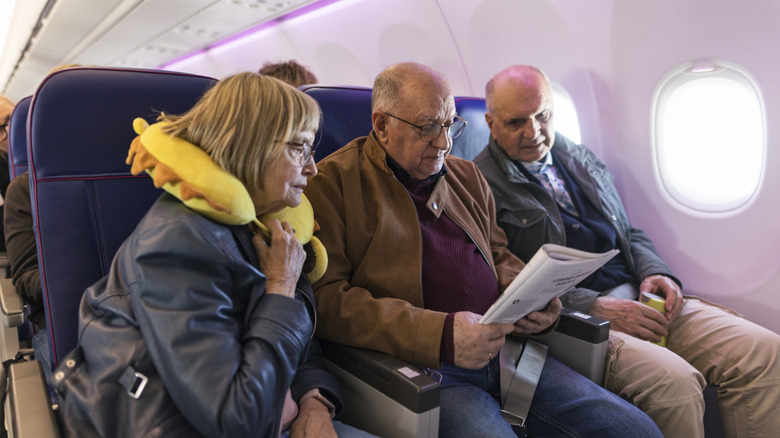
The opportunity to travel the world is something that people of all ages long for, and thankfully there are no age limits when it comes to travel. If you're passionate about experiencing different cultures and exploring new places, you'll be able to do so well into your golden years, and there are plenty of popular vacation destinations that are perfect for seniors. Keep in mind that Rick Steves, one of the world's best travel experts who offers tons of top-tier travel tips, is over 70 years old. According to data gathered by AARP, around 70% of older adults in the United States were planning trips in 2025. Around 42% of them were planning to use airplanes as their mode of transportation. With a greater number of older travelers on flights, some scientists claim that elderly passengers should have to sit separately on airplanes for safety reasons. This would even apply to couples traveling together.
Commercial flights are generally considered a safe way to travel, but dangerous emergencies do occasionally occur. During an emergency situation, it is crucial that all passengers are able to exit the aircraft as quickly as possible. Lives could depend on the speed in which an evacuation is able to be completed. We already know that airline passengers can put everyone in danger when they ignore emergency procedures and slow things down. Seconds could make all the difference. A recent study indicated that elderly passengers could potentially slow down an evacuation, which would put everyone on board at risk.
One of the potential solutions, according to the scientists behind the study, is for elderly passengers to be distributed strategically throughout the aircraft. Older adults already face discrimination, and assigning seats on commercial flights based on age could be controversial. Ultimately it could mean that elderly passengers would have to sit separately from their loved ones during their flights.
Research shows that elderly passengers could slow down emergency evacuations
The Federal Aviation Administration has determined that it is imperative that commercial airlines be able to evacuate every single passenger from the aircraft in 90 seconds or less. According to a recent scientific study published by AIP Advances in 2026, that is less likely to happen with higher numbers of elderly passengers unless seating strategies are implemented.
"Elderly passengers introduce specific challenges in emergency evacuations due to slower reaction times, reduced physical mobility, and a higher likelihood of requiring assistance. These limitations can delay both the initiation of movement and walking speed, particularly in crowded cabin environments," the study published by AIP Advances states. Other factors that could further slow down elderly passengers include impaired vision and hearing loss, which make it challenging to understand signage, announcements, or alarms. The researchers also claim that elderly passengers could have a higher susceptibility to panic and may be more likely to sustain injuries during a stressful evacuation.
In order to test different scenarios, researchers created a full-scale cabin model of an Airbus A320 airplane using Rhino 3D. They simulated a "dual-engine fire scenario" using a software called Pathfinder that models the way crowds of people move. The researchers tested 27 different scenarios with "three cabin layouts, three elderly to nonelderly ratios, and three spatial distribution patterns." Alarmingly, none of the scenarios resulted in an evacuation being completed in 90 seconds or less. The shortest evacuation time they were able to model lasted 141 seconds. "Higher elderly ratios and poor seating arrangements led to longer evacuation times and uneven exit usage," the study claims.
Separating elderly passengers could help keep everyone on board safe during a dangerous situation
Based on their findings, the scientists claim that "age-sensitive modeling and seating strategies" are extremely important when it comes to ensuring the safety of every passenger on board an aircraft in case an emergency occurs. The study indicated that when elderly travelers are clustered together in one area of the aircraft, it can be dangerous.
"When elderly passengers are unevenly distributed and concentrated in certain areas of the aircraft, their reduced mobility may lead to localized congestion and obstruct the movement of other evacuees. Furthermore, age-related cognitive decline and heightened stress sensitivity can impair situational awareness, delay decision-making, and reduce compliance with crew instructions," the article argues.
A potential solution to the problem would be to strategically seat elderly passengers in specific locations throughout the aircraft in order to speed up evacuation times and make the process more efficient. As an example, the study indicated that it is easier for elderly passengers to evacuate quickly if they are seated in an aisle seat compared to a non-aisle seat. Seating arrangements that take these factors into consideration could help speed up evacuation times, which could ultimately save lives. Unfortunately, in order to put the findings into practice, it could mean that elderly couples would be forced to sit separately on flights.