
Not Yosemite, Not Yellowstone: This National Park Has The Most Lakes By Far
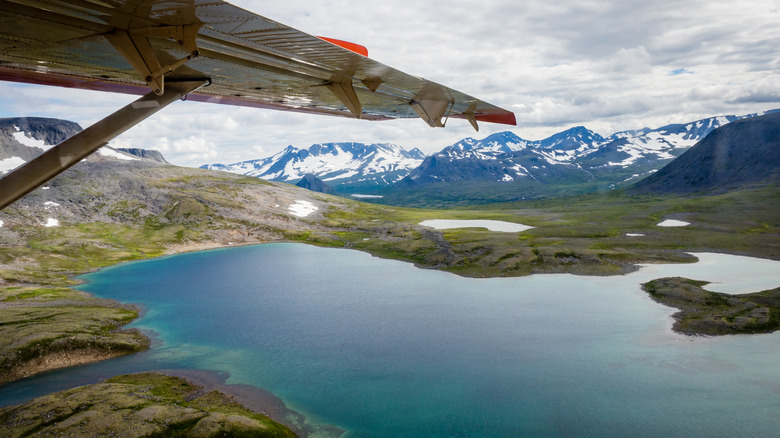
Nature takes many forms in U.S. national parks. In the Grand Canyon, it presents as a deep chasm, whereas in Rocky Mountain National Park, it's snowcapped peaks. In national parks in Northern California, ancient redwood and sequoia groves blanket the landscape. One park in particular, though, may be more defined by its water than by its land, and that's Katmai National Park and Preserve on the northern Alaska peninsula.
Katmai is among the must-see places in Alaska for first-time visitors. It's one of the largest U.S. national parks, spanning 4.2 million acres — bigger than any other park in the lower 48, exceeded only by a few of its Alaskan counterparts (Gates of the Arctic and Denali). Katmai has miles-wide glaciers and rugged coastal areas along with mountains and volcanoes, some exceeding heights of 7,000 feet. But more than anything, it has lakes: 9,257 of them, to be exact. This far exceeds the number in Yellowstone National Park (around 600) and Yosemite (around 3,200). Alaska's Denali National Park is a closer contender, but with only around 4,000 lakes, it also can't compete.
Glacial action accounts for many of Katmai's lakes. As massive ice sheets scoured what is now Katmai, they carved deep basins, which became reservoirs for rain and streams of meltwater from the surrounding mountains. Lakes also formed in two calderas in the park — Katmai and Kaguyak — in the wake of volcanic eruptions. Today, these shimmering lakes are not just beautiful to behold. They're part of the park's vast, interconnected watershed system that provides a critical habitat for salmon and brown bears.
Katmai National Park and Preserve's varied lakes
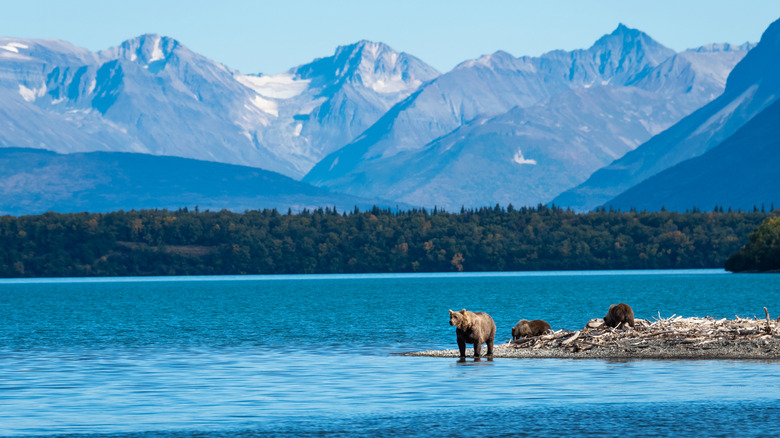
Katmai's lakes come in many shapes, sizes, and colors. Covering 235 square miles, Naknek Lake is not just the park's largest, it's the largest lake within any U.S. national park. Nearby Lake Brooks is much smaller and oval-shaped, while Lake Grosvener is long and narrow. The lakes in Katmai vary in color, too, depending on the type and amount of sediment floating in them. Some, like Brooks Lake, are crystal clear, whereas those with muddy sediments are less translucent.
Still others contain rock flour, a fine powder that reflects light and causes the water to appear milk blue. Naturalist John Fitz, who kayaked the Iliuk Arm of Naknek Lake, described this phenomenon: "Suspended in the water column, rock flour scatters blue and green wavelengths of light exceptionally well creating the rich hues that meets my eyes. Drifting on Iliuk Arm in a kayak on a calm sunny day, surrounded by blue above and enveloped by turquoise underneath, looks and feels like paddling in sky."
Yet another color palette emerges in Katmai Caldera Lake: mostly dark blue but with greenish swirls above the locations of underwater hydrothermal vents. Katmai's lakes boast impressive scenery, but here — 2,000 feet down in the bowels of a volcano — the views are especially dramatic, with newly formed glaciers cascading down the caldera walls toward the lake. The crater in which the lake now sits resulted from the collapse of Mt. Katmai's summit during the 1912 eruption of nearby Novarupta. This was the largest eruption anywhere in the world during the 20th century.
Top experiences in Katmai National Park and Preserve
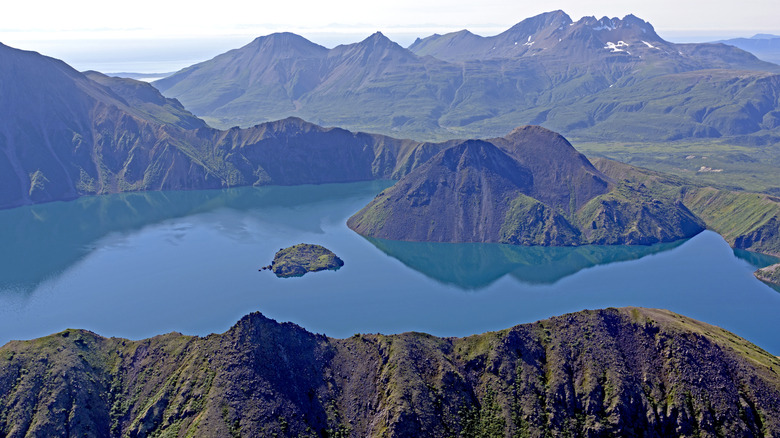
The fact that Novarupta and adjacent volcanoes are still considered active injects some excitement into planning a visit to Katmai National Park & Preserve. Though the park's volcanic Valley of Ten Thousand Smokes is technically one of the places in the world where you can hike among active volcanoes, be forewarned: the terrain here is remote and rugged. The hike to the caldera lake can be done but requires advanced knowledge of glacier travel to navigate crevasses. Fortunately, there are other ways to experience the park that don't require glacier crossings and volcano trekking.
As a destination, Katmai remains an underrated national park that promises incredible wildlife views in addition to its lakes and volcanoes. One of the most thrilling things to do at the park is wildlife watching, as the park is home to around 2,200 brown bears. Of course, as the bears are freely roaming, you could run into them anywhere in the park. But a likely spot to see them is at Brooks Camp during summertime, when they come to feast on salmon in the Brooks River. The most popular way to travel to Brooks Camp is by small floatplane. Another option would be to arrive via boat trip on Naknek Lake, as the camp sits near the point where the Brooks River meets the southeastern shore of the lake. An adventurous prelude to Katmai's brown bears, the boat trip would also be a way to experience the park's greatest lake.