

Florida's Coastal Military Base Boasts A Free Museum That's Open To The Public
At the world's largest naval aviation museum, your money is no good, since admission and tours are free and paid attractions like flight simulators are cashless. The National Naval Aviation Museum in Pensacola takes visitors to Florida's Emerald Coast on a trip through military history, exhibiting over 150 aircraft from the U.S. Navy, Marines, and Coast Guard. It's just half a mile down the road from another popular destination, the Pensacola Lighthouse, which is part of the same active military base, Naval Air Station Pensacola.
Members of the general public can access the National Naval Aviation Museum through the base's West Gate on the Blue Angel Parkway. Parking is free, too, but U.S. citizens 18 and up must show a Real ID, such as a driver's license, or a valid passport to enter. Because this is an operational military base, security is tight, meaning you're not allowed to bring backpacks, and even diaper bags are subject to search. Visitors are also subject to background checks to ensure they don't have any felony convictions. Foreign nationals must be escorted by a U.S. citizen, and they must present their green card or another document proving their permanent resident status.
With all that out of the way, you'll be free to explore the museum, which is spread out over 350,000 square feet in a two-story building with an additional hangar bay behind it. The 37-acre property includes outdoor exhibits and a flight line with bleacher seats where the Blue Angels squadron performs practice air shows. An F-14 Tomcat jet, the first ever displayed publicly, sits outside the museum with its nose pointed skyward. With its western Panhandle location, the family-friendly Mardi Gras destination of Pensacola inhabits a different time zone than most of Florida, and in its own way, the museum likewise transports visitors to a different time.
History comes alive at the National Naval Aviation Museum
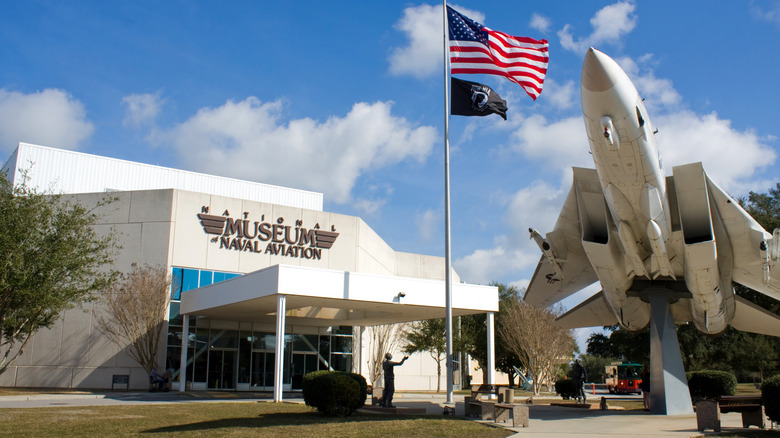
The entrance to the National Naval Aviation Museum takes visitors past a monument that depicts five U.S. airmen, plucked from different 20th-century wars. Their bronze sculptures represent the cross-generational Spirit of Naval Aviation. A replica of the Navy's first aircraft, the A-1 Triad, hangs behind the monument, while another part of the entrance recreates the USS Nimitz's flight deck. Though its name became linked to a highly publicized UFO incident through The New York Times, the Nimitz is also the Navy's longest-serving aircraft carrier, with its decommissioning in 2027 coming more than 50 years after its first deployment.
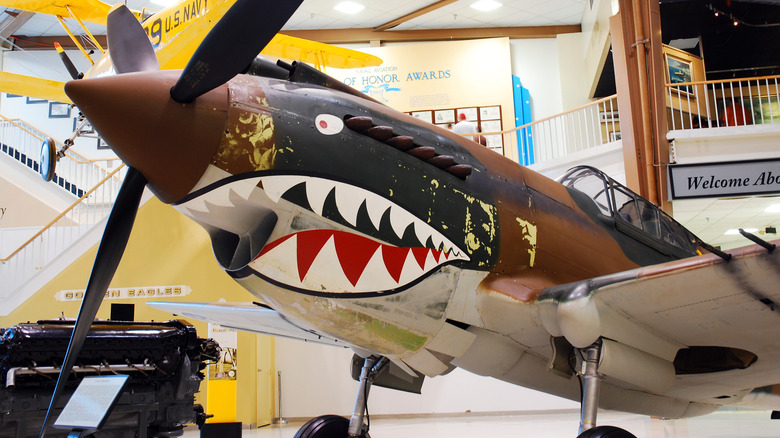
The National Naval Aviation Museum is open from 9 a.m. to 4 p.m. daily except Thanksgiving, Christmas, and New Year's. Visitors can roam the museum's exhibits at their own pace, but free guided tours, led by a retired U.S. military volunteer, also depart from the information desk every hour and a half from 9:30 a.m. to 1 p.m. Among the museum's World War II exhibits is a P-40B Tomahawk flown by the American Volunteer Group, aka the Flying Tigers, who famously decorated the noses of their planes with shark teeth. In addition, you'll see the SBD-2 Dauntless, which survived Pearl Harbor and the Battle of Midway, the latter leaving it riddled with over 200 bullet holes.
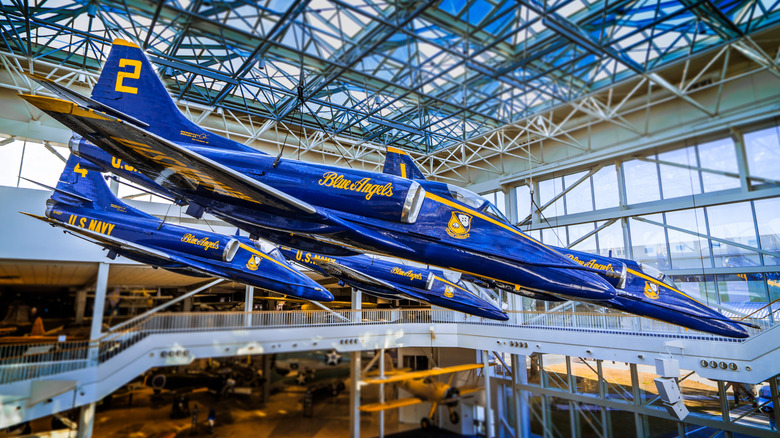
The 75-foot Blue Angel atrium, visible on both floors between the museum's south and west wings, has four A-4 Skyhawks suspended in flying formation. Though Disney World is Florida's only no-fly zone, the Blue Angels have occasionally made passes over the theme parks there in May for Military Appreciation Month. May 2026 saw the museum expand its roster of paid attractions to include a "Fly with the Blues" simulator, where visitors can get in the pilot's seat of an F/A-18 Super Hornet.
Don't miss the second-floor exhibits or Hangar Bay One
Head upstairs before you leave the main building at the National Naval Aviation Museum. There, you'll find an exhibit about the USS Enterprise — not the "Star Trek" ship, but the highly decorated World War II ship that served as its namesake. Another interesting artifact on the second floor is a raft that allowed three crew members to survive at sea, traveling 900 miles to the Cook Islands after their torpedo bomber got separated from the Enterprise. The South Pacific exhibit brings an island airfield to life around an FM Wildcat, salvaged from Lake Michigan. (You'll find more "sunken treasures" like that on the first floor.) Home Front U.S.A. recreates 1940s Pensacola, while authentic control cars from blimps of that era precede the Lighter-than-Air exhibit.
In the museum's Hangar Bay One annex (which closes at 3:30), you'll see Vietnam War exhibits, including a restored UH-1B Iroquois helicopter, complete with mannequins in flight gear donated by veterans. More commonly known as the "Huey," this helicopter flew combat missions with the Army before joining the Navy's Seawolves squadron. Coast Guard helicopters like the Sea Guard and Pelican are exhibited inside and outside the hangar as well. In the Apollo exhibit, there's a lunar module on display, like the kind you'd see at Kennedy Space Center, the Florida icon that's America's best attraction.
One of the last exhibits you'll see in Hangar Bay One is the R4D-5L Skytrain, "Que Sera Sera." A variant of the C-47 (the type of plane that transported paratroopers into Normandy on D-Day), this particular Skytrain holds the distinction of being the first aircraft to land at the South Pole. If you had somewhere warmer in mind for your Florida vacation, not to worry. It's only a 17-mile drive from the National Naval Aviation Museum to the Pensacola Beach Ball Tower and Boardwalk, where sugar-white sands help make the Panhandle an underrated Florida vacation spot.