
California's Deepest Lake Is Also Its Most Popular With Crystal-Clear Water
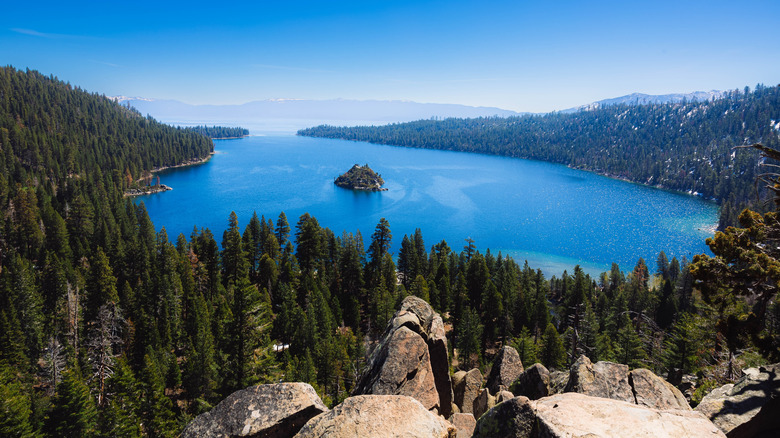
Lake Tahoe is the place where the Golden State meets the Silver State and great moments in history meet the great outdoors. This crystal-clear lake and the pine forests around it see more tourists than all of California's breathtaking national parks (even Yosemite, the fifth most-visited nationwide). Formed over two million years ago during the Ice Age, it's North America's largest alpine lake and its oldest permanent freshwater lake. The shoreline spans 70-plus miles, crossing over into neighboring Nevada, and its waters sink to a depth of 1,645 feet, making it the second deepest lake in the U.S. after Oregon's Crater Lake.
According to All About America, Tahoe is the country's most-visited lake, too. It and other sources put the lake's annual visitors at around 15 million, but the official Lake Tahoe Destination Stewardship Plan notes that this inflated statistic arises from the confusion between unique visitors and visitor days. From 2018 to 2022, Tahoe averaged just over two million unique visitors (or "total individuals"), with some spending more than one day on the lake, thus raising the number of visitor days. However, even in 2020, when the pandemic hit, the number of visitors would rise to 5.9 million when you count all the surrounding national forest lands in the Lake Tahoe Basin Management Unit.
That's enough to outpace America's second most-visited national park in 2026. Tahoe is also the country's most-photographed lake (per World Atlas) and its most-searched lake with intent to visit (per Lake.com). One thing to keep in mind when planning a trip to Tahoe is that the lake's overwhelming popularity has resulted in overtourism in some spots. Hotel reservations could start filling up months in advance of your flight into Reno–Tahoe International Airport. The Lake Tahoe Visitors Authority sometimes directs travelers away from places like the stunning Sand Harbor Beach State Park in favor of less crowded areas.
Plumb the depths of Lake Tahoe
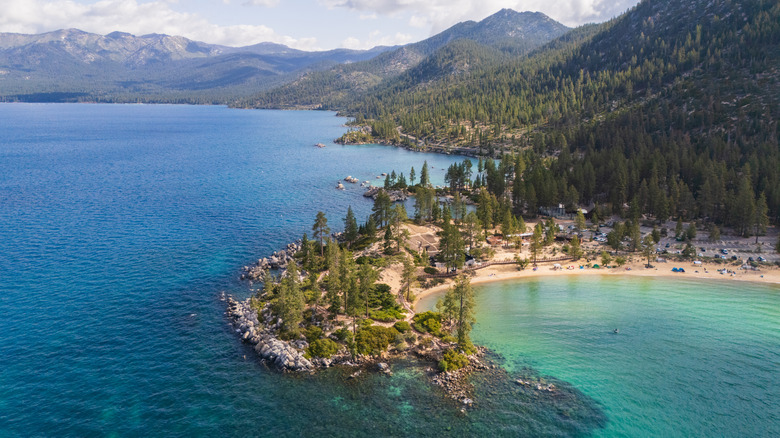
Tahoe's true clarity — measured by lowering a white disk into the lake and noting when it disappears from sight — varies by year. It's murkier in summer than winter, but even on an off year like 2024, observers could still see over 60 feet down. In Emerald Bay State Park (arguably the best base for exploring Tahoe), snorkelers and scuba divers will find boats and barges, marked with underwater interpretive panels, sunken at depths of 10 to 60 feet along the Maritime Heritage Trail. From late May to late September, tours of "Tahoe's hidden castle," the 38-room Scandinavian mansion, Vikingsholm, are available first-come at the Visitor Center.
Emerald Bay has a dog-friendly boat camp where you can dock, and from mid-June to Labor Day, it's reachable by shuttle from South Lake Tahoe or the West Shore. As the seasons change, the lake maintains its appeal as a year-round destination, with water sports giving way to winter sports. Budget travelers can hit the slopes at the Donner Ski Ranch, which SFGate calls "Tahoe's last affordable ski resort." On Old School Days (Tuesday through Thursday) in January and February, the resort offers adult lift tickets and equipment rentals for as low as $69 and $30, respectively.
Though it caters to families and remains family-owned, the ski ranch is indirectly named after the notorious Donner Party. This group of early pioneers resorted to cannibalism for survival when the nearby Donner Pass proved impassable, leaving them stranded in the area for winter. Graffiti now decorates the abandoned Donner Pass Train Tunnels, where 19th-century Chinese immigrants helped build out the Transcontinental Railroad. Summer guests of the ranch can explore these tunnels with a headlamp and hiking boots as they learn more about Tahoe's history and its place in American culture.
Tahoe's history runs as deep as the lake
In 1960, the Palisades Tahoe ski resort (then known as Squaw Valley) brought international attention to the area when it hosted the first Olympics broadcast on television. Walt Disney staged the opening and closing ceremonies for CBS, which got the idea for the instant replay when the men's slalom event ended in a close call. Putting the infrastructure in place for California's only Winter Games jumpstarted the tradition of cities building Olympic Villages to accommodate athletes. You can follow in their footsteps at Palisades Tahoe and the Olympic Village Inn.
1960 is also when Frank Sinatra bought the Cal Neva, a North Lake Tahoe hotel with a hundred years of history behind it. Established in 1926, this is the same resort near Kings Beach where a Hollywood talent agent discovered "The Wizard of Oz" star Judy Garland in the mid-1930s. Lucille Ball was a guest, and John F. Kennedy stopped by while campaigning for president. A heart-shaped bed in a since-demolished cabin is where Marilyn Monroe slept the weekend before her death in 1962.
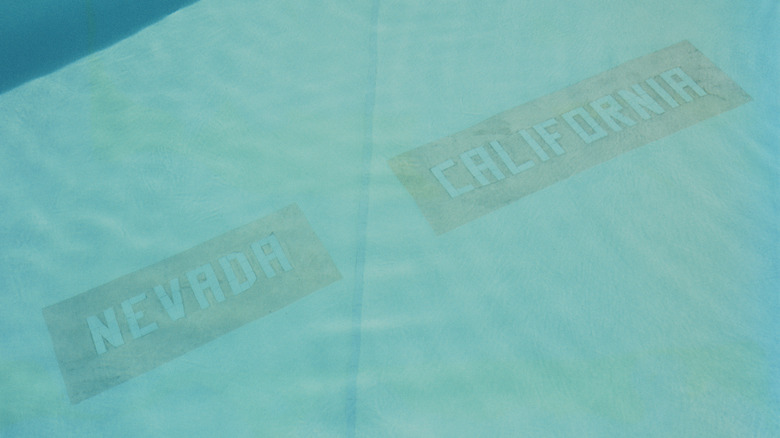
The stone boathouses on Tahoe's West Shore, where "The Godfather, Part II" was filmed in 1973, belong to the private Fleur du Lac Estates. However, set-jetters can still visit the former Cal Neva, which inspired the 2018 movie "Bad Times at the El Royale," when it reopens in 2027 as the Lake Tahoe Proper Resort & Casino after a $298 million redevelopment. Plans involve restoring at least one of the underground tunnels, used for smuggling VIPs and Prohibition-era alcohol, along with a pool that marks the Nevada–California state line underwater. While it might be too cold to swim in Lake Tahoe outside summer, a good, heated pool could be the next best thing.