

How Many Languages Are Flight Attendants Required To Learn?
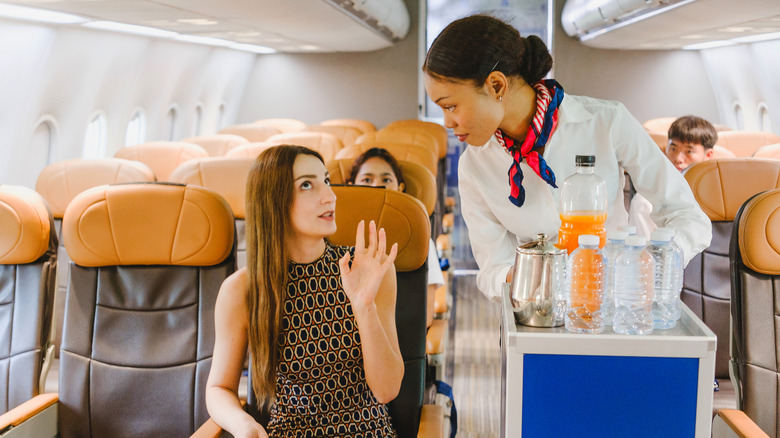
Some flight attendants travel so frequently that they're able to speak several languages fluently, and they're probably familiar with a handful of essential words and phrases from multiple countries they've visited. If you've ever taken an international flight, you've likely heard a flight attendant make crucial safety announcements during boarding. Most of the time, they'll rattle off the information in English before switching to the majority language of either the country of origin or the destination. They make the transition seem effortless, and it may have left you wondering: How many languages are flight attendants required to learn? The answer depends on which airline they work for.
There are definitely some strange requirements in place to become a flight attendant, but the ability to speak multiple languages isn't always necessary. Many domestic airlines, particularly in the United States, don't require that flight attendants learn a language other than English. Shortly after I graduated from university, I decided to work as a flight attendant while pursuing writing on the side. During my time off, I used my flight benefits to travel all over the world, but for work I mostly flew to cities within the United States. At my airline, I only needed to speak English.
That said, some major international airlines do require that all flight crew members speak at least a couple of languages fluently. Why? Flight attendants know how to handle all different kinds of emergencies that can arise on an airplane, including what to do during an emergency water landing and how to safely evacuate hundreds of passengers off the aircraft. However, most of their shifts are spent tending to passengers' needs, explaining basic safety instructions, and serving snacks and beverages. Given this, it's important for them to be able to communicate effectively.
Not all airlines require their flight attendants to learn multiple languages
At my airline, all of the in-flight announcements were offered exclusively in English, even during the rare charter flights to Spanish-speaking destinations. Although I spoke Spanish fluently, I was never asked to perform announcements in Spanish. I also didn't have priority over other flight attendants when it came to working flights to Spanish-speaking destinations. If I was lucky enough to have one show up on my flight schedule, other flight attendants and passengers did appreciate my ability to bridge the language barrier on an individual basis, but that was about it. It was helpful to be able to speak to passengers in their own language in order to make them feel more comfortable and to communicate crucial information.
Recently, I flew on Delta Airlines to Costa Rica and one of the flight attendants performed the announcements in Spanish. I asked him if he had a better chance of being awarded flights to Spanish-speaking destinations over a colleague who didn't speak a second language, and he said that he did. So, although some airlines might not require that flight attendants speak a second language, those who do speak them might be awarded a better flight schedule due to their abilities. Language training company ALTA says that flight attendants who participate in the Delta Language Program "are offered a unique set of benefits ... not offered the regular flight attendants."
Multi-lingual flight attendants may have better career opportunities
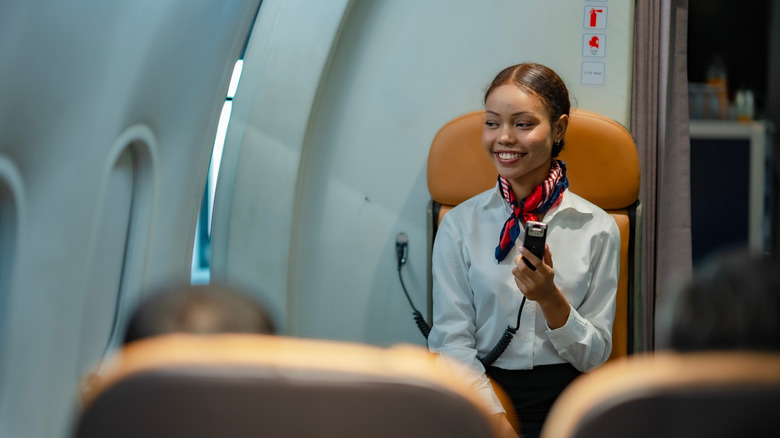
During an emergency situation, it is crucial that flight attendants have the ability to communicate critical safety information and procedures to passengers, so having crew members who speak multiple languages on board is a good idea for airlines. On any given flight, there could be passengers who speak many different languages. Some people, especially tourists from the United States, travel internationally without being able to speak a single word of the language primarily spoken in the country they are visiting. During an emergency, a flight attendant's ability to speak multiple languages has the potential to save lives.
Some major international airlines around the globe mandate that their flight attendants learn at least a few languages. Air France, Emirates, and Lufthansa require that their crew members speak a minimum of two languages. Usually, one of them has to be English. Many Europeans speak three or more languages, so it makes sense that flight attendants would need to be able to communicate easily with people from many different countries.
While it might not be 100% necessary to speak multiple languages in order to get a job as a flight attendant, it can greatly increase your ability to get hired by a major international airline. The more languages you can speak fluently, the better career opportunities you might have along the way. Given how flight attendants are paid, any advantage can be worthwhile. Airline recruiters for certain airlines may assess a flight attendant's language proficiency as part of the interview process, and someone who speaks multiple languages has a much better chance of getting the job. Additionally, some airlines offer tuition reimbursement programs. At the airline I used to fly for, foreign language classes were among the types of courses that qualified for tuition reimbursement from the company.