

Breaking This Important Airplane Rule Can Get You Kicked Off Your Flight
Anyone who has ever flown on a commercial airplane has overheard the instructions that are issued over the aircraft's PA. Slight variations of the same instructions are repeated so often that many frequent flyers can recite them by heart. You've probably heard flight crew members ask you to "ensure that your items are stowed securely beneath the seat in front of you" during boarding, or to "fasten your seatbelt" when the seatbelt sign flicks on. Undoubtedly, you've also heard the announcement that occurs just before takeoff, when it's time to put your electronic devices in airplane mode. Plenty of passengers don't take inflight announcements very seriously, but it's important to remember that the rules exist for your safety. Some airlines are cracking down on the rules, and if you refuse to put your cell phone in airplane mode, you might get kicked off your flight.
On April 27, 2026, a Delta Air Lines passenger refused to hang up their phone call. Flight 1323 was at Miami International Airport when the passenger refused to comply with crew member instructions to end their call as the plane began to taxi out to the runway for takeoff. After flight attendants requested compliance multiple times, and other passengers began to chime in, the plane returned to the gate and the passenger was removed.
Even if you think that the airplane mode rule is unnecessary, it's crucial that all passengers follow crewmember instructions. Failing to do so can put yourself, and everyone else on board, at risk. Many airlines, including Delta, have a zero tolerance policy for disruptive behavior — which means that if you don't do what you're told, you probably won't be departing on your flight.
What's the big deal about putting devices in airplane mode?
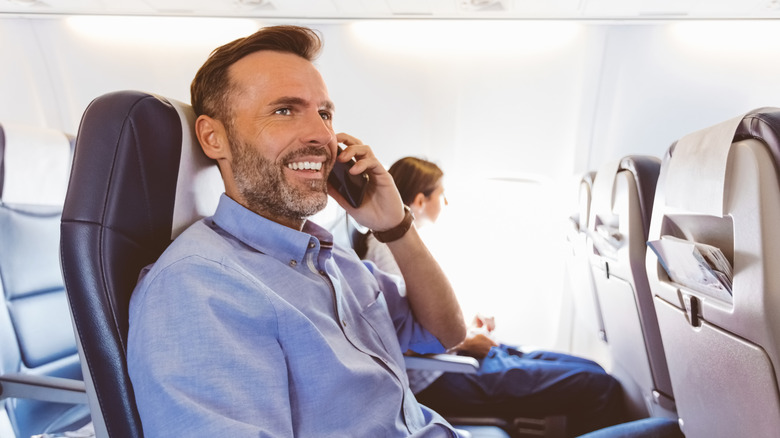
At some point, you may have accidentally forgotten to put your phone on airplane mode before takeoff, and noticed that nothing bad happened. The plane didn't crash, and you arrived at your destination safely. If it has caused you to wonder why the rule is in place, you're certainly not alone. Some passengers think the rule is outdated and unnecessary, but refusing to put your phone on airplane mode has the potential to cause chaos for pilots.
In order to connect to a wireless network, your cell phone sends out radio waves. They can also receive signals. When your device is set to airplane mode, it does not send out or receive signals. The rule exists because those radio waves could potentially interfere with the aircraft's electronic equipment. There's also the possibility that the waves from cell phones could interfere with pilots' headsets. During takeoff and landing, pilots often have low visibility, so they rely on verbal information provided by air traffic controllers on the ground. It's crucial that they're able to hear that information clearly, without interference.
It may seem annoying to have to switch on airplane mode before your plane takes off, but keep in mind that there was once a time when passengers were required to completely power off all electronic devices for takeoff and landing. In 2013, the FAA changed the rules and said that passengers could use their devices during all phases of flight, as long as they were set to airplane mode.
If you don't cooperate with crew members, they have the right to remove you
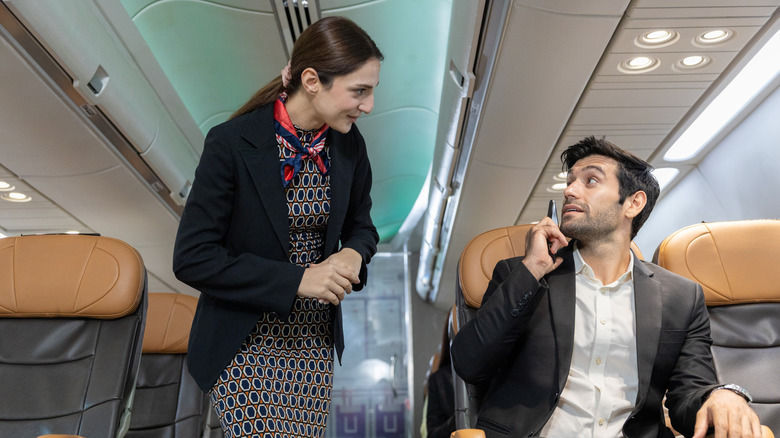
Although the chance of your cell phone causing major problems on board a commercial aircraft is low, you should still adhere to the rules. FAA regulations are federal laws, and crew members are obligated to uphold them on flights. For that reason, any passenger who refuses to comply with instructions runs the risk of being removed from the flight for the safety of all passengers on board the aircraft.
Causing a disturbance is one thing that flight attendants strongly advise against doing on a plane. When a passenger isn't able to follow simple instructions and becomes disruptive or abusive when crew members insist that they follow the rules, there is a good chance that they may be kicked off before the aircraft departs. Such was the case on Delta Airlines flight 1323. From the perspective of aviation professionals, it is safer to nip those types of issues in the bud while the plane is still on the ground. If a passenger were to become increasingly agitated in the air, it could cause a safety issue for everyone on board.
When the Delta passenger became aggravated and refused to turn on airplane mode, other passengers responded. In a video of the incident circulating on social media, other passengers can be heard asking the perpetrator to "please be considerate," and that's exactly what every single person who boards a commercial aircraft should do. Remember, commercial flights are public transportation. You aren't in your living room. You should always remain courteous of pilots, flight attendants, and your fellow travelers. Refusing to follow the rules, even if you believe they aren't important, could ruin your vacation before it even begins.