

Renting A Car? Rick Steves Urges Tourists To Use This Item For Free Parking

There are some major differences between America and Europe that you'll need to know if you're roadtripping. Rick Steves, one of the world's top travel experts, has made millions, but he still appreciates saving a few bucks on his adventures. His website is a gold mine for budget travel hacks, and he has some genius parking tips. One of his best suggestions is to use cardboard parking discs to score free parking when you're traveling in Europe.
Finding free street parking can be challenging if you're not familiar with narrow roads or parallel parking in a new rental. Instead of fighting for street parking, many travelers choose to pay for a parking lot — even Steves. "In midsize towns, I generally just pull into the most central and handy lot I can find. In bigger cities, I avoid the center (often an unpleasant grid of one-way streets) and head straight to a parking lot outside the core," Steves wrote in a blog post called "Fueling Up and Parking."
However, little costs like parking fees can start to quickly add up and eventually become a major budget killer for travelers. It's a good idea to try to save money wherever you can, and opting for free parking in Europe is an excellent way to save your budget for more exciting travel experiences. Checking the glove compartment for a cardboard parking clock allows you to take advantage of free parking zones — including parking lots — in some European countries.
Take advantage of free parking in Europe by using a parking clock
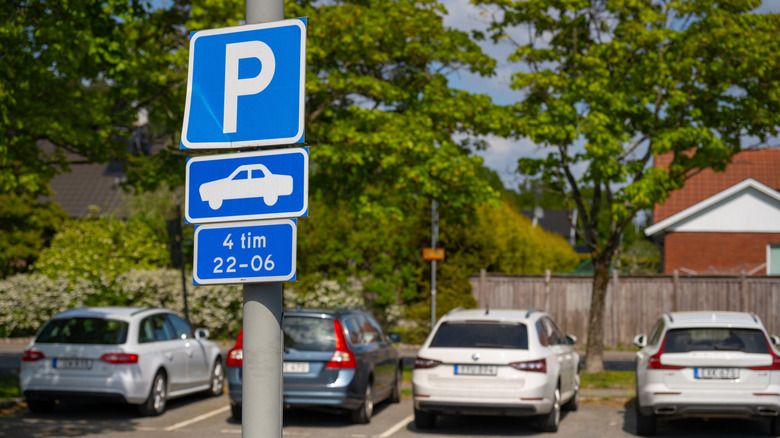
When traveling in Europe, you may not have to pay for parking at all if you're only staying in the parking lot for a short time, but you'll need to use a cardboard clock if you don't want to get a ticket. "Dashboard 'parking clocks' are used in some areas instead of parking meters," Steves explained in his article about parking.
The parking clocks that he is referring to are also known as parking discs. They are essentially thin pieces of blue cardboard shaped like a rectangle, and they are usually about the size of your hand. There is a cutout window with a moveable wheel inside. On the wheel, there are numbers and notches. As you rotate the wheel, you can change the time displayed through the window. To use the parking discs, simply rotate your disc so it points to the next half-hour mark. Place it in a visible spot on your dashboard. Make sure that you return to your car before your free parking runs out. It is not permitted to go back to your car and change the time on the disc in order to park longer for free.
In European countries, areas with free parking are often referred to as Blue Zones. "In many countries, parking signs indicate how long it's free to park, providing you place the cardboard clock on your dash set to the time you arrived," Steves wrote in another article titled "The Dirty 30 – More Cheap Tricks." Displaying the parking clock on your dashboard lets parking enforcement personnel know whether or not you are within the free parking time limit.
Where to find parking clocks and when to use them
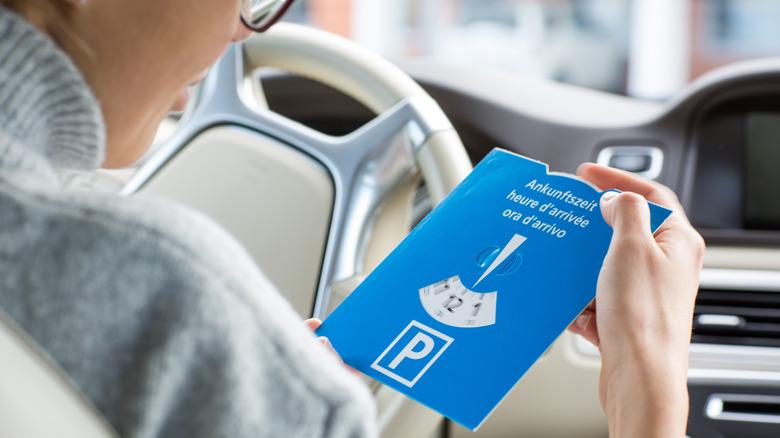
According to Steves, parking clocks are especially common in Germanic countries, where they're often called "Parkscheibe." Germany, Austria, Belgium, and Switzerland allow travelers to take advantage of free parking with the parking clock, and Blue Zones are indicated by signage. You are permitted to park for free in those areas during certain periods as long as you have a parking disc on your dashboard. If you're traveling in Italy, the cardboard parking clocks are called "Disco Orario." In France, the parking disc is called a "disque de stationnement" and the rules are similar.
If you're renting a car in a European country that has Blue Zones with free parking, your rental should come equipped with a parking clock in the glove box. If not, Steves mentioned in his "Fueling Up and Parking in Europe" article that they "can be bought cheaply at gas stations, newsstands, and tobacco shops."
Keep in mind that the rules may vary slightly depending on where you are traveling, and not all countries use the parking disc method. Do a little research on the country you are visiting to see if you can take advantage of free parking, or contact your rental car company to ask if the parking clocks are included.