

Weird Blue Creatures Are Covering Beaches In Oregon. Here's What Visitors Should Know
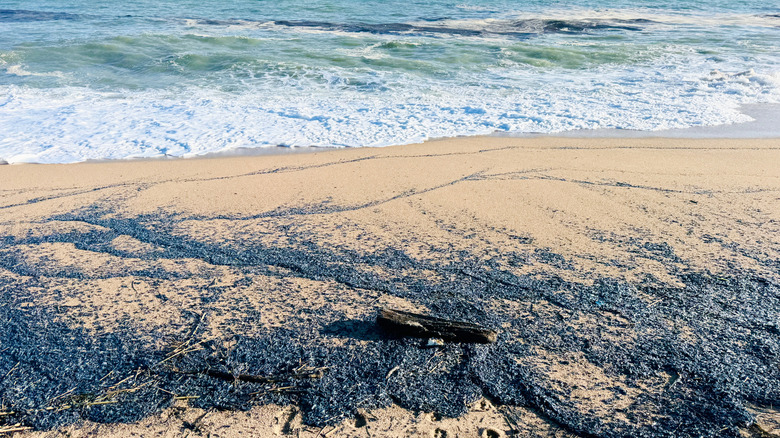
Occasionally, Oregon's coast becomes bewilderingly alien with an unnaturally electric blue shore too vivid to be foam and too vast to be a coincidence. That's how you know the Velella velella have arrived. Most people shorten the scientific name to "blue Velella" or simply "Velella," but they're also nicknamed "by-the-wind sailors." No matter what you call them, these tiny blue blobs wash up in droves, coloring the shore like scattered beach glass. If you happen to be visiting Oregon during a stranding, you're witnessing one of the Pacific Coast's most surreal natural spectacles. And according to The Oregonian, one such stranding was underway as of March, 2026.
Sometimes confused for Portuguese man-of-war jellyfish, Velella are not true jellyfish at all — but they're closely related and in the same hydrozoan family. They have a transparent sail that juts out above the waterline, sticking up from the body like a fin, and use their purple tentacles below the surface to trap zooplankton and larval fish.
Because of that sail, they're blown ashore in the millions, billions, or even trillions during the largest events and can cover over 620 miles of coast. The numbers involved are almost impossible to imagine, but University of Washington researchers have done the math for us, drawing from 20 years of citizen-science data through their Coastal Observation and Seabird Survey Team (COASST) program. They also discovered that blue Velella typically wash ashore when the temperatures rise and the winds shift. Strong westerlies can mean the end for entire colonies of these strange creatures that typically wash up on Oregon's shores in the spring.
Where to see a blue Velella stranding event in Oregon
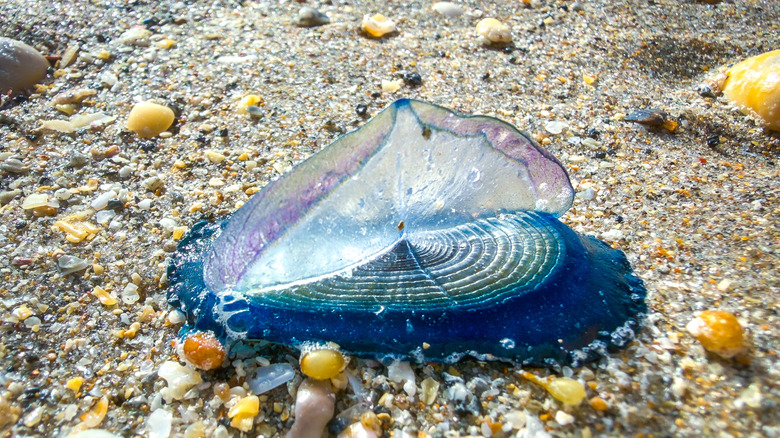
If witnessing this phenomenon is on your bucket list, a road trip along the Pacific Northwest's Highway 101 is a good place to start. Visit Oregon's coast after a warmer winter for the highest likelihood of catching a mass stranding. It's not something you can plan around precisely, but it's also not pure luck — your best bet is to aim for April, though clearly, strandings can also happen in March. Blue Velella usually wash up around Lincoln City, Arcadia Beach, and Neskowin, which features an underrated "ghost forest" along the Tillamook Coast, but you might find them scattered at other beaches as well. While the blobs look strangely pretty when they take over the beach, their washed-up fate isn't as glamorous up close. By-the-wind sailors shrivel into papery husks that smell awfully fishy as they decompose.
Fortunately, Velella aren't like dangerous jellyfish you can encounter at the beach. Most people can handle them without any reaction, but they do have some stinging cells (called nematocysts), so it's still not wise to walk barefoot through fresh strandings, just in case. If you do touch one, make sure to wash your hands before touching your eyes or mouth — but you don't need to rush off to the hospital.
However, if you're out walking your dog, you'll want to be a little more careful. Blue Velella aren't highly poisonous or fatal to dogs, but your furry friend will be more susceptible to the stingers and may get sick or itchy if they confuse the blue blobs for dog treats. Check local beach reports before you go, keep your dog on a leash, and bring a camera. A blue Velella stranding is fleeting, strange, and completely free — the best kind of Oregon coast adventure.