

This Country Will Soon Offer One Of The Fastest Bullet Trains In The World
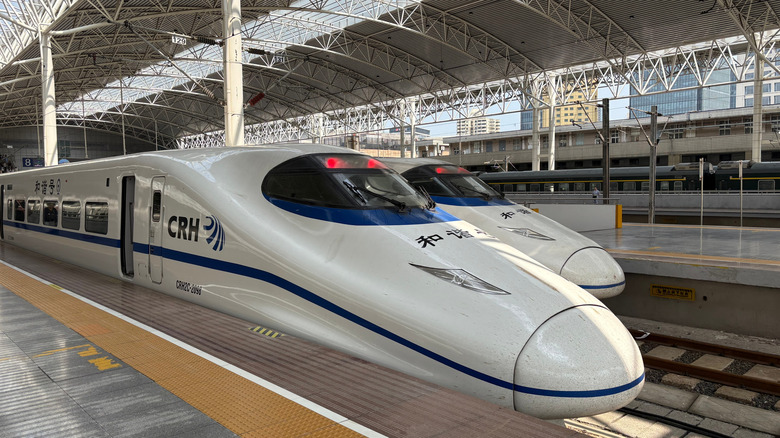
High-speed rail is generally considered to be the future of sustainable travel. High-speed trains are safe, comfortable, and convenient, with almost none of the hassle and setbacks that plague airports and road trips. Traveling by rail removes many of the delays and inconveniences of flying, with no long queues at security, fewer luggage restrictions, and no need to make long journeys to out-of-town airports. Countries all over the world are investing in their high-speed networks in order to provide alternatives for passengers, both commuters and tourists.
When you think of countries with incredible high-speed trains, your mind probably heads straight to the rail system of Japan. The world-famous Shinkansen, usually known as the bullet train, is an engineering marvel that connects most of Japan, with trains that hit a top speed of 200 miles per hour on the Tōhoku line that connects Tokyo and Shin-Aomori. Germany is another of the top five countries with the most high-speed rails in the world, with its ICE network operating across the country at speeds of up to 199 miles per hour. They have also developed a maglev train system, which can hit a top speed of 342 miles per hour, but it has never been put into service. However, the country that is currently setting the benchmark for fast rail travel is China, with its remarkable CR450 train.
China has recently unveiled prototypes of its latest high-speed rail innovation, an electric bullet train that has hit top speeds of 280 miles per hour in testing, with plans to run it commercially at around 250 miles per hour. This would make it one of the fastest commercial trains in the world in regular operation, and probably the fastest conventional wheel-on-rail train.
Speed, safety, and comfort with China's high speed rail
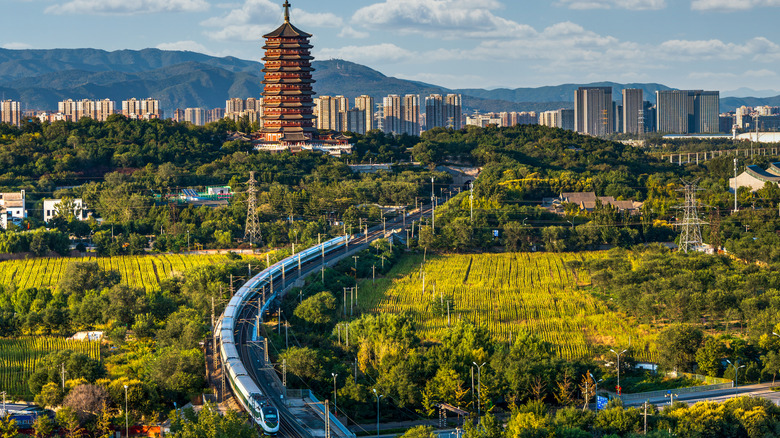
The CR450 is packed with innovative technology and cutting-edge design, which helps it squeeze out more speed without impacting safety or sustainability. Remarkably, despite the significantly increased top operating speed, it actually uses 20% less energy than the CR400 Fuxing trains it is designed to replace. This is largely due to a more streamlined and aerodynamic design but also because the train is around 10% lighter than its predecessors, with a much lower running resistance and significantly improved water-cooled traction systems. This means the train can be faster without using more power, resulting in less impact on the environment and no need to increase ticket prices to cover costs.
When racing through the countryside at speeds touching 250 miles per hour, safety is obviously of the highest importance. The CR450 has a multi-level emergency braking system, which allows it to come to a full stop from 250 miles per hour in the same amount of time (and, crucially, over the same distance) as the current trains running at 217 miles per hour. The train is packed with sensors that closely monitor all of its systems, from car bodies to fire detection.
Redesigning the trains to achieve these remarkable speeds hasn't come at the cost of passenger comfort either. Indeed, the engineers have put an enormous amount of effort into ensuring that these new trains are an upgrade on the older models. They have reduced noise inside the cars and increased the amount of space passengers have to move around, with four separate classes from Standard to Premium First. The train is expected to match or even better the total travel time of domestic flights within China, making the journey from Beijing to Shanghai, for example, in around two and a half hours.
The future of rail travel
The CR450 is part of China's wider strategy to improve its already impressive rail network and make traveling around the country an even easier experience for both tourists and commuters. The CR450 is expected to enter full commercial service this year, operating across the 29,000 miles of track that connects all of mainland China, the largest rail network in the world. There are, of course, challenges to this strategy.
Firstly, the infrastructure across the network needs to be updated and checked to ensure it can manage trains running at speeds of up to 250 miles per hour. There is also a PR campaign to be considered, as the wider plan relies on passengers choosing high-speed rail to replace driving or flying for cross-country trips.
China already boasts the largest railway station in the world, Chongqing East. And given the success of China's previous rail strategy and the impressive test results that the CR450 has demonstrated, it feels like this is just the beginning of the super-high-speed rail story, and one that Japan and European countries will be emulating soon.