

This Gorgeous Beach In Italy Is Quite Popular Despite Its Not-So-Secret Danger
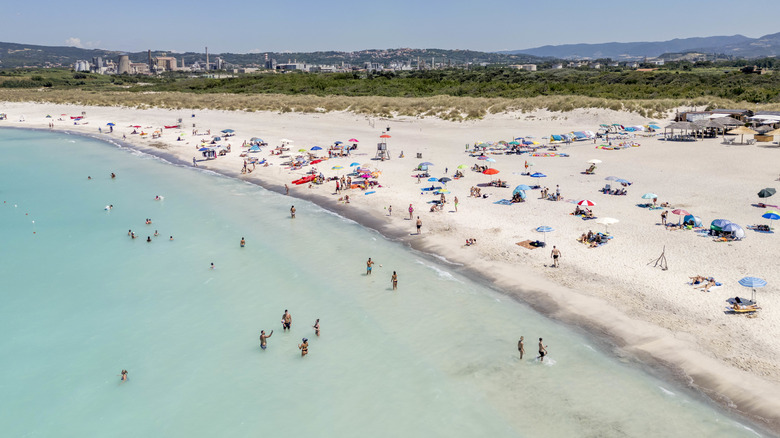
A summer visit to the Italian coast should be a laid-back, peaceful escape with afternoons spent between lying on a towel and cooling off in clear water, before finding a table in a historic piazza with sand still in your hair and a local specialty on your plate. Within that dreamy vacation sequence, there's an inherent trust about the water quality of the beach. There are ways for beachgoers to stay safe in and out of the water, but we also assume the water is being tested that and authorities would notify the public if there were health concerns, like these safety measures on France's beaches. Unfortunately, it's not always that simple.
On the Tuscan coast is the town of Rosignano Solvay. At first glance, the beach seems pristine, with shallow, light turquoise water lapping against white sand. But a closer look reveals something concerning. Stand on the shores looking out to sea, and you understand why it was given the nickname "Caribbean of Tuscany," but turn around, and you see a chemical plant a stone's throw away. The facility belongs to the Belgian Solvay chemical company and converts limestone into soda ash, an ingredient for making glass.
A 2017 study found that Rosignano had significant excess mortality rates from Alzheimer's and other diseases, which left many residents concerned about possible contamination from the plant and its canals that drain into the sea. Salvoy maintains that its facility's byproduct is simply limestone sand and poses no health risks. Calls for another study to analyze the health concerns have created a standoff between residents and activists on one side and the $10 billion multinational and some local government officials on the other. All while many continue to take their families to enjoy sunny days on the white sands.
The fight for environmental safety
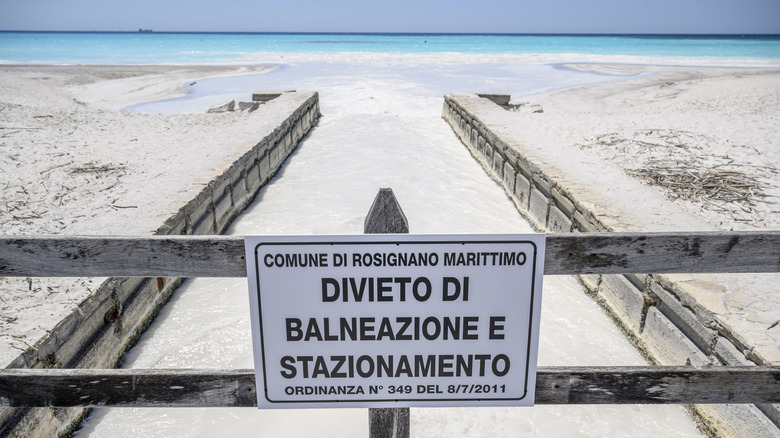
The Salvoy company built this location on the Tuscan coast in 1912. It has been such an instrumental part of the local economy that the town incorporated the name Rosignano Solvay. For over 100 years, the plant, only 200 meters from the beach, has drawn water from the Mediterranean to use for cooling in the production process. The water is then discharged into drainage canals with the facility's limestone sand byproduct. According to Bloomberg, the milky-white canals flow with 250,000 tons of solid waste material per year back to the sea, giving the beaches their Caribbean appearance.
The activity is legal and monitored by the government, but a 2008 study by a local environmental agency claimed that the company had discharged 400 tons of mercury into the water over the period of 1940-2005. Then came the 2017 study published in the International Journal of Occupational Medicine and Environmental Health that showed Rosignano Solvay had significant excess mortality in a variety of diseases when compared to the town of Cecina, which has no industrial activity. The study did not directly state the causes of the findings, but it raised significant concerns and calls for further investigation.
Cardiologist and city council member Claudio Marabotti was the lead author of the study and, along with other elected town commission members, put forward a proposal for another study. But the measure failed to get enough votes to move forward in a council meeting in 2022, with the mayor stating that Rosignano's overall mortality was not statistically abnormal for the region. Solvay's permit to operate in Rosignano had already been extended for 12 years in January, but pressure from activists and international media have caused the company to take notice.
Solvay pledges to reduce its discharge
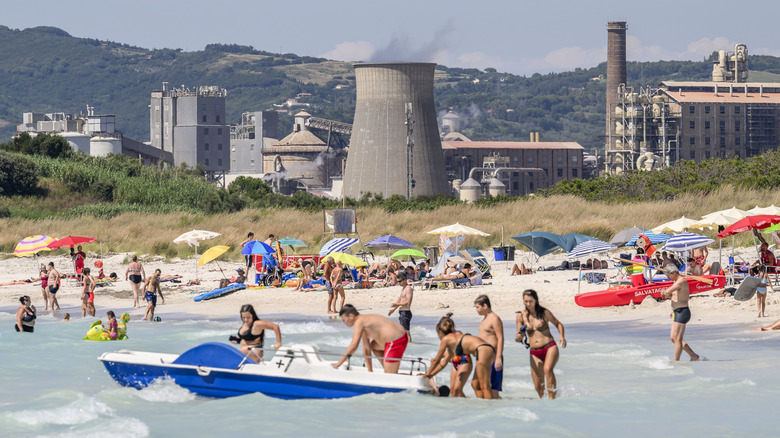
The Solvay company put out a factsheet in 2022 regarding its practices, stating, "Solvay does not use or add heavy metals in its soda ash process in Rosignano. Limestone, like many types of rock or stone, naturally contains traces of heavy metals, but those remain imprisoned in a solid state in the limestone and are not harmful for living organisms, including people and fish." While the company's discharges are within legal limits for heavy metal contaminants, some experts say that looking at the concentrations in samples is outdated and the aggregate amounts of contaminants gives a more accurate analysis.
Without a proper follow-up study, it's difficult to definitively know the environmental and health impacts. A new study would take a year of research and cost around $46,000. About which, Marabotti told Vice, "In my opinion, this study is absolutely necessary and cannot be further postponed. Obviously, we could have a risk for public health that should be recognized and reduced as soon as possible. Moreover, in the case no relationship was found, this could in turn have a positive effect on tourism, not really hampered by the reputation of being a polluted place."
For its part, Solvay has put forward plans to invest €15 million to cut back limestone residue and carbon emissions, with overall discharges into the sea reduced 20% by 2030, 40% by 2040, and completely by 2050. In the meantime, tourists continue to visit and swim in the famously white beaches at the Caribbean of Tuscany, paying no mind to the smokestacks in the background. But to play it safe, it might be best to add Rosignano Solvay to this list of destinations to avoid when booking your next European beach vacation.