
This Spectacular California Beach's Unique Feature Makes It A Popular Coastal Destination
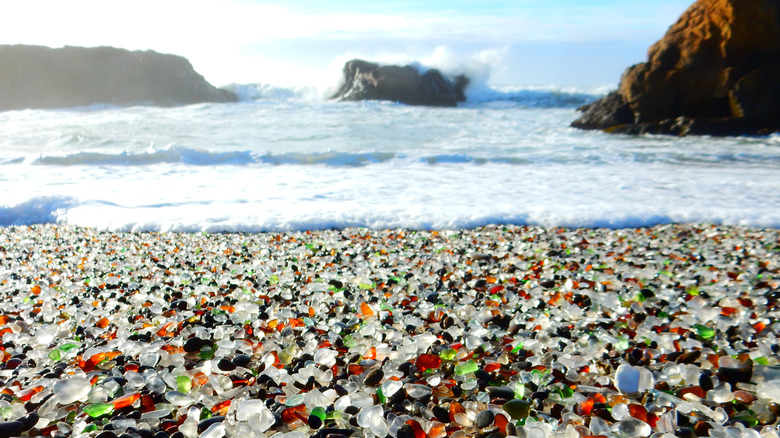
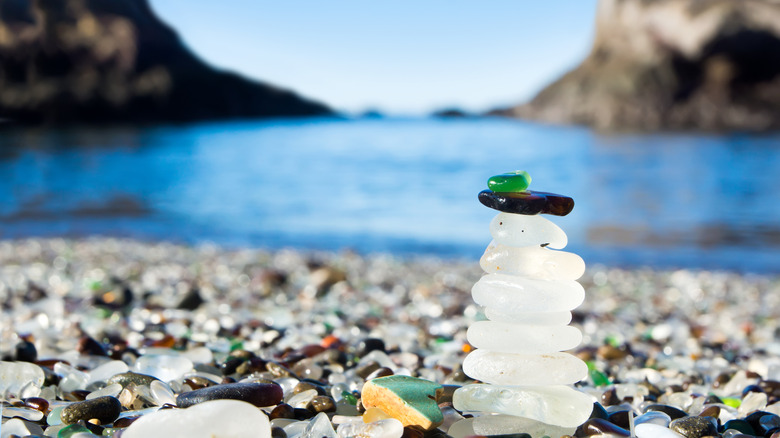
Glass Beach is one of the most unique beaches in America. The beautiful Fort Bragg beach is covered with small pieces of smooth, colorful sea glass. It is so enchanting that it has become a popular stop on California's idyllic North Coast.
This beach was not always considered such a gem, though. It may have been unique, but no one called it beautiful or enchanting in the early 20th century. In fact, people in the region called it "the Dumps." That is because it became the town dump after the massive earthquake that rocked San Francisco in 1906. People threw everything — from glass to appliances to vehicles — over the cliffs as they cleaned up and rebuilt the city of Fort Bragg. The Pacific Ocean below was basically a trash heap for decades.
Fort Bragg's city dump was finally closed in 1967. Then the Mendocino Land Trust, a nonprofit that conserves and restores land for public access, went to work. It removed waste, cleaned up the site, and protected it against future development. MacKerricher State Park, which now includes nine miles of coastline and more than 2,400 acres, was established. A the same time, the ocean was doing its part. It was breaking the big chunks of glass into small pieces and naturally polishing them into small, sparkling gems. That sea glass is now strewn all over the sand.
How to access Glass Beach
Glass Beach is in Fort Bragg, one of the best beach towns in California you've never heard of. The small city was founded as a military garrison in 1857, which was incorporated 32 years later. It is now home to more than 7,000 people. Route 1, known as the Pacific Coast Highway (the PCH), which extends 656 miles between Dana Point (in south Orange County) and Leggett (over 43 miles north of Fort Bragg), runs through the glass beach. Mendocino City, which, together with Fort Bragg, is one of the must-see destinations for your ultimate West Coast road trip, lies just 10 miles south.
Most road trips to the northern coast of California start in San Francisco, California's fourth most populous city. San Francisco International Airport (SFO) is the nearest large airport, with services connecting from all across the country. From there, it is a nearly four-hour drive up the 101, another scenic highway, to reach Fort Bragg. You will pass quaint small towns, cities, charming redwood forests, and wineries along the way.
Once you arrive in Fort Bragg, you will find Glass Beach at the southern end of MacKerricher State Park. It is easily accessible from a free parking lot where Elm Street meets Old Haul Road. You will follow the Coastal Trail, an eight-foot-wide paved path, to an unpaved footpath that heads down to the beach. If it is low tide and sunny, you should be able to see the glistening sea glass before you even reach the sand. To preserve the sea glass, you can enjoy it while you're there — but don't take it home.
Explore the rest of MacKerricher State Park
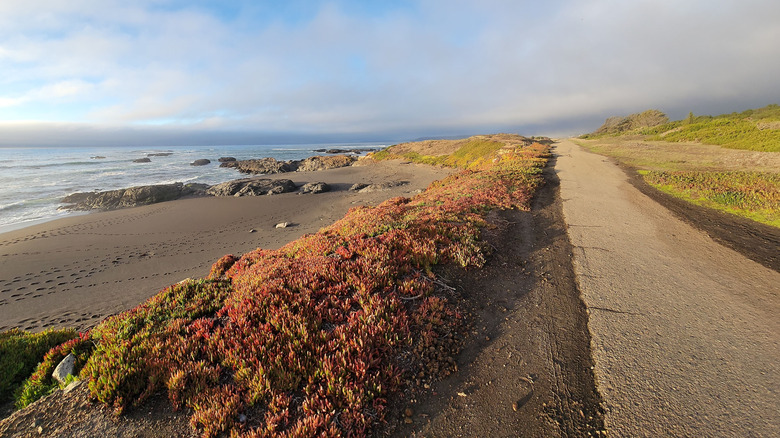
Though Glass Beach is what initially drew you to Fort Bragg, you should not pass up the opportunity to explore the rest of MacKerricher State Park (just note that there is a vehicle day use fee $8) while you are here. The MacKerricher State Park Visitor Center is located right off the PCH, about three miles north of Fort Bragg. There is a huge skeleton of a 30-foot-long gray whale at the entrance, and you may see seals on the beach itself.
Lake Cleone (a 30-acre lake), picnic areas, and a lot of campsites are behind the Visitor Center. The lake, which was once a tidal lagoon, is now the home or rest spot of more than 90 species of birds, and there's a 1.3-mile loop trail that circles the lake you can enjoy. It is a popular fishing spot for largemouth bass and prickly sculpins, as well. The Lake Cleone picnic area has running water and great lake views. There are more than 140 campsites (from $35 per night) in the state park, so you can spend more than a day exploring the area. You'll have restrooms, food storage lockers, fire pits, and more — but it's closed October through February.
The rest of MacKerricher State Park is full of bluffs, dunes, forests, and wetlands. Natural tidal pools trap water along the shore where you might glimpse some small fish, crabs, sea anemones, and more. Harbor seals like to lounge, sunning themselves on the surrounding rocks. Mid-April through mid-May is the best time to visit the rookery to see the seal pups. Then, the coastal headlands, particularly during the winter and the spring, are good places to scan the water for migrating whales. No wonder Fort Bragg is on so many wish lists.