

5 Of Europe's Best Clifftop Castles To Visit For Magnificent Views
One of the most exciting and attractive aspects of Europe as a vacation destination isits rich, fascinating history. Wherever you go in the Old World, you'll encounter amazing architecture and remarkable ancient structures showing just how powerful Europe's past was and remains. One of the clearest examples of this, and one of the most amazing things to see on a trip to Europe, is its wonderful variety of castles.
Europe is filled with incredible fortifications, from tiny watchtowers and fortified houses to vast, hulking citadels. Due to the strategic military purpose many of these stunning strongholds were originally built for, they can often be found in some of the most awe-inspiring locations, perched atop towering peaks and overlooking daunting drops. For fans of panoramic vistas and medieval splendor, Europe's cliffside castles are outstanding.
If you want to blend historic excitement with gorgeous natural beauty and unreal views, we've picked out five of the most impressive cliffside castles across Europe. From Neuschwanstein Castle in Germany and Pena Palace in Portugal to the dramatic glory of Bled Castle in Slovenia, the impenetrable grandeur of Strečno Castle in Slovakia, and the tiny hilltop fortress of Guaita in San Marino, these are unmissable destinations for history buffs.
Neuschwanstein Castle, Germany
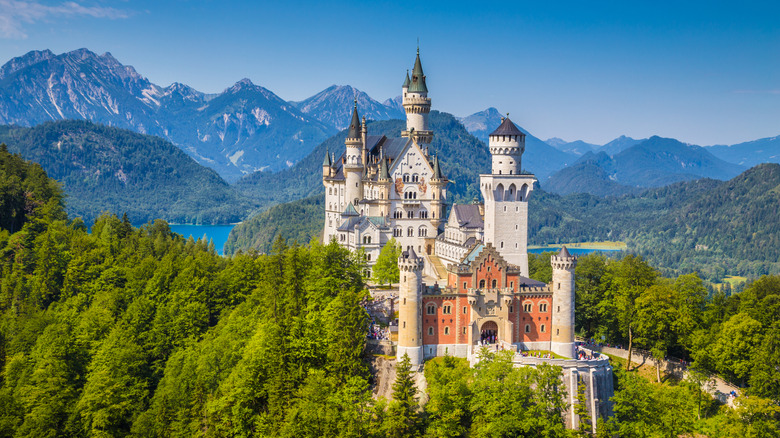
Neuschwanstein Castle in Bavaria, Germany, is one of Europe's most mesmerizing cliffside castles. It's also one of the world's most visually recognizable castles, being the inspiration for Disney's Sleeping Beauty castle, which forms part of its iconic logo, a symbol known around the world. It's easy to see why Neuschwanstein Castle caught Walt Disney's eye. It's a proper storybook structure, straight out of a fairytale, with clean white walls, towering turrets, and gorgeous royal blue spires, perched atop a forested mountain with an amazingly beautiful background of hills and valleys.
Unlike many of Europe's other castles, Neuschwanstein was specifically designed to be something out of a fantasy, with aesthetics rather than practical military or defensive applications the priority. King Ludwig II of Bavaria wanted to demonstrate his royal power and grace, and designed Neuschwanstein as the epitome of what he felt a palace should be.
This flew in the face of reality, as he had just lost a war and actually bankrupted the kingdom with his building project. In the end, he was declared insane, arrested, and died under mysterious circumstances. Nevertheless, his pet project is a magnificent, magical folly and a must-visit for castle fans in Europe. Regular admission to the castle costs 21 euros ($25).
Pena Palace, Portugal
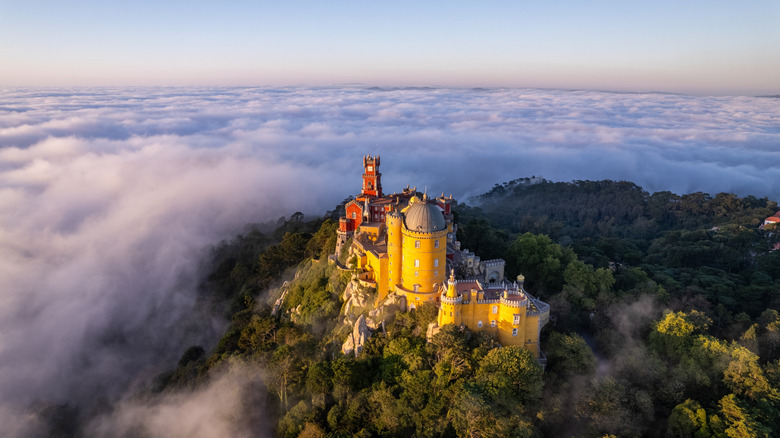
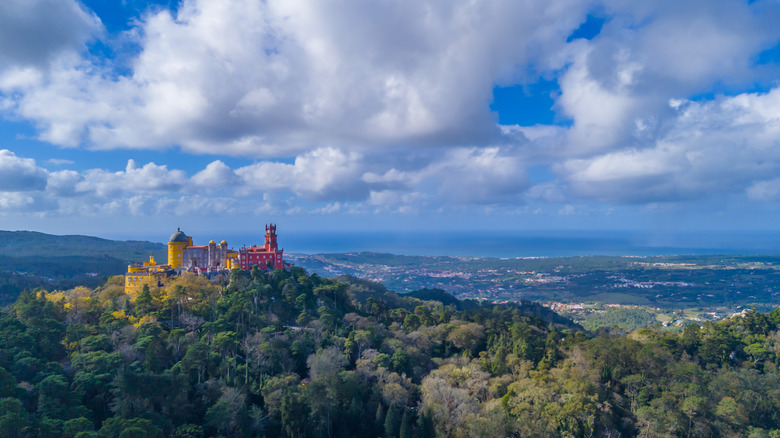
Another spot that seems to have been lifted straight from the pages of a fantasy novel is Pena Palace, just outside Lisbon in Portugal. With its eye-catching pink, purple, yellow, and red walls, picturesque crenelations and buttresses, and deliberately grotesque gargoyle water spouts, it's an incredible sight, and it's easy to see why renowned European travel expert Rick Steves calls this vibrant masterpiece "the Versailles of Portugal". Constructed on the site of a medieval monastery, the castle was designed as a summer retreat for the Portuguese royal family in the mid-19th century.
Part of Pena's charm is its eclectic mixture of architectural styles, a feature of the Romantic style that was popular at the time it was renovated, restored, and rebuilt. With influences that include German Gothic, Italian Renaissance, and Andalusian Moorish, it's an astonishingly varied sight, a riot of color and design, that's as captivating to look at from afar as it is to explore up-close.
The castle appears out of the forest on the winding approach from the coast, often wreathed in mists, on a prominent outcrop of rock in the Sintra mountains. The views from the battlements and terraces are glorious, gazing out across the woods and plains below, and on a clear day, you can see all the way to the Atlantic Ocean in the distance. There are a number of different monuments, gardens, and buildings to visit in the Parques de Sintra, all of which have separate tickets. The entry fee just for the Pena Palace and Gardens is 20 euros ($23.70).
Guaita Tower, San Marino
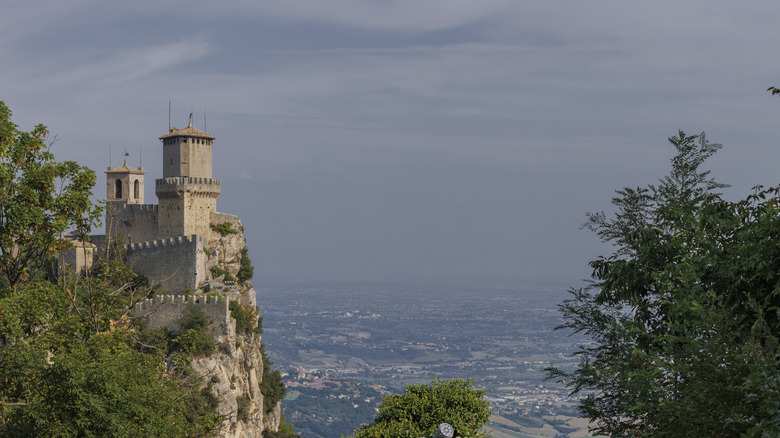
San Marino is one of the world's most unusual places. A principality of just 24 square miles, it's the fifth-smallest country in the world, and claims to be the world's oldest continuously existing sovereign state. Located in the foothills of the Apennine Mountains, its landscape is craggy, rocky, and dramatic, with the capital, San Marino, perched on top of the peak of Monte Titano. As a landlocked state surrounded entirely by another country, forts and watchtowers have been a feature of San Marino for its entire existence, and the Guaita Tower is one of its most impressive, looking out from the edge of Monte Titano over the Italian plains below.
Guaita Tower is one of San Marino's iconic Three Towers, fortresses constructed to protect the capital city. The oldest of the three, it's played various roles throughout history, most notably serving as a prison and a vital defensive structure during the conflict between the Papal States and the Malatesta family of Rimini.
Visitors can climb around the historic stone structure, exploring inside and out, as well as accessing the other two defensive towers of San Marino via narrow, steep pathways. For the best views, climb to the very top of the Guaita Tower, perched high above the city and the plains below, for a complete, 360-degree panoramic vista. Entry costs 8 euros ($9.50) for a combined ticket for all 3 towers and several other state museums.
Bled Castle, Slovenia
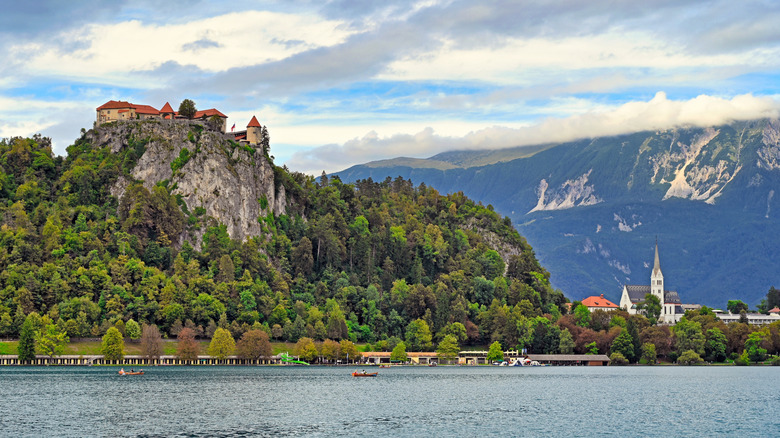
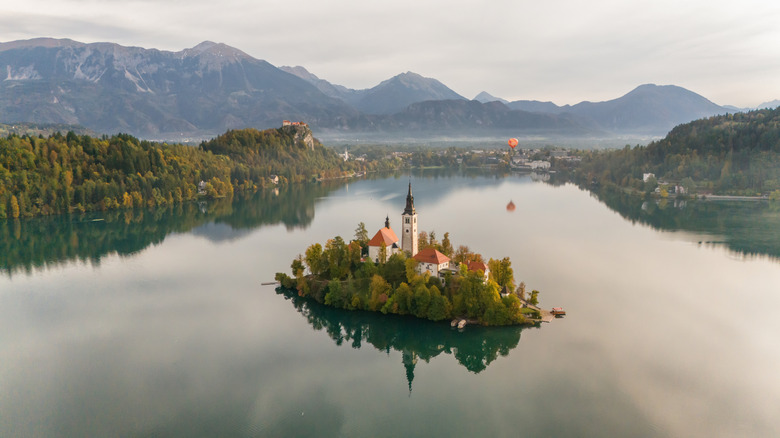
The picturesque turquoise waters of Lake Bled and the snow-capped peaks of the Julian Alps create the perfect backdrop for Bled Castle, making it one of the most visually stunning fortresses to visit in Europe. Slovenia is one of Europe's best-kept secrets, and this magnificent castle is one of its most glorious hidden gems. Built over one thousand years ago, it's Slovenia's oldest castle, and a visit gives travelers the chance to dive into the fascinating and often overlooked history of this fabulous corner of Europe. Entrance to the castle costs 19 euros ($22.50) per person.
Perched on a cliff overlooking Lake Bled, the views from the castle are stunning, taking in the beautiful island at the center of the lake with its 15th-century church, the rolling forested hills that surround it, and the faded, craggy peak of Mount Triglav, Slovenia's highest mountain, in the distance. The castle itself offers far more than just great views. It boasts a wonderful museum with incredible artifacts from Slovenia's rich history, all the way back to the region's first inhabitants, most notably a 60,000-year-old Neanderthal flute.
Fans of historic architecture will be delighted by Bled's combination of Romanesque and Renaissance, as well as the delightful illusionist frescoes in the 16th-century chapel. The castle also boasts an excellent restaurant, which serves up local delicacies and wine from its own wine cellar.
Strečno Castle, Slovakia
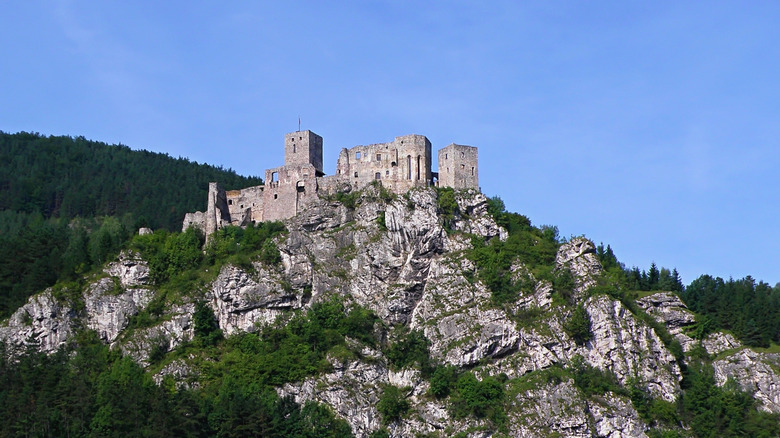
Slovakia has some of Europe's most dramatically situated castles, but Strečno towers high above the competition. Looming over the Váh River, seemingly carved out of the side of the cliff itself, it's a majestic, brutish ruin with some truly extraordinary views of the Slovakian countryside. It was originally built in the 14th century to guard the river passage and ensure that merchants paid the appropriate river toll, and it's easy to see what an imposing structure it would've been.
In the 17th century, the castle was demolished by King Leopold I. It was renovated in the late 20th century, but remains in ruins today, an echo of what it once might've been. Exploring the walls and damaged structures is still a romantic and atmospheric step back in time to Slovakia's medieval past.
Alongside the ruins and the remarkable views, Strečno Castle has an excellent museum with several interesting exhibitions, including displays about the castle's inhabitants and owners, as well as an archaeological exhibition exploring the history of the region. Entry to the castle is 7 euros ($8.30) per person, and an English-speaking tour guide can be hired for 15 euros ($18) per group.
Methodology
To curate this list, we looked at lists of top castles to visit in Europe from a range of authoritative sources. We then cross-referenced with location, maps, and image searches, plus first-hand accounts, to find a comprehensive list of the most impressive castles with the best views. From this list, we chose five of the best, based on reviews and recommendations, prioritizing castles that were able to provide a combination of amazing panoramic vistas, beautiful settings, and awe-inspiring fortifications.