

Was Flying In The 1970s As Glamorous As Travelers Remember?
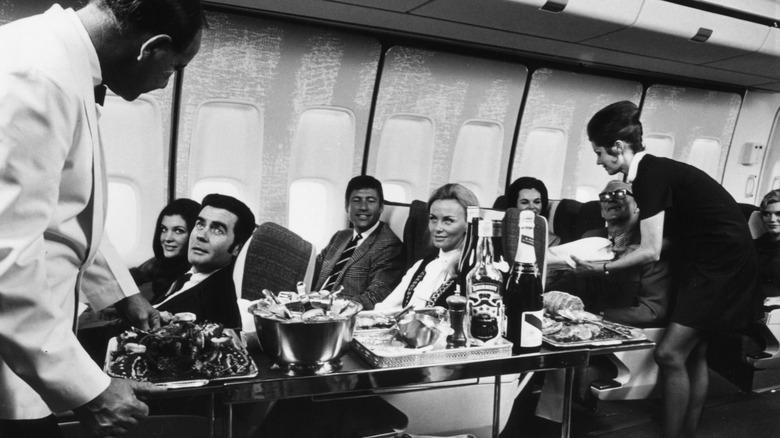
In our modern era, traveling by airplane isn't really viewed as a luxurious experience. Most frequent travelers agree that it's kind of a drag, and many suffer from flying anxiety that is exacerbated by the lack of space and uncomfortable atmosphere. Unless you're willing to shell out the big bucks for a seat in first class, you're likely going to feel cramped and a little bit stressed out by the time you deplane to your final destination. If you're taking a long-haul flight, you might be served a salty meal that resembles a TV dinner, and if your flight is only a few hours, you'll be lucky if you receive a tiny bag of stale pretzels. Flying in the 1970s was an entirely different experience. Travelers certainly enjoyed some glamorous perks when flying throughout that era, but it wasn't quite as perfect as the pictures portray. Between the cost, the risks, and the way some staff and passengers were treated, air travel wasn't as glamorous as it's often portrayed.
By the start of the 1970s commercial air travel had already been popular for several decades. Shortly after WWII people began traveling much more frequently, and by 1955 more people traveled by plane than by train in the United States. Long-haul flights across the Atlantic offered a much faster alternative to traveling across the pond via ocean liner. The 1950s, 1960s, and 1970s are nostalgically referred to as the "Golden Age of Travel," and it's pretty easy to see why.
Glitz and glamour on 1970s jets
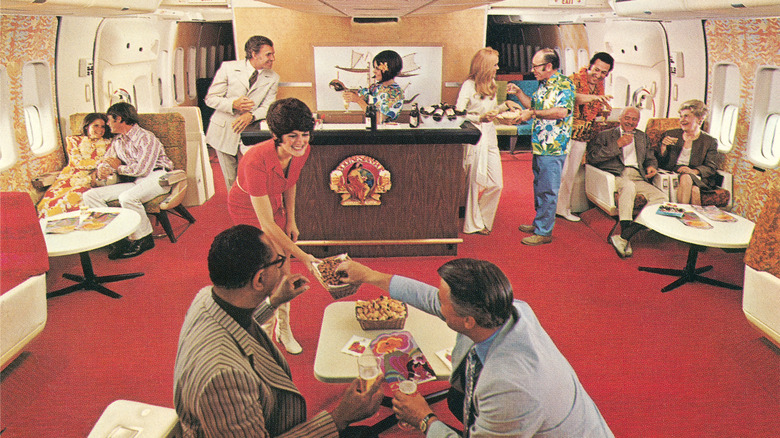
Planes had gotten bigger and tickets had gotten cheaper by the '70s. Before the Jet Age, traveling abroad was difficult. The journey from the U.S. to Europe by boat took around five days. Most people could only afford to make the trip once or twice in their lives — if at all. On January 13, 1970, an article published in the New York Times announced that a Pan American World Airways Jumbo jet made the trip in just six and a half hours. The Boeing 747 carried 361 passengers. It was the largest aircraft the world had ever known and was dubbed the Queen of the Skies.
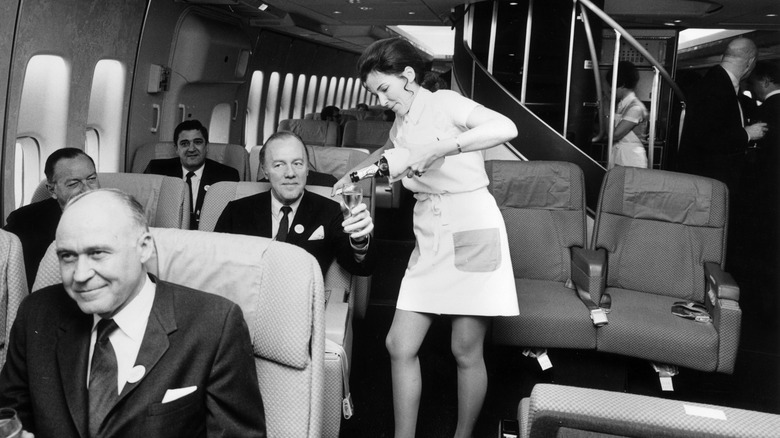
Passengers on those 1970s jets enjoyed glamorous service. A traveler named Gene described what it was like flying on a 747 back then in a post on a SimplyFlying discussion forum. "They actually carved a roast beside your seat," he wrote. He went on to describe a flight from JFK to MAD in 1975 in which he ordered cocktails at the upper deck bar before returning to his seat for a luxurious meal. Airlines used to offer passengers comfortable seats and luxury perks. (There are lots of things airlines used to do but don't anymore.) Today most airlines ask you to swipe your credit card for a can of soda, but back then passengers enjoyed a bottomless supply of free booze.
First-class passengers could expect menus designed by chefs with food like lobster and steak served on fancy china plates. Some planes even had live piano music in the chic on-board cocktail lounges. Flight attendants were known as stewardesses and were primarily young, beautiful women. Their uniforms were designed by iconic luxury fashion designers.
The dark side of travel in the 1970s
Jet Age travel was luxurious, but it wasn't all sunshine and rainbows. Sure, 1970s passengers enjoyed more glamorous perks — but they ultimately paid for them in the cost of their ticket. These days traveling via plane is accessible to most people thanks to ultra-low-cost carriers, but in the 1970s most of the passengers on airplanes were still rich white people. Flying was difficult for Black travelers in the 70s. Airlines were no longer allowed to legally segregate passengers in-flight, but many airports across the United States were still segregated. Some Black Americans avoided traveling by plane due to racism.
The aviation industry was, and by some accounts still is, extremely sexist. Requirements to become a flight attendant were rather extreme. Ladies were expected to weigh under 140 pounds and have slender figures. They had to be taller than 5' 2" and shorter than 5' 9". They weren't allowed to be married, have kids, or be pregnant, and were expected to retire in their early 30s. Those images of smiling flight attendants from aviation's Golden Age belie the fact that many stewardesses were constant victims of sexual abuse and harassment from passengers and pilots alike.
The dangers of 1970s air travel
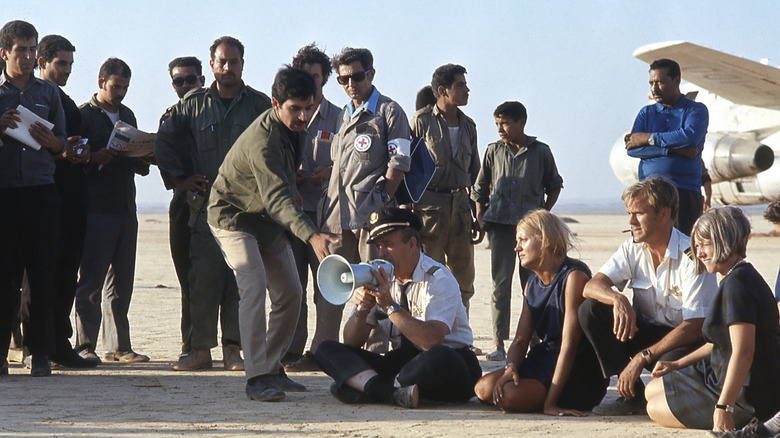
Flying was also somewhat dangerous back then. Hijackings were pretty common in the '60s and '70s, and hijackers would hold passengers and crew members hostage until exorbitant ransoms were paid. On September 6, 1970, four separate airplanes were hijacked on the same day. Throughout the decade, there were 394 airline accidents around the globe. 2,373 people were killed in plane crashes in 1972 alone.
Planes lacked modern collision-avoidance systems, ground-proximity warning systems, and real-time weather radar. Navigation relied more heavily on pilot judgment and ground-based radio aids. While effective, the risk of midair collisions and weather-related accidents was higher than it is today — especially during poor visibility or severe storms.
Additionally, smoking was permitted in designated sections, and some airlines even handed out free cigarettes to passengers. It didn't raise many eyebrows at the time, since smoking indoors was common almost everywhere. Today, we know that sitting for hours in a sealed cabin filled with cigarette smoke posed serious health risks to both passengers and crew. Although flying today might not be as glamorous as it appeared back then, it is safer, cheaper, and more accessible.