

Europe's Top 5 Hot Springs To Stay Warm During Your Winter Getaway
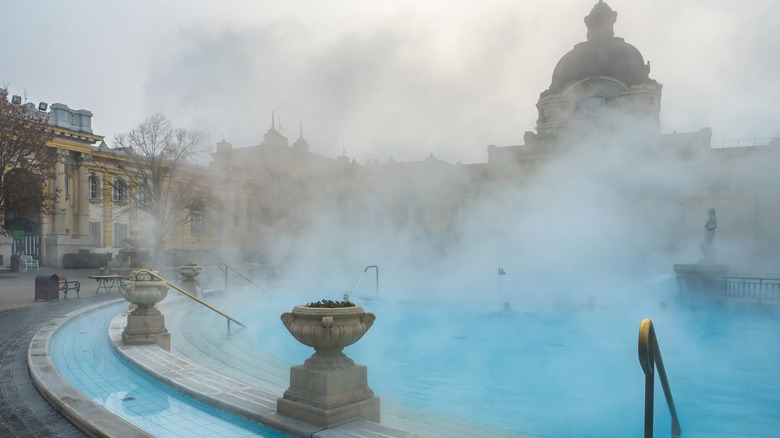
Winter vacations are often characterized by physical activity. Cold weather attractions tend to come with a fairly large dose of exertion, whether it's flying down black diamond ski runs, trekking across frozen glaciers, or paddling through crystal-clear fjords. But sometimes, when the temperature hits rock bottom and the nights come early, what you really want is to relax and pamper yourself. And for a luxurious, peaceful, and wonderfully decadent winter vacation, Europe's natural hot springs are hard to beat.
Thermal spas are naturally occurring hot tubs, warmed by powerful geothermal energy beneath the ground, and rich in soothing, energizing minerals. Thermalism in Europe has a long, rich history stretching back centuries, and Europe's thermal baths are usually found in beautiful destinations and surrounded by stunning architecture. Soaking in a natural hot spring is the ideal way to recover after a day of cold weather activity, or a delightful thing to base an entire trip around!
So if you're heading off on a winter getaway to Europe, why not check out these five amazing hot spring destinations, from the Council of Europe's legendary European Route of Historic Thermal Towns. Winter warmers don't come better than this!
Szechenyi Baths, Budapest, Hungary
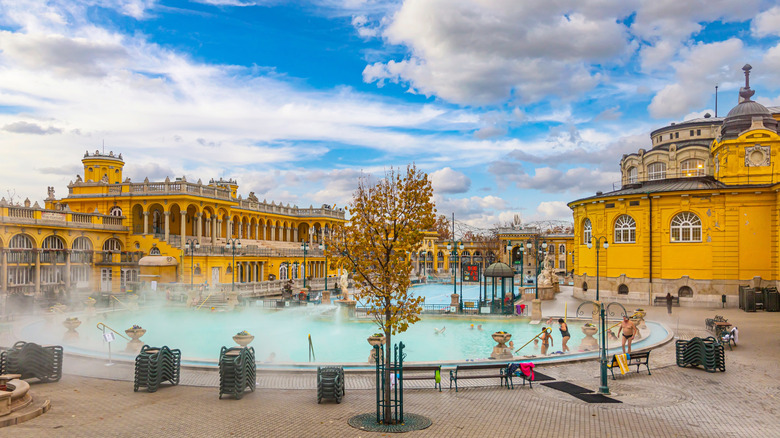
Budapest is one of Europe's greatest spa cities, filled with an incredible array of gorgeous Turkish baths, most dating from the 16th and 17th centuries. The city's best, local-approved thermal bath is the majestic Szechenyi Baths, an enormous, opulent complex of 15 indoor and three outdoor pools, saunas and steam rooms, and a variety of other spa facilities. The building is stunning, built in 1913 in neo-Baroque and neo-Renaissance styles, with the large outdoor pools a particular highlight, set against the yellow walls and grey domes of the main buildings.
The Szechenyi Baths are particularly atmospheric during winter, when elderly locals play chess around the edge of the main pool, almost hidden in the steam and semi-submerged to stave off the cold, crisp air. Budapest itself is a winter gem, with spots like St Matthias Church and the Fishermen's Bastion looking exquisite against a backdrop of snow and frost.
The Szechenyi Baths are located in City Park (Városliget) in the northeast of Budapest, at the end of the historic M1 metro line. Tickets can be bought online in advance or at the ticket office, and start at HUF 9,900 ($30).
Baden-Baden, Germany
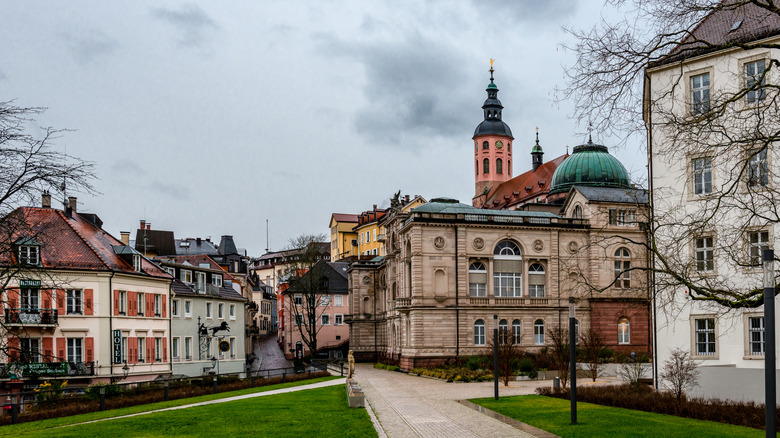
Baden-Baden has been a spa town for nearly 2,000 years, since the Roman emperor Caracalla discovered the town and built thermal bath facilities there in about 200AD. It's one of the most famous spa destinations in Europe (Baden-Baden literally means 'bathing' in German!) and has been a glamorous vacation spot for people looking to "take the waters" and enjoy the natural healing properties of the baths since the 19th century.
Baden-Baden boasts 12 artesian thermal springs, packed with sodium chloride. Rising at temperatures between 133°F and 156°F, they are some of the hottest springs in the region. There are two main spa complexes, the Roman-Irish Bath (Friedrichsbad) and the Baths of Caracalla. Friedrichsbad is the older and more traditional offering, with beautiful tiling, classic German spa treatments, and complete nudity, while Caracalla is rather more modern, with outdoor areas contributing to a slightly more sociable atmosphere.
Baden-Baden makes a fantastic destination year-round, but it's truly magical during winter. The deep, dark Black Forest surroundings are sumptuous when dusted with frost and snow, offering incredible opportunities for brisk winter hikes, while neighboring towns come alive with classic German winter markets, covered in twinkling lights, and with plenty of seasonal treats to eat and drink. The historic spa town is located in southwestern Germany, near the French border. It's a short, half-hour drive from Karlsruhe-Baden-Baden Airport, and under an hour from both Karlsruhe to the north, and Strasbourg, across the border in France.
Bagnères-de-Bigorre, France
Another spa town with a staggering amount of history behind it, Bagnères-de-Bigorre was one of the Roman Empire's most popular and famous hot springs. The town was conquered by Julius Caesar in 56 BC, and was named Vicus Aquensis, which translates as City of Waters. The natural thermal baths remained popular throughout the town's history, and today it's one of the most renowned pampering spots in southwest France.
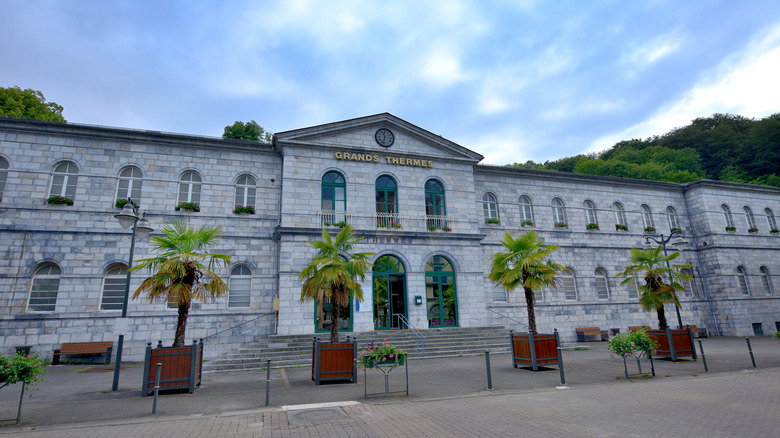
Les Grands Thermes is probably the most traditional and beautiful spa in Bagnères-de-Bigorre, thanks to its grand 19th-century classical frontage and Pyrenean marble details. It offers a wide range of healing treatments targeting everything from rheumatism to psychosomatic disorders, as well as three thermal pools. Another intriguing option in town is Aquensis Thermal Spa, which focuses more on pampering, with a hammam, a luxury spa, and various pools. Entry starts at €13 ($15).
The reason why Bagnères-de-Bigorre makes such an excellent destination for a winter spa getaway is its location, in the heart of the Hautes-Pyrénées, right next to the Grand Tourmalet/Pic du Midi ski resort. It's the perfect combination of exhilarating winter sporting action and thermal relaxation.
Baden bei Wien, Austria
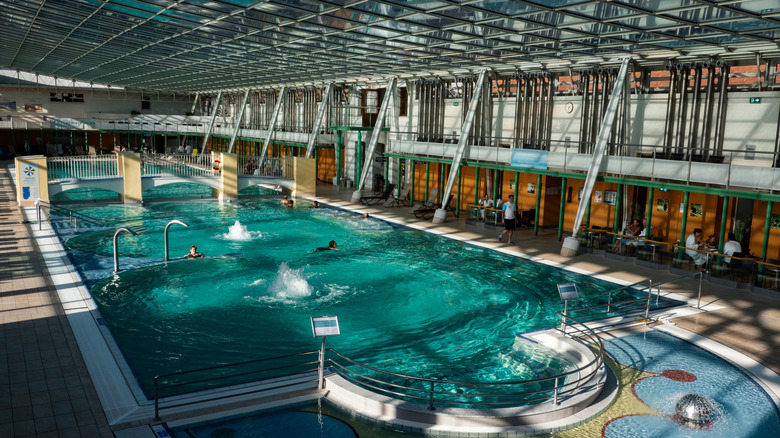
Situated just outside Vienna, one of Europe's most elegant cities, Baden bei Wien is one of the most fabulous spots to visit in Europe for a natural hot springs experience. One of the eleven Great Spa Towns of Europe, according to UNESCO, there's archaeological evidence of human settlement in the center of the thermal spring field here since Neolithic times, making it one of the most ancient spa destinations in the world. A popular spot throughout history, the sulphur-rich waters have been famous for their healing and soothing properties since Roman antiquity, and the town was known as the "Spa of Emperors" in the 19th century thanks to the patronage of the Habsburg rulers of Austria-Hungary.
The Kurpark is the main site for thermalism-focused tourism. This 200-year-old park is the home of the Kurhaus, an extravagant roof of glass and metal that covers the original hot spring and forms the Baden bei Wien Thermal Spa. The landscaped gardens offer a beautiful backdrop to a soak in the hot waters, and it's easy to see why Baden bei Wien has attracted a large number of famous names over the years, including Beethoven and Mozart, who both composed some of their most famous works here. It's also worth exploring the Arnulf Rainer Museum, an art gallery housed in a former bathhouse, which is an incredible combination of architectural beauty and artistic expression.
As a cold weather getaway, Baden bei Wien benefits enormously from its proximity to Vienna, one of the top destinations for a winter trip to Europe. From world-famous Christmas markets and outdoor ice-skating to cozy coffee houses, it's an exceptional place for a winter city break.
Caldes de Montbui, Spain
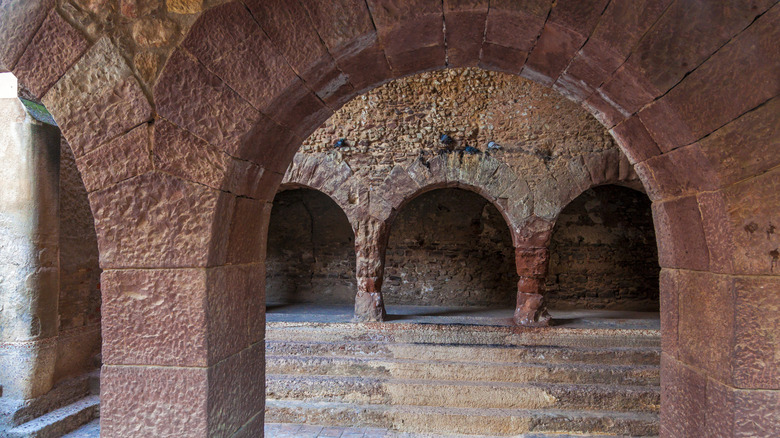
Hidden away in the upper valley of the Caldes River in the Valles Oriental in Catalonia, Caldes de Montbui is one of Spain's most charming spa towns, and the oldest in the region. With its mild climate, impressive landscape, and rich history and culture, it's a wonderful destination for a spa vacation year-round, but especially during winter. The weather in Catalonia tends to remain relatively warm even during the coldest months, meaning you can explore the town in comfort, but you're also just a stone's throw away from the Pyrenees Mountains, which offer exceptional skiing, hiking, and other winter sports.
The hot springs in Caldes de Montbui are fantastic. The waters emerge from the earth at 74ºF, making them some of the warmest in Europe, and the Roman baths have been preserved exceptionally well, making them one of the most charming places to discover the history of thermalism.
Soaking away aches and pains surrounded by pristine ancient architecture is a truly special experience. The historic main pools and spa complex, centered around the Font del Lleó and old hospital (now the Thermalia museum), have been preserved as a tourist attraction, but there are plenty of spa hotels dotted around town where you can enjoy the waters yourselves, like Espai Cel.
Methodology
To compile this list, we consulted the European Route of Historic Thermal Towns, a component of the Council of Europe's Cultural Routes Programme, established in 1987. Its mission is to enhance, protect, and promote thermalism, all while encouraging cross-border cultural tourism in Europe. We then analyzed each destination on how appropriate it was for travel and tourism during winter, reviewing travel blogs and review sites. We prioritized destinations with complementary seasonal activities and attractions.