

What Happens When Trains Experience Mechanical Issues? Here's What Travelers Should Know

Taking the train is a fantastic way to travel and a great way to minimize your carbon footprint. They're a more eco-friendly method of transportation than airplanes and automobiles. Plus, they can often get you to where you're going much faster and for less money. The European continent has an incredible high-speed train network connecting major cities and small towns. Asia is home to some of the fastest high-speed rails in the world. Even the U.S. has some surprisingly luxe train trips worth taking.
When taking the train, it's possible to visit multiple countries without setting foot in a stressful airport or splurging on a car rental, and tourists can often enjoy epic scenery throughout the journey. That being said, there are downsides to train travel. Just like cars and planes, trains experience mechanical issues. When they do, it can cause serious travel delays. If you're planning on taking the train during your next vacation, it's important to be prepared for potential mechanical issues.
Like airplanes, trains have scheduled routes. When mechanical issues occur it can create a snowball effect, meaning your departure time might change at a moment's notice. If the issue is serious, you might have to reschedule your trip for another day, book a different route, or take an alternative mode of transportation. If you're already on the train when it breaks down, you may be stranded for several hours. In remote locations, it's possible that you could end up stranded overnight.
If your train has mechanical issues, travel delays are likely
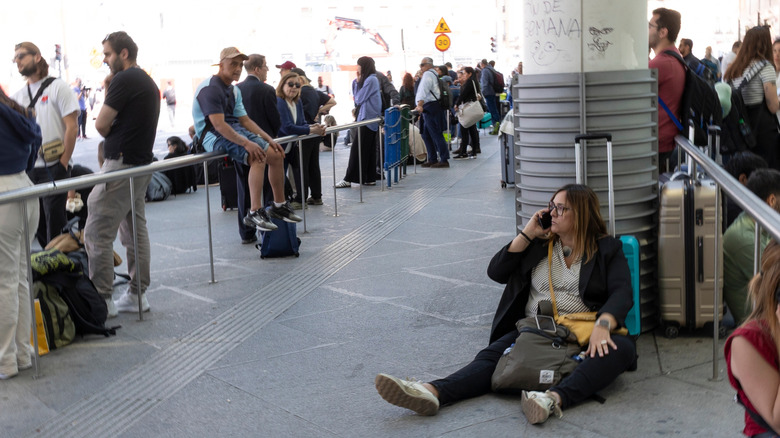
Like most frequent train travelers, I have endured my fair share of mechanical issues and delays. I've had to spend an extra hour standing around at a train station more times than I can count. Serious delays are rare, but they do happen. On a recent trip to Germany, my train broke down mid-route. We were about 20 minutes away from our destination when the train came to an unscheduled stop at a small rural train station. The conductor's voice echoed over the loud speaker, and everyone began grumbling and grabbing their belongings. Everyone waited on the train platform for about an hour until a series of buses picked us up to transport us to our final destination. Our three-hour journey ended up taking about five hours.
Similarly, in December 2025, around 300 passengers were stranded on Canadian trains overnight due to mechanical problems. Passengers were traveling from Montreal to Toronto when their train came to a halt near Brockville, Ontario. They were stuck onboard for around eight hours before the train was able to proceed. The delay impacted two other trains along the same route, and some passengers were stuck onboard for nearly 13 hours. Eventually, after hours of discomfort, all passengers arrived at their destinations. The company, Via Rail, said that passengers would receive a full refund and travel credits.
On December 8, 2025 multiple Amtrak trains departing from Chicago had mechanical problems that caused cancellations and delays. The California Zephyr and the Southwest Chief were both cancelled en route. The Floridian also faced major delays, and passengers were given the option to take a bus instead. All passengers were offered full refunds.
Tips for dealing with train travel delays caused by mechanical problems

If you're planning on traveling by train, it's important to download the official train travel apps for whichever countries you plan on visiting. Usually the apps will send you updates when trains are delayed or canceled. If you have access to the proper app, you may be able to quickly switch trains, spend extra time relaxing at your hotel before heading to the station, or shift your travel plans entirely.
During my recent mechanical delay in Germany, my first order of business was to find out what was happening. I didn't speak German, so I couldn't understand the conductor's cancellation announcement. If you find yourself in a situation like this, just ask around. Eventually, you'll find a fellow passenger who speaks enough English to explain the situation. If not, look for a staff member. They usually have official looking uniforms and often stand on the platform near the trains' doors.
Try to keep calm and stay positive. It's a frustrating situation when your train is delayed or cancelled, but stressing won't help matters. Trust that company officials will do everything possible to fix the mechanical issue in a timely manner so that you can reach your destination. Remain flexible, and ask if there are alternative modes of transportation if you're on a tight schedule. You may be able to disembark and call a cab or take a bus. When you're forced to wait out delays onboard a train, try to relax by reading a book or taking a nap. Make sure to call the train company to see if you can receive a ticket refund. In some cases, you may also be entitled to compensation for food and accommodations.