

This Popular Jet Has Been Linked To Toxic Fume Events — Here's What Travelers Should Know
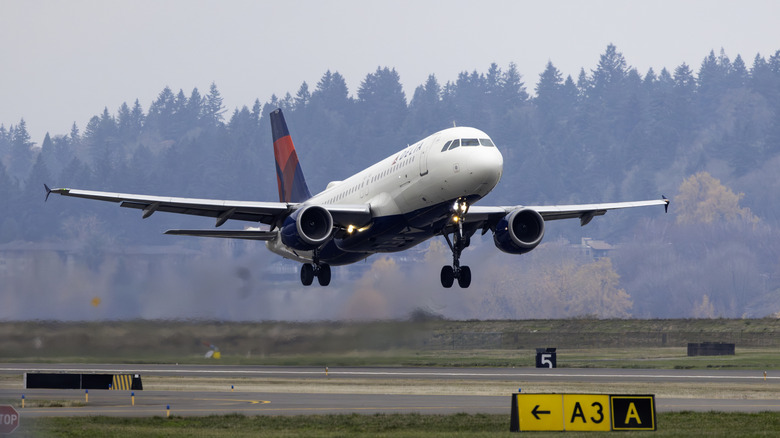
If you've flown anywhere in the past decade, odds are you've been on an Airbus A320. These jets are everywhere, as they're among the most widely used passenger jets in the world, operating across various airlines — American, United, Delta, JetBlue, Spirit, you name it. They fly thousands of trips every single day. So, when stories started popping up about "toxic fume events" linked to A320s, it caught attention. The headlines took off after a Wall Street Journal (WSJ) investigation dug into the fume issue concerning passengers and crews.
What's a "fume event"? Basically, it's when the air in the cabin becomes tainted. This contamination might sometimes involve engine oil or hydraulic fluid vapors leaking into the cabin air. In relation to this, people can experience all kinds of weird smells during flight, ranging from "dirty socks" smell on the plane, to burnt oil, to wet dog, to nail polish remover, none of which of course seems pleasant. A report by AOL, using FAA and WSJ data, shows that Airbus A320-family jets often have more of these fume incidents than other planes. That mostly boils down to how the jets get their fresh air.
Here's how it works: the Airbus A320 plane gets air from what's known as a bleed-air system. With this bleed-air system, compressed air comes in from the engines or the auxiliary power unit, and the air is then circulated into the cabin. Usually, that's totally fine, without any issues. But when seals or parts start to wear out, fumes can begin to slip into the air supply.
Some things you should understand as a traveler
While caution is understandable, regulators have insisted (per the LA times) that toxic fume events aren't that common overall. It's not arguably among the air travel issues you need to worry too much about resolving. Constant exposure is where the harm truly lies, and that can be a problem for frequent globetrotters and cabin crew members. Nonetheless, out of the millions of flights yearly, the number of reported fume events is increasing, running into the thousands since 2010. And this has raised concerns among pilots and flight attendants who face repeated exposure. In fact, some crew members have presented with brain injuries and neurological ailments, as neurologist Dr. Robert Kaniecki told WSJ.
Research has revealed that most fume events happen during takeoff, climbing, or descending, moments when the aircraft is working the hardest. And as FlyAware puts it: "This is because, during these moments, the air flow through the engine is not stable." Since reporting isn't mandatory, experts think the real number of cases is probably higher than what official records suggest — 330 cases yearly, based on a 2015 review cited by the FAA.
Thankfully, some airlines are trying to rectify the problem. Delta, for example, has started swapping out auxiliary power units on hundreds of their A320s to cut down on oil fumes getting into the cabin. What's most important here for you as a traveler is to stay aware and pay attention. If you ever notice an odd or strong smell onboard, let the cabin crew know right away. Pilots may just divert the flight if needed. Despite the scary headlines, there's no doubt that flying is still one of the safest ways to travel, and you might even want to check out this low-fare, fuel-efficient airline considered "America's greenest".