

The Sketchy Reason Why Travelers Should Never Throw Away Luggage Tags At The Airport
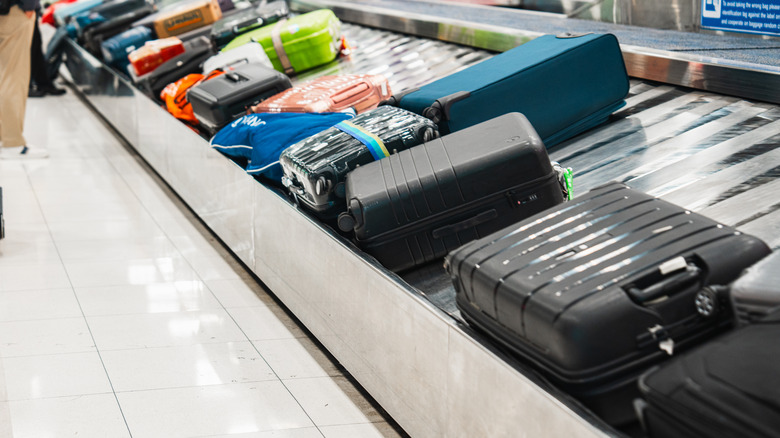
Some people get overly excited when they're traveling because they just can't stop thinking about what awaits them at their destinations. Some may even make the worst airport etiquette mistakes without realizing it. That's what excitement can do to you. This visible overexcitement can also make people fall prey to airport scammers. Many people fall victim to scammers as a result of their negligence to certain details they often think of as minor and unimportant, but these little "unimportant mistakes" are enough to get you into unimaginable trouble in the long run. For a start, how well do you keep track of your luggage tags? Do you rip them off the moment you arrive at your destination, or do you hang onto them until your next trip? Either way, you're still doing it wrong.
The one thing you should do before checking your luggage is tearing off the old tags. Hanging onto your old luggage tags until your next trip is not a good idea. It can get any airline staff confused if the old and the new tags get mixed up. In case your luggage gets lost, it also makes it difficult to send your luggage through to the right place. However, while it's very important to remove the old tags in place of the new ones, an even worse scenario is tearing off your luggage tags right at the airport. This could cost you much more than lost luggage; those luggage tags you nonchalantly throw away can allow scammers an easy entrance into your personal life. A treasure trove of data about you is in those tags — enough to help scammers steal your identity or perpetrate any other identity-related crimes.
Why you should never remove your luggage tags at the airport

Airport scammers, like other scammers, have mastered their art. One professional move they make is finding a strategic place to stay at baggage claim areas. They know these areas are among the busiest in the airport, so they patiently wait, looking for anyone who removes their luggage tags the moment they claim their baggage. As each traveler drops their tags, the criminals pick them up. The circle continues until they're done for the day. These scammers then collect full names, flight details, and even membership numbers – this is why you should know what you should or shouldn't put on your luggage tag.
The criminals use this information to make fake claim calls to airlines, reporting the baggage as lost or damaged to collect compensation. As scammers, they do everything in their power to sound as convincing as possible. They already have your details, so providing matching information isn't that big of a problem. If they succeed in their trickery and subsequently get compensated, or get given a travel voucher depending on the available solution, the scammers have robbed you of any potential compensation in case you yourself genuinely have a claim to make. It becomes even more problematic if you have to prove you're the owner of your own luggage. This recent scamming method has made even legitimate reimbursement claims appear fraudulent.
How to protect yourself from luggage tag theft

Luggage tags are not some itchy rash or irritating worm you need to get rid of as soon as possible; it doesn't do you any harm if you wait a little before you dispose of them. Hanging on to your luggage tags until you get home brings you one step closer to protecting yourself from identity theft. If you can carry your luggage without any hassle, there shouldn't be any reason not to carry the tags; this takes nothing away from you, and the advantage of doing so outmatches the additional weight the tags carry. Remember: An insignificant step sometimes makes a significant difference.
The airport is not the only unsafe place where your luggage tags shouldn't be dropped; your hotel is another. If you must leave the tags behind at the airport or in a hotel, don't leave the information behind — destroy it before you discard the tags by tearing them into as many pieces as possible so it's difficult to read. Pay special attention to the part with the barcode. Even better, run the tags through a shredder if you have one. This makes it essentially impossible for any scammer to put the pieces of your travel information together. This way, you're protected. An ordinary tag you see as "just a paper" may seem unimportant, but it can unlock so much about you and put your safety at risk.