

Rick Steves Recommends Visiting This Eerie Destination In Italy Full Of Ancient Bones
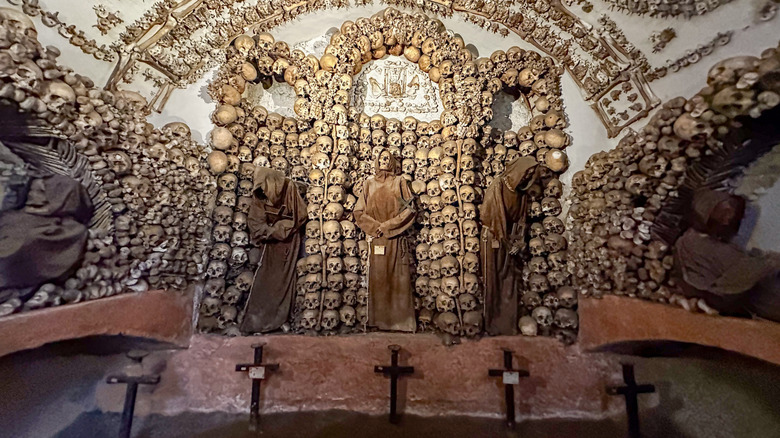
In a region with as long and rich a history as Europe, it's hardly surprising that the dead are extremely present. Almost every country in Europe has its own rituals, traditions, and unique customs concerning what to do with the remains of those who've passed, which can sometimes result in unusual, macabre, and downright creepy places for travelers to visit.
European travel expert Rick Steves might be 'the Mr. Rogers of travel', but he's no stranger to the spookier side of tourism, and loves discovering weird and wonderful attractions dedicated to remembering the dead. He is, in his own words, "intrigued by human bones," and is always on the hunt for eerie attractions to visit. He advises fans of dark tourism destinations around the world to look out for churches and monasteries run by Capuchin monks, as "their mission [is] to remind us that in a relatively short period of time, we'll be dead, too." They do this by "hanging their dead brothers up to dry and then opening their skeleton-filled crypts to the public." One of his favorite Capuchin sites is the crypt of Santa Maria della Concezione in Rome, an extraordinary ossuary or bone-church containing the bones of over 4,000 Capuchin friars!
Santa Maria della Concezione is located to the north of Rome's historic city center, just south of the Villa Borghesi, close to the Baroque Triton Fountain. It's right outside the Barberini metro station on the A line, and about a 20-minute walk from Roma Termini, the city's main train station.
A grisly reminder of the inevitability of death
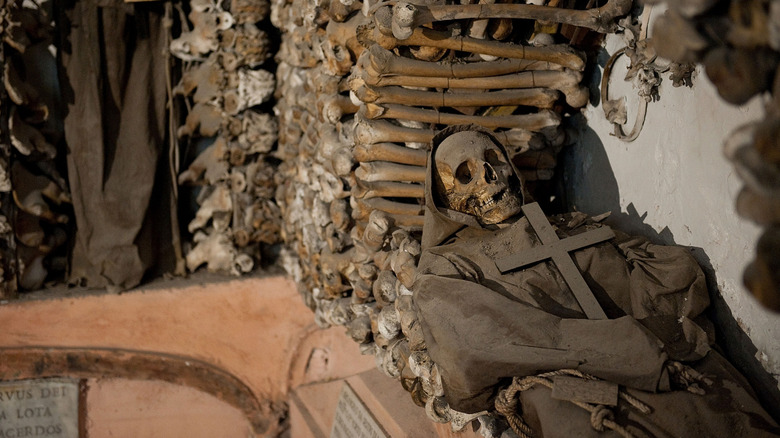
The Capuchin crypt in Rome has captivated the imagination of visitors for centuries. The Marquis de Sade was a fan in the late-1700s, and Mark Twain wrote about his visit in 1869. The ossuary was founded in 1631, when the Capuchin friars moved into the monastery of Santa Maria della Concezione from their previous home near the Trevi Fountain. Just as they do in the Catacombs of Paris and the Catacombe dei Cappuccini in Palermo, the monks interred the skeletons of their dead brothers in the crypt below the church, using them as macabre interior decor, and allowed visitors to view them.
Steves explains that "the bones of 4,000 monks who died between 1528 and 1870 are lined up for the delight — or disgust — of always wide-eyed visitors." The Capuchin ossuary is definitely not for the fainthearted, but it's a fascinating look into an alternative approach to how we view death. The monks separated the bones of their dead brothers, creating a crypt specifically for skulls, a crypt of legs, and even a crypt just containing pelvises!
As Steves points out, the Capuchins' bizarre approach to preserving monastic skeletons isn't just a whim. It's a fundamental part of the medieval concept of memento mori, reminding people of the time that everyone dies and that no one is above death or God. A plaque reminds visitors of the Capuchins' motto, that "we were what you are ... you will become what we are now," and as Steves points out, travelers who visit will "learn that many of these bones — even long after death — still have something to say."
Other bone churches around the world
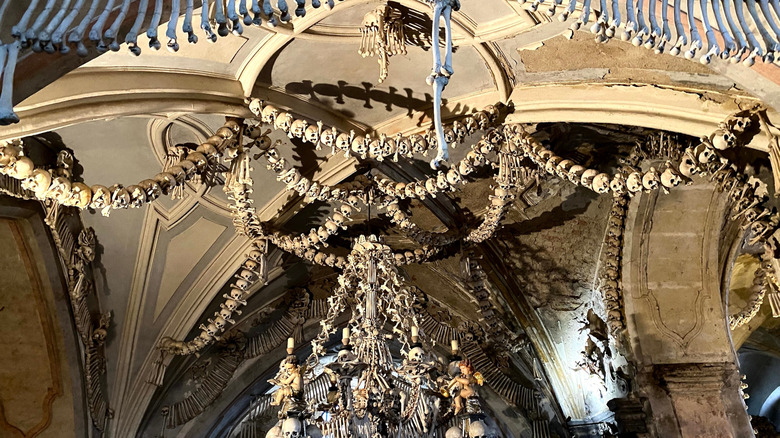
Steves says that "in Europe, seekers of the macabre can get their fill of human skeletons," and he's not wrong. The Capuchin crypt in Rome is far from the only place where unusual tributes to the dead can be found, and there are hauntingly beautiful and macabre ossuaries around the world.
The Capuchins themselves have similar bone churches in Paris and Palermo, both of which are remarkable places to explore. The Sedlec Ossuary beneath the Cemetery Church of All Saints in Kutná Hora in the Czech Republic is fascinating as well, and was allegedly inspired by the Capuchin crypt in Rome.
The Capela dos Ossos (Chapel of Bones) in Évora, Portugal, is a little different, as rather than being buried in a subterranean crypt, the bones here line the walls of the entire chapel. San Bernardino alle Ossa in Milan also has a side chapel decorated with skulls, while the Skull Chapel in Kudowa-Zdrój is unusual because its bones come from victims of war, famine, and disease, rather than deceased monks. But perhaps the weirdest of all is the Hallstatt Charnel House, which houses over 600 carefully hand-painted skulls, the largest collection of painted skulls anywhere in Europe.